Raise the Standard with Lean Problem Solving – Part 2

In the previous article you have seen why use lean problem solving, what are the types of problem solving and some examples. In this article let’s understand the process of Lean Problem Solving.

Once you have identified the type of problem faced in the value stream or value chain, they next step is to understand how to structurally work on detailing, analyzing, find the root cause, implementing resolution and monitoring it to ensure the value stream or value chain  works as per expected.

By removing the obstacles the organization continues it trajectory of becoming better at delivering customer value and eliminating waste across the entire value chain.

For effectively solving the problem, lean management prescribes an eight step structured process to be followed. The steps can be , there are The steps in the Lean problem-solving process are as follows:
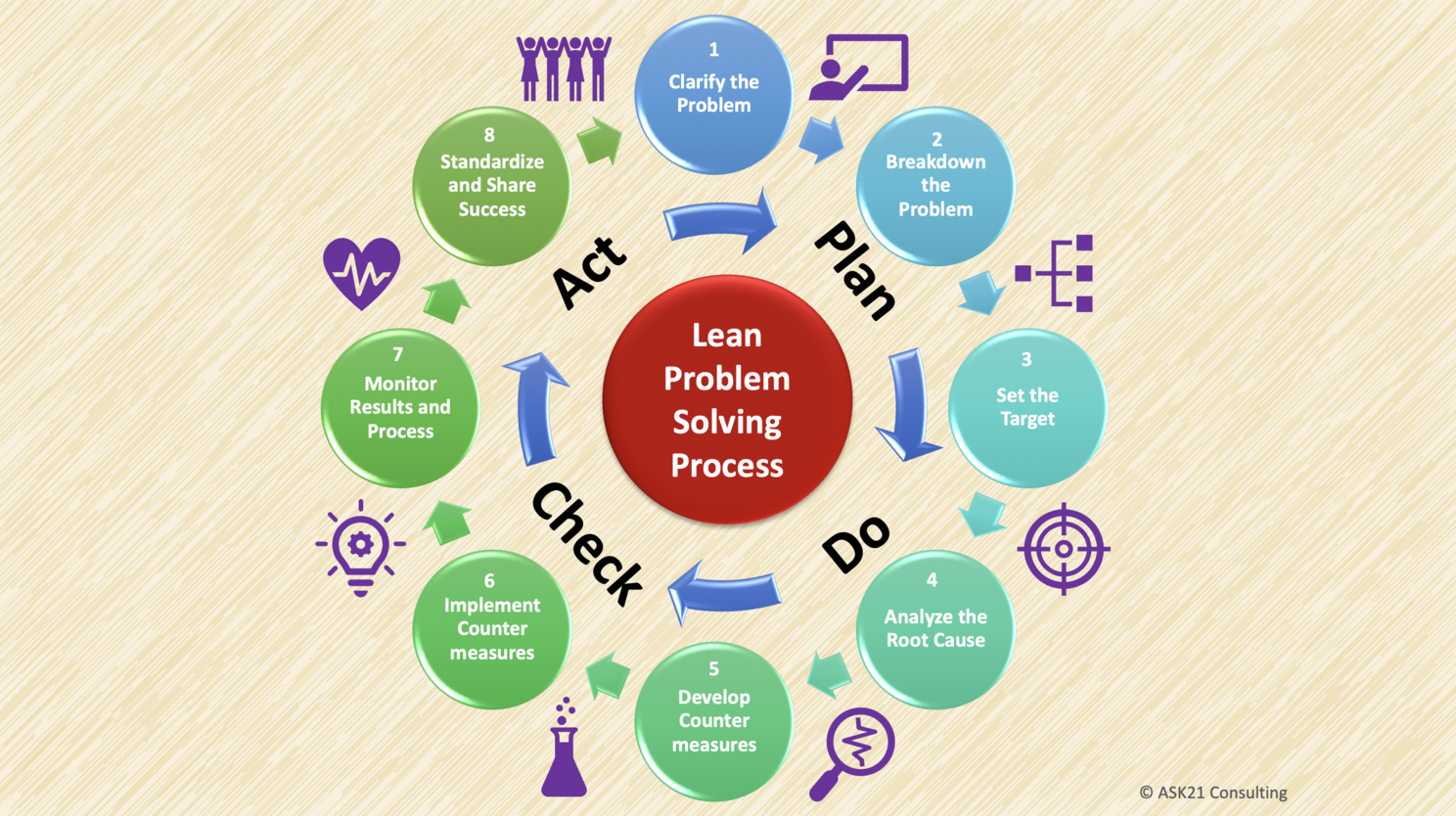
Problem Solving Process

1. Clarify the Problem – In this step the team needs to go to gemba and identify the type of problem as well as do necessary clarifications to ensure the problem is clearly articulated and understood by all in the same way. Always keep in mind that different people will see the same problem differently and this is why this step is critical in ensuring everyone see the problem correctly.

2. Breakdown the Problem – The easiest way to solve the problem is to break it down in smaller pieces and then analyze each piece with respective team members to understand the cause and effects clearly. During the earlier step different set of areas might have been reported related to same problem. Breaking down the problem in to smaller areas or smaller pieces makes it easier to go through each with the right focus and tools.

3. Set the Target – Based on the type problem, it is important to set a realistic target to get it resolved with speed and accuracy. The target must be established keeping in mind the impact of the problem on the entire value chain and how fast it needs to be addressed to remove the blockage. It is also equally important to understand capacity and capability of the team in resolving the problem. People with right expertise and experience must be involved to set the target and resolve the problem.

4. Analyze the Root Cause – This is an important step in problem solving where the root cause analyses needs to be performed. The root cause analyses can be performed using fishbone diagram and 5 Whys method. There can be other tools and techniques also applied like the Problem Tree method to clearly articulate the core problem, it’s possible root causes and impact or effect of those. This needs to be done with the team to ensure all inputs are correctly captured and documented.

5. Develop Countermeasures – After the root cause analysis is completed, the team can focus on identifying and developing counter measure to remove the obstacles and resolve the problem. The focus should be on having counter measures for each root cause or even better one countermeasure that can address and resolve multiple root causes. It is important that the effect of counter measure must be thought through as well to ensure they do not create more impacts and/or gaps in the value chain outputs.

6. Implement Countermeasures – One of the important steps in the problem solving process is to test and implement the counter measures. Before implementing it, the counter measures must be tested and validated with a possible dry run to ensure they will work as per planned and not create any new impact to the value chain. Upon successfully testing and validation the counter measures can be implemented as per planned schedule.

7. Monitor Results and Process – Post implementation close monitoring and reporting must be enabled for capturing the results from the value chain and especially the impacted area. The entire value chain process must be kept under monitoring to confirm that the before and after implementation of countermeasures have standardized the output results.

8. Standardize and Share Success – After a pre-defined period of monitoring and reporting, the problem can be marked as fully resolved and completed. At this stage the standardised process can be replicated across in case there are more similar instances of the process running (E.g., an application with multiple instances). The success can be also shared widely in the organization to ensure everyone is kept informed about the problem and how it was resolved.

Along the entire problem solving process there is an underlying Deming’s Cycle (PDCA) in work. Deming’s cycle (Plan-Do-Check-Act) helps in ensuring continuous improvement is on everyone’s mind. Here’s a quick overview of Deming Cycle stages,

PDCA Cycle

1. Plan: Plan focuses on identifying, articulating and planning improvement. If we look at it from the problem solving process steps, Clarify the Problem, Breakdown the problem and Set the Target are part of Plan stage.

2. Do: Do is also about executing the change or improvement. We can also relate it to Design, Build and Test and Implement parts. If we look at it from the problem solving process steps, Analyze the root cause, Develop Countermeasures and Implement Countermeasure are part of Do Stage.

3. Check: Check comes after implementing the improvement to monitor and report results. Check is all about monitoring and reporting to confirm that the improvement, change or problem solving is working fine across the value chain. If we look at it from the problem solving process steps, Monitor results and Process step is part of Check stage.

4. Act: Act is focused on making the change or improvement stick and making it a best practice by adhering it across the organization. If we look at it from the problem solving process steps, Standardize and Share Success step is part of Act stage.

The PDCA cycle continues as the improvements are never over. For the problem solving part also the problem is resolved but further improvements and standardization as well as raising the standard to the next level continues.

Lean Problem Solving is important for all organizations. It helps to remove the obstacles in the value chain / value stream and brings the organization to the new standard, reducing costs, improving efficiency, effectiveness, and value for the customer.

Raise the Standard with Lean Problem Solving – Part 1

Lean management focuses on eliminating waste, improving efficiency and effectiveness. It helps raise the standard for the organization year on year. There are four important areas for effective Lean management, these are kaizen, daily management, value stream mapping and problem solving.

Lean Problem solving focuses on removing obstacles faced in the value chain to deliver superior value to the customer. Problems in Lean are referred as obstacles that impact the process by brining stop to it or slowing it down significantly.

Lean Problem solving is a not stop journey across the organization’s value chain to identify facts based obstacles and team up to identify root causes and resolve it. Problem solving can be also related to going to raising the level of standard at which the organization operates. Going to next level of standards would also need removal of obstacles in the value chain to make the shift.

Problem solving in general must be handled structurally with facts and prioritization to ensure priority obstacles are addressed first and addressed first time right. Jumping to gun and rushing to resolve problems could create several other problems that the team might not have thought as they would have not studied all possible root causes and effects of change.

Types of Lean Problems

To ensure right approach is applied to problems, the problem must be first identified and categorized correctly. The problem categorization will help select the correct approach for analyzing and identifying the root causes, impacts and solution for the problem. The categorization also helps identify the correct tools and processes to be used for effective and efficient problem solving.

There are generally four types of Lean prescribed problem categories. The first two categories (Troubleshooting and Gap from standard) are related to obstacles that happened in the value chain and identified as a problem to be solved. The other two (New Target condition and Innovation / Open Ended) are obstacles foreseen or happened while raising the standard or level of the value chain. Let’s understand these four types in little more details,

No alt text provided for this image

1. Troubleshooting Problems – Troubleshooting problems are common types of problems that every organization has. This type of problem solving is generally called reactive problem-solving as the problem is solved only after it has happened and created an impact for the value chain. In this type of problem solving the fix is quickly identified and fixed. But it might be that the problem will repeat again unless root causes are fully identified and process changes made to ensure it doesn’t repeat.

Here is an example to understand this type of problems,

The organization has a manufacturing line for Electronic Water Heating Kettles. The manufacturing line produces 100 Kettles per hour by putting together several parts of the Kettle and assembling 10 Kettles every 6 minutes. During the morning shift an Andon alarm sounds off and the production line has to be stopped. Everyone gathers around to review what happened. The team founds that the Kettles plastic base is not being placed properly by the machine as the pressure pad seems to have spoiled. The team quickly replaces the pressure pad and the production line is restarted with a downtime of 1 to 2 hours. The team has replaced the pressure pad but didn’t fix it from reoccurring as they did not check the frequency when the pressure pad must be replaced to avoid any significant downtimes again. In such cases a proper root cause analyses and long term monitoring can help to understand when the pressure pads should worn out and replaced. The threshold can be set to replace the pressure pads at the appropriate interval and the problem will be stopped from reoccurring.

2. Gap from Standard Problems – The second type of problems are called Gap from Standard problems. These problems are Gaps found in the standards procedure and outputs / performance of the process. These problems have to be solved structurally to ensure the value chain outputs and outcome match then stipulated standards. These problems have huge impact to the overall value chain and value creation so they need to be resolved in such a way that they do not repeat. A quick fix won’t work for these problems.

Here is an example to understand this type of problems,

The organization has a manufacturing line for Electric Irons. The manufacturing line produces 100 electric irons per hour by putting together several parts and assembling 10 irons every 6 minutes. The production line has been operational but the throughput of the production line has dropped from 100 per hour to only 50 per hour over past 3 days. In this case the production can continue still but the team must sit together and look at the cause and effects of what could be causing the problem. Tools like 5 Why’s and Fishbone analysis etc, should be used to identify root causes. The Gap in the standard output is clear, the root cause could be many areas and each must be checked and analysed to come to conclusion on root cause. The fixes can be applied accordingly and a cadence on reporting and monitoring must be placed to check if the fix has worked. The entire problem solving approach and process must be structurally done to ensure first time right resolution of the problem without any room for reoccurrence. In this case the root cause was assembly output where out of 100 irons produced only 50 were passing the quality checks. The reason identified was the soldering gun on the assembly line was missing the soldering point resulting in irons not working post assembly. The further analysis reflected the soldering wire used was of poor quality making the solders non effective and loose ended. The real root case was to change the soldering wire vendor and choose better quality soldering material.

3. New  Target Condition: The third type of problem is caused due to New Target Condition in the value chain. The new target condition can arise due to kaizen improvements or events. It can also arise if the standard output and outcome of the value chain is already above its stipulated target mark, so the organization can decide to raise the standard to next level target. But raising the output levels also means understanding the gaps in detail on what obstacles could be faced if not handled well while raising the standard target output. This also requires structured approach to understand current capacity and capability of the resources and what needs to change to meet the new standard accurately. Kaizen tools as well as A3 problem solving tools should be used in full to ensure each area is well studied for cause and effect.

Here is an example of new target condition,

The organization has a manufacturing line for Electric Irons. The manufacturing line produces 100 electric irons per hour by putting together several parts and assembling 10 irons every 6 minutes. The production line has been operational but the throughput of the production line has been consistently up from 100 per hour to only 150 per hour over past 1 week. In this case the organization is thinking about raising the standard to 150 irons per hours looking at past 1 week performance. Before the step is taken the team will need to formally run through Kaizen event including value stream mapping and use of other cause and effect tools to understand full overview and impact of the change in the long run.

4. Innovation / Open ended: The fourth type of problem is innovation related and can be also called open ended problem solving. These type of problem solving emerge from the organization bringing in new innovation in the value chain. The innovation will impact and change the entire value chain. In such situations it’s not easy to realize what problems could arise and how to resolve them. The team will need to work through the process to identify areas in the value chain that could lead to obstacles if the new innovation value chain is introduced. In such cases a risk log with mitigation actions and ownerships must be workout and put in place.

Here is an example of new target condition,

The organization has a manufacturing line for mobile phones. The current manufacturing value chain is a mix of people and machines working together to get the outputs. The current output is 50 mobile phones per hour. The organization has decided to bring an innovation to double the production of mobile phones. For achieving this the value chain has been planned to be made full automated with robotics. A trial run has proven that it should work out. This is an innovation problem which will require the team to work together to identify how this will need to be orchestrated to avoid any problems. The team can structurally work out the plan to step by step ramp up and introduce the new innovation as well as plan for required capacity and capability plans.

In this article only this much. In the next article we will discuss the process of problem solving and how it helps the organizations to raise the standards.

Lean Problem Solving is important for all organizations. It helps to remove the obstacles in the value chain / value stream and brings the organization to the new standard, reducing costs, improving efficiency, effectiveness, and value for the customer.

Daily Management with Lean

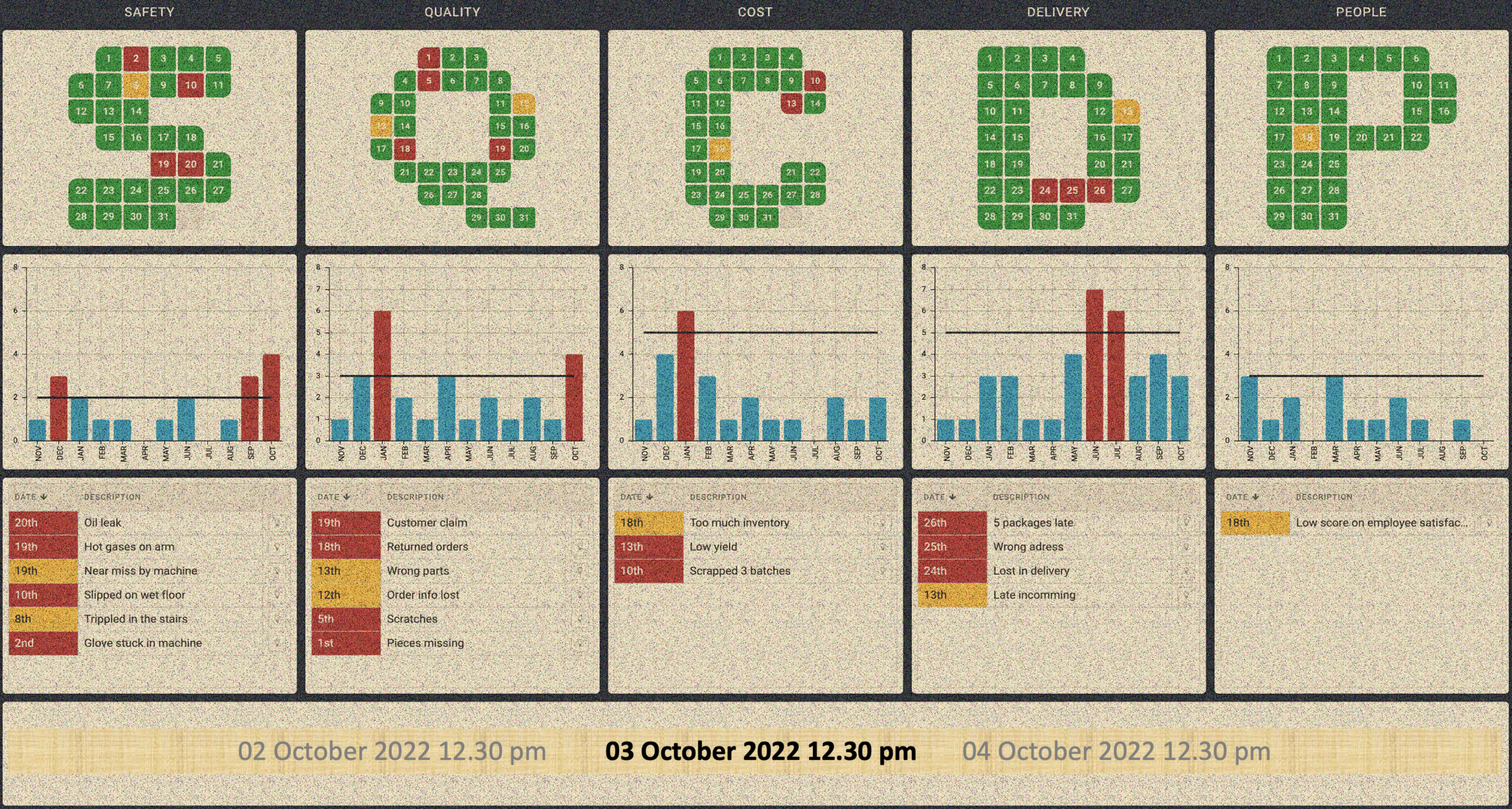
One of the important tools in Lean Management is Daily Management. Daily management is achieved using a visual dashboard. The dashboard can be manually prepared, printed and presented or even electronically published each day to share progress with all involved stakeholders and participants.

Daily Management visual dashboard is used to track and monitor progress of key performance indicators, targets and goals that are important for the organization. It is used on especially those areas where impact is high and the team needs to ensure that they do not slip agreed targets. It is also used to quickly identify and visualize areas of attention and issues that must be resolved to achieve the targets.

Daily Management helps in comparing performance improvements on daily basis at a glance look. It shows the areas with colors to bring attention (E.g., red could mean target is not achieved, green means target achieved and on track, orange or yellow means target will be achieved with in agreed threshold of some %).

Daily management needs standardized processes, templates and possibly automated systems to generate and share daily progress at a specific time each day. It requires efforts and commitment from the organization stakeholders and key team players, to ensure they stick to the cadence and review progress each day.

Over a period of time, it becomes a habit and when it’s done well, it helps in ensuring key targets are achieved and exceeded across the organization. Lean prescribes some standards on how daily management should be done to achieve efficient results.

Daily Management (DM) Process

Daily management consists of four areas that must be done. These four areas help to check and understand how the organization is progressing and which areas need attention to keep on track. Here are the four areas,

Daily Management Process

1. Daily Accountability Process Meeting – The daily accountability process meeting is arranged to visualize progress and identify areas of concerns as well as run through the issues and actions.

In the meeting a check is done to ensure everyone on the team has everything they need to perform and achieve that day’s targets. It also allows people to speak up and ask for help wherever they need attention and help from the team and senior stakeholders.

The DM (Daily Management) visual dashboard used is to track the overall targets and attention areas. The DM board also captures key issues and actions on a daily basis. The DM boards can be automated to save repetitive efforts and a big TV screen can be used to visualize tracking of KPIs and review of issues and actions.

Daily Accountability Process (DAP) meeting helps the participants visualize the entire progress transparently, collaborate and brainstorm together.

The meeting is a stand-up meeting as it is supposed to be a quick review of 15 to 30 minutes followed by next steps of actions.

2. Leader Standard Work – Leader standard work is set of work culture and behaviors that the lean leaders must adhere. Lean leaders are tasked to ensure every member of the team contributes to best of their abilities in achieving the results.

Part of the work is also to ensure Lean standards and ways of working are followed by all team members. Leaders check the progress on daily basis to ensure ways of working are modelled and used by all.

In case of gaps or issues found in ways of working, Lean leaders coach and train the members to lift them up and bring them back on track.

3. Gemba Walks – Gemba walks are attached to going to place where the work is done and action is ongoing. Gemba walks are done to places where its important to check and seek opportunities for improvements to become more efficient and effective in delivering superior value to the customer.

Lean leaders and drivers take the gemba walk to observe how the processes are functioning in real life on the ground Vs how they are being presented. The insights help them think about better ways to do things as well as identify best practices that can be applied to other parts of the organization.

4. Process Confirmation – Best on the observations from the Gemba walk, the team can confirm if the process is working as defined or they see variations of it and need for improvements.

The process confirmation can be also be done as period internal or external audits without notice to check and confirm that standard operating procedures (SOPs) are fully adhered to as well as Segregation of duties are well maintained as per defined roles not allowing conflicting roles managing tasks or stages that they are not supposed to manage.

This results in ensuring the entire organization functions as per defined as well as fully adheres to process changes and standards.

Daily Management (DM) Board

The DM Board can be designed to have KPIs that matter most for the organization as well as department or division (level) at which the DM board is prepared. There is no point having top level or even region level KPIs on the department’s DM board if those are not actioned and in control of the team members. The KPIs used for tracking must be meaningful and in control of all the team members.

The DM board can have or look for KPIs from SQDCP areas(Safety, Quality, Delivery, Cost, and People). The DM board must be placed near to the work area where all team members and stakeholders can easily look at it. This will ensure the board is kept latest and remains on everybody’s mind for regular review and actions. It will improve collaboration and discussions amongst team members to help each other with new ideas on making things easier and efficient for all.

Let’s understand how the DM board can be arranged for effectiveness and efficiency.

1.     In the DM board SQDCP areas always have 31 short cells representing 31 days of the month.

2.     In case of weekly DM board, each cell can be representing the weeks and in such case 52 cells will be required to track weekly hit or miss of respective targets.

3.     The cells can be filled with Red, Green, Orange/Yellow and Grey colors.

a.     Red means the target is missed for that day and generally there will be an issue reflected in the board under issues section.

b.     Green means the target is achieved and everything is on track.

c.     Orange/Yellow can be used to show is target is missed but still within defined threshold and controllable to get it back on track.

d.     Grey can be used for non-working days or for days that are extra in the month (e.g. if Sep is 30 days, 31st cell will be in grey color).

4.     The issues occurred for red cells are discussed in the Daily Stand up meeting and action(s) are assigned to ensure those issues are resolved and does not repeat.

5.     It is not mandatory to place all the SQDCP areas on the board. The team can select only those they need to track depending on mutual agreement and alignment with stakeholders.

6.     The SQDCP areas can be also arranged flexibly (e.g., PCDQS or SQCDP etc.) based on the organization, department or division’s priority focus areas.

7.     There are other areas that can added as well for tracking, E.g., Inventory (I), Productivity (P), Bugs (B), Environment (E), Tickets (T) etc. This means the letters can KPIs to track for hit or miss are flexible as per team needs.

8.     Here are two examples of the SQDCP DM board. One example is using simple excel or white board based template while the other is a fully automated online dashboard.

a.     Excel or white board Based Tracking Dashboardb.

Excel DM Board

b.     Fully Automated Tracking Dashboard

DM Digital Board

Benefits of Daily Management

Let’s understand the benefits of using Lean, Daily Management and Visual Dashboards,

1.     Visualize the progress of important targets and KPIs on daily or weekly basis, at glance with in few minutes.

2.     Visualize the issues faced by the team in respective key performance areas within few minutes.

3.     Understand actions taken by the team, action owners and by when the issue will be resolved to bring the team back on track.

4.     Improved transparency and empowerment as the DM boards are maintained by the team members and bring full transparency to the team on progress made as well as issues faced.

5.     Team collaboration improves as team members discuss, brainstorm and come up with new ideas to get things done and achieve targets.

6.     Lean and Daily management culture gets embedded in every one’s way of working leading to significant improvements and

7.     Full compliance on regulatory audits as entire team follows and complies with the standardized operating procedures.

8.     Customer experience and value increases as the team continuously improves.

Lean Daily Management and Visual Dashboard helps organizations achieve and exceed their targets swiftly as everyone in the team thrives to do the best by adhering to Lean ways of working.

Kaizen for Continuous Improvement

Kaizen is a Japanese word with meaning “change better” or “continuous improvement”. It is method used for continuously improving business processes and value chains through small meaningful increments which over a period of time result in big improvements across the entire value chain.

Kaizen focuses on eliminating seven types of lean wastes in the value chain. Kaizen was used for almost a century by manufacturing plants of Toyota. In the past 2 decades the usage and adoption has gone up across all business industry and sectors. The Kaizen process and workflow is fully digitized with online tools and workflows (E.g., Microsoft SharePoint Workflow).

Kaizens are also referred as following,

1.     Point Kaizen – The most commonly used kaizens are referred as point kaizen. These small improvements and doesn’t need a lot of efforts to implement while still having measurable impact.

2.     System Kaizen – As the name suggests, it relates to improvements brought to life using IT system. The second most used kaizens are system kaizens which are widely used by most of the organizations.

3.     Plane Kaizen – This is the 3rd most used Kaizen which is related to the improvements made to value stream or value chain.

Kaizen Types

If we come to discussing the types of Kaizens then there are actually five types of Kaizen methodologies, keeping in mind Kaizen means improvement (change for better) so its not necessarily small changes only but they can be large ones too:

1.     Kaizen Teian – In this type of Kaizen the improvements are done bottom up instead of top down. It means improvements start at the lowest level in the organization. For this to work the Lean management mindset (continuous improvement culture) must be already well deployed across the organization. Everyone in the organizations participates and submits their improvements to improve their work, when this is done across the entire organization, it leads to large improvement in removal of lean waste. Kaizen Teian can be called as Point Kaizen as well.

2.     Kaizen Events – Kaizen events are big and planned improvements in the value chain. These improvements are done by calling for a workshop with participants from the value stream planned for improvement. Participants work through VSM (value stream mapping) workshop to identify and prepare the plan to eliminate lean wastes. Kaizen events help improve the value chain significantly by improving efficiency, effectiveness and creating superior value for the customer.

3.     Kaikaku – Kaikaku is a radical change and it focuses on business transformation through radical changes to its value stream and value chain. It is not so much about identifying lean waste and eliminating it, instead this is about changing the entire process of how the organization does the business. It requires significant planning and focused efforts to achieve it successfully. Digital Transformation can be one of the examples of Kaikaku.

For Kaikaku’s success, these 10 commandments can be used,

i.         Throw out the traditional concept of manufacturing methods.

ii.         Think of how the new method will work; not how it won’t work.

iii.         Don’t accept excuses.

iv.         Totally deny the status quo, be ready to start new.

v.         Don’t seek perfection. A 50% implementation rate is fine as long as it is done on the spot.

vi.         Correct mistakes the moment they are found.

vii.         Problems give you a chance to use your brains.

viii.         Ask “why” five times.

ix.         Ideas from ten people are better than one person’s knowledge.

x.         Kaikaku knows no limits.

Post successful implementation of Kaikaku, continuous improvements cycle can start using Kaizen.

4.     Kakushin – Kakushin is break through innovation Kaizen. Kakushin is related to switching over the entirely new way of working in the value chain. It’s related to breakthrough innovation in how the organization functions in its value stream. It is entirely changing (not transforming) the value stream of the organization. E.g., switching production line from manual or semi-manual to a production line entirely managed by robotics and robots. Kakushin requires large risk taking to transform how an organization functions and does its business (E.g., We can say that apple has undergone Kakushin. Same can be said about Tesla cars manufacturing etc.)

5.     Kaizen Blitz – Kaizen Blitz are similar to Kaizen events but in smaller scale. Kaizen blitz are achieved by calling for small workshop of few hours to a day max to identify improvements. These improvements are then immediately taken up and deployed with in 3 to 5 days. Improvements are chosen in way that they can be done quickly with speed and deliver huge improvement.

Kaizen Principles

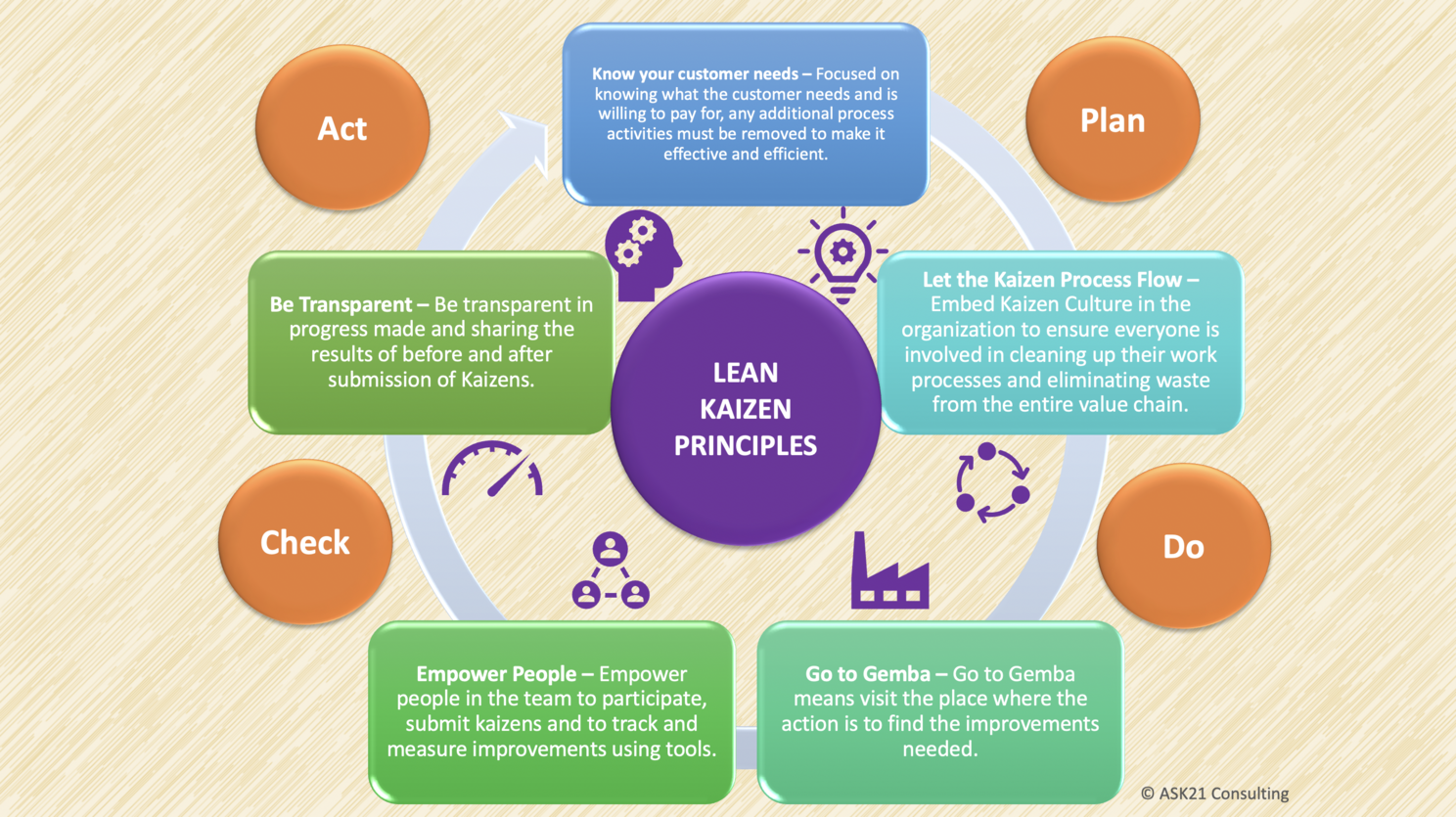
There are 5 Kaizen Principles that make the Kaizens efficient and effective. The 5 principles are:

1.     Know your customer needs – Focused on knowing what the customer needs and is willing to pay for, any additional process activities must be removed to make it effective and efficient.

2.     Let the Kaizen Process Flow – Embed Kaizen Culture in the organization to ensure everyone is involved in cleaning up their work processes and eliminating waste from the entire value chain.

3.     Go to Gemba – Go to Gemba means visit the place where the action is to find the improvements needed.

4.     Empower People – Empower people in the team to participate, submit kaizens and to track and measure improvements using tools.

5.     Be Transparent – Be transparent in progress made and sharing the results of before and after submission of Kaizens.

Kaizen Principles

Kaizen Process Flow

Kaizens can be managed using the following simple process steps,

1.     Identify the process and area of improvement

2.     Analyze the process and its current performance

3.     Identify & document wastes (gaps)

4.     Identify & document improvements

5.     Complete Kaizen plan, review and approvals for execution

6.     Execute and Test Kaizen Changes

7.     Implement tested improvement changes

8.     Measure results and report current vs new performance gains

9.     Mark the Kaizen as completed

10.  Maintain continuous improvement

Kaizen Process Flow and Tools

Kaizen Tools (Methods and Approaches)

For making Kaizens more effective and efficient several effective methodologies and approaches must be applied. Here are the methods and approaches that can be used,

i.         The 5 W + H Model – Use 5 the Why model (Who, What, Where, When, Why and How) for identifying the root cause, gaps and improvements.

ii.         Lean Wastes – Use TIMWOOD (Transportation, Inventory, Motion, Waiting, Over production, Over processing and Defects) waste identification to identify waste types and related improvements.

iii.         The Deming Cycle – Use Deming’s PDCA (Plan Do Check Act) cycle for the  effective execution of Kaizens.

iv.         The 5 S Framework – Use the Lean 5S framework (Seiri, Seiton, Seiso, Seiketsu, Shitsuke).

·       Seiri (Sort) – Sort only what is needed where is needed.

·       Seiton (Simplify) – A place for everything and everything in its place.

·       Seiso (Sweep) – Clean the workspace and keep it clean.

·       Seiketsu (Standardize) – Standardize the first three “S.”

·       Shitsuke (Sustain) – Stick to the first 4S.

v.         Ishikawa Method – Use the Ishikawa method of applying 5M’s (machine, method, material, man/mind power, and measurement/medium)

vi.         Lean Management 6P Method – Use the 6P method (Policy, Process, People, Plant, Program & Product) of Lean Management

vii.         Kanban Visualization Board – Use Kanban board for kaizen implementation actions tracking and monitoring.

Kaizen Template

A standard Kaizen template is useful for effective documentation and reviews. Here is simple sample template overview,

Kaizen Template

Kaizen Benefits

Kaizen culture and improvements have many benefits for the organization. Here is a quick overview of benefits,

i.         Elimination of waste in the value chain

ii.         Improved effectiveness and efficiency

iii.         Productivity gain across the organization

iv.         Sharing and use of best practices

v.         Costs reduction due to elimination of waste

vi.         Improved quality of outcomes and outputs

vii.         Improved customer experience

viii.         Better value creation for the customer

ix.         Improved teamwork and employee engagement

Once the whole organization starts to think about eliminating waste at their levels and finding better ways to do things, their productivity goes up significantly, quality of products/solutions/services increase, value creation for customer gets better, costs reduce and employee engagement goes up.

Kaizen is more of culture & mindset than just a framework or tool of Lean Management. Kaizen works well and result in massive improvements across the organization’s value chain delivering superior value to the customer.

Value Stream Mapping for Lean Management

Value stream mapping (VSM) is a lean management method and tool for analyzing the business process and/or the entire value chain (value stream) of the business. It consists of core business process review and optimization from its current state to future state by eliminating waste in the process.

VSM can be also considered as a process flow map consisting of product, people and tools reflected across the process stages including issues and gaps identification. It is generally drawn with a group of people that operate as part of the flow and play a role in managing respective process stage deliverables (outcomes). The process selected must be focused on delivering certain specific value to the customer.

The core purpose of VSM is to identify and remove waste in the value chain and in return increasing efficiency and effectiveness of the value chain. By removing waste the value chain becomes optimized and faster than before resulting in productivity gain and achieving its desired outcomes with in lesser time and reduced number of resources.

Lean focuses on creating superior value for the customer while still using fewer resources to get it done. In turn ensuring the entire value chain is streamlined for efficient performance and delivery.

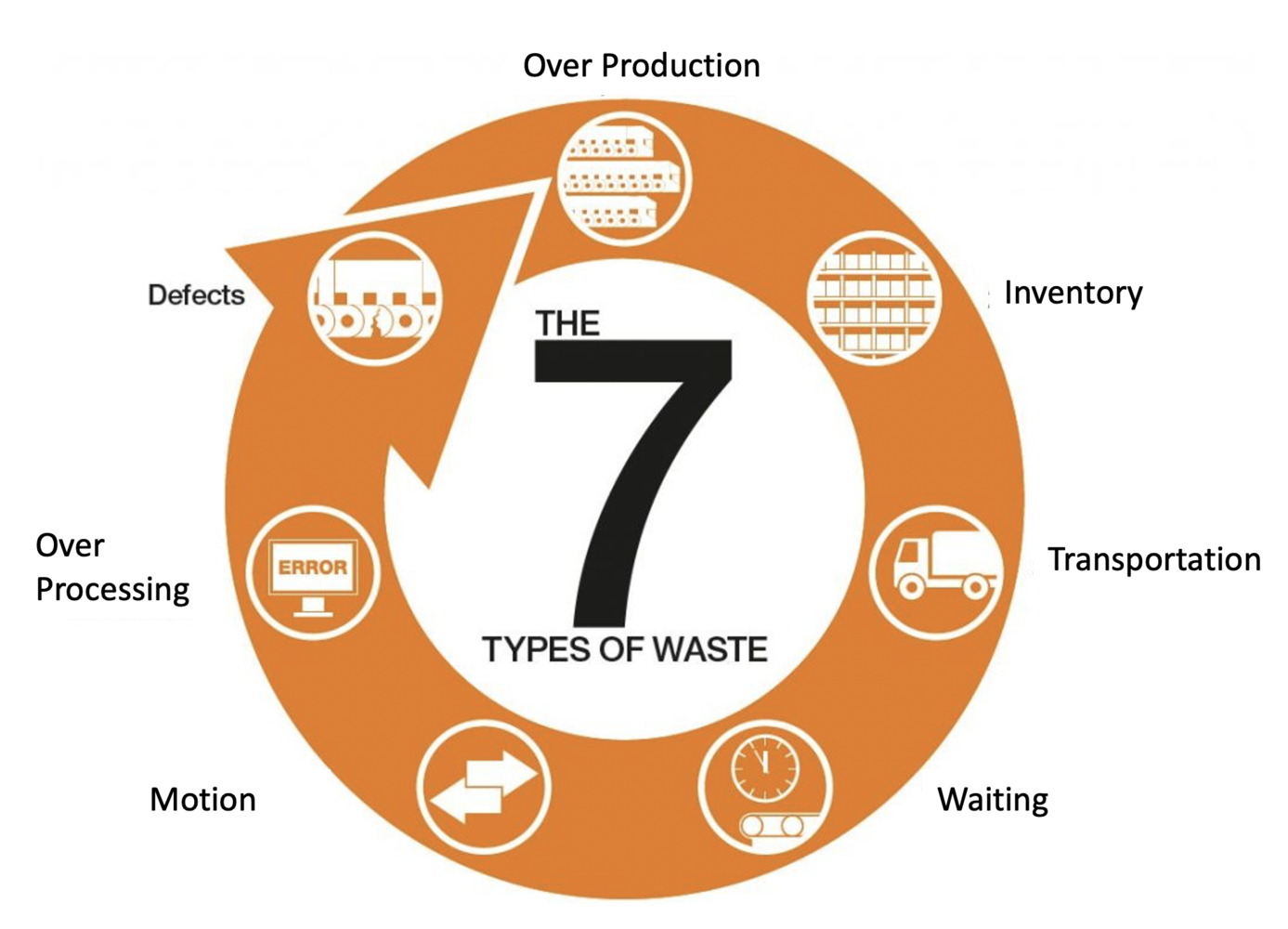
Identifying and eliminating waste is the core part of lean management. There are mainly seven types of waste in Lean management namely,

1.     Transportation – Transportation waste is related to any movement of materials, supplies and resources that does not add any value to delivering customer needs. E.g., Extra trucks, fork lifts, unnecessary movement of materials and supplies etc.

2.     Inventory – Inventory waste is related to any excess supplies that does not add any value to delivering customer needs. E.g., Excess stocks storage, Excess stock at production lines, Excess stocks in warehouse etc.

3.     Motion – Motion waste is attached to any unnecessary movement of resources, people and machines that does not add any value to delivering customer needs. E.g. People movements without need, machine movements without need, back and forth movement to get tools or parts resulting in waste of time etc.

4.     Wating – Waiting waste is attached to long periods of elapsed time waiting between tasks and stages for people, machine, materials that does not add any value to delivering customer needs. E.g., People waiting for machine or parts, People waiting for each other to start work, Poor planning having too much free time in the plan etc.

5.     Over Production – Over Production is attached to too much advance production of goods that are not requested by customer. E.g., Poor demand planning, Too fast production or advance production etc.

6.     Over Processing – Over Processing is attached to additional efforts put on task that does not add any customer to meeting customer needs. E.g. too many approvals for each request, endless analysis of needs etc.

7.     Defect – Defect is attached to rework needed to resolve defect in the product or service to meet customer needs. E.g. Product quality issues, non-standard work processes, no clarity and checks on customer needs etc.

TIMWOOD

While there are mostly only seven types of waste in the process, in real life situations there could waste in the process related to systems as well, E.g. Unsecured system, Wrong authorizations etc.

As VSM started as part of Lean its primary use has started in manufacturing and industrial processes. From past decade VSM has been used across all business sectors and divisions, E.g., Healthcare, Consumer goods, IT, Supply chain management, Finance, Customer Service, Logistics etc.

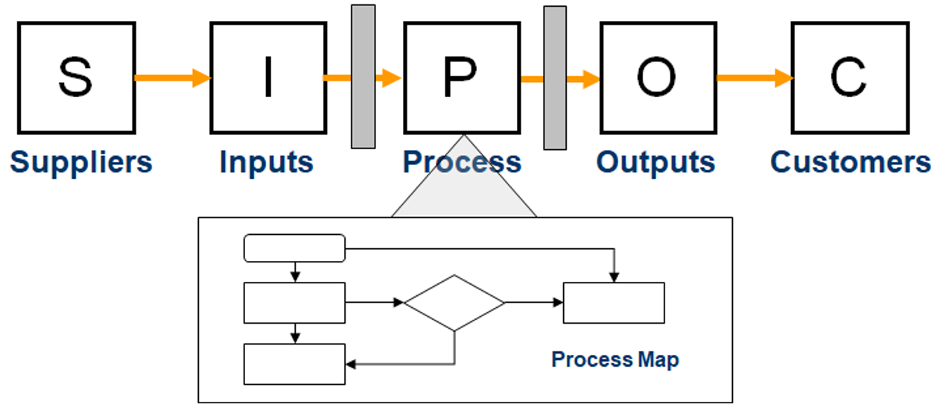
Value stream mapping starts with the use of SIPOC method considering Suppliers, Inputs, Process, Outputs and Customers are fully covered in the process map and reviewed. SIPOC is a high level view of a process consisting of Suppliers, Inputs, Process, Outputs and Customers.

SIPOC

Here is a brief overview of VSM process mapping model template overview as per Lean standard, with brief explanations on how to create it,

Lean VSM Model

Here is a brief overview of VSM process mapping model example overview as per Lean standard,

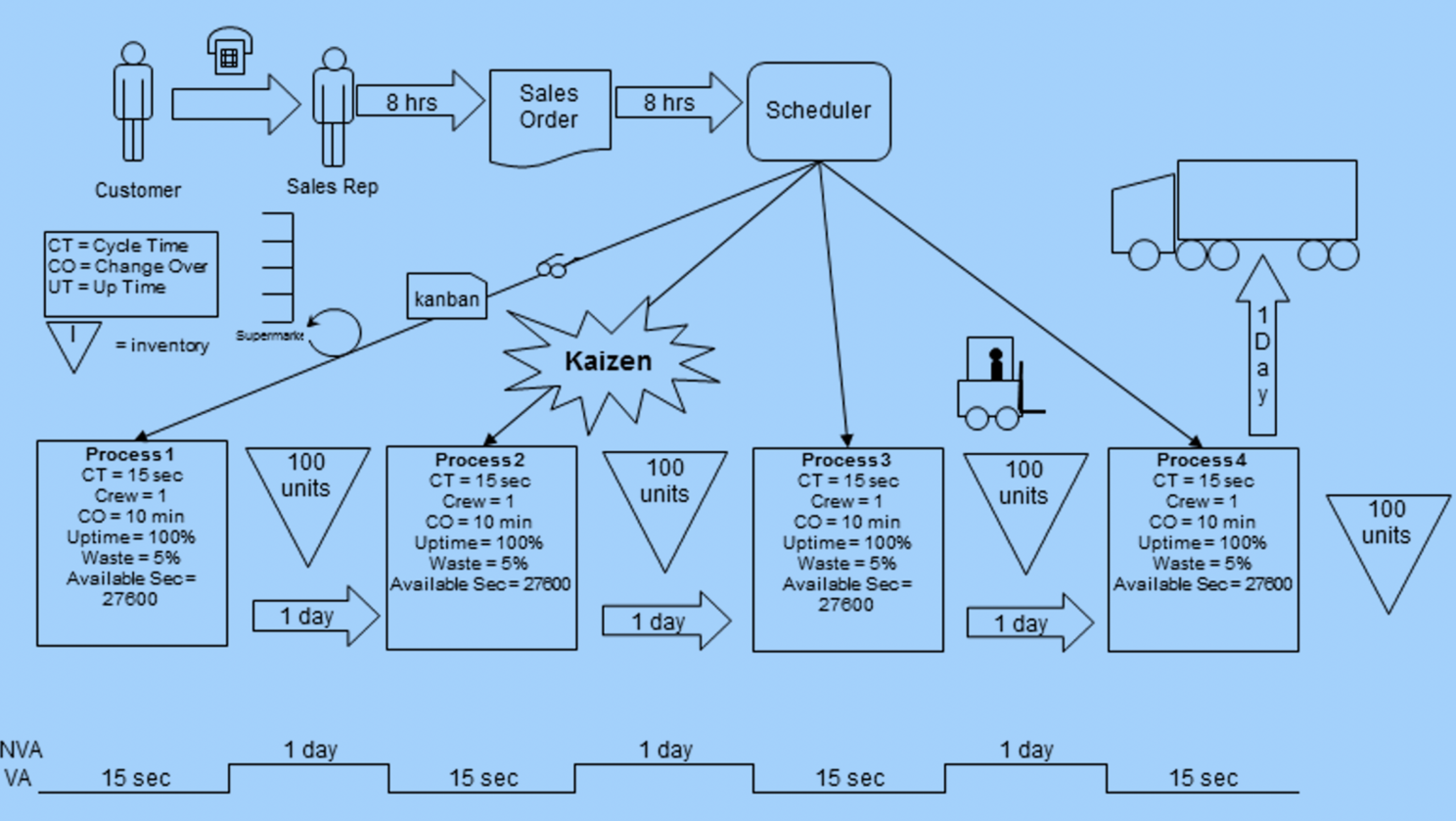
VSM Process Map Example

How is VSM arranged

VSM consists of all the key stakeholders of the value stream at each stage. It is generally arranged as a half day to 3 days workshop depending on the size and complexity of the value stream mapping.

The process is initiated with the current process map which starts with ensuring the need for VSM is clear for every one involved.

For making the VSM need clear to all, before the workshop a core team arranging the VSM creates a VSM charter consisting of a one-page overview (similar to project charter) specifying the problem, purpose, who will lead the session, who needs to be involved, who is sponsoring etc.

Here is formal process steps for achieving VSM,

VSM Process

1.     Define the need – This step focuses on defining the need for value stream mapping session. It includes identifying stakeholders, define VSM charter, planning the event schedule and participants, complete all the preparations (like high level process views, logistics, prints, post its, markers, stickers) etc.

2.     Map The Current State – This stage starts in the VSM workshop where the team begins with,

a.     High level SIPOC process overview specifying process stakeholders, inputs, output and major steps. This helps everyone understand the current state at high level easily.

b.     Next the team starts working on detailing out entire value chain with more granular details like who is involved, what is the throughput time, what gaps or issues are faced, what is done well and what needs improvement.

c.     The focus is always on process and delivering value to customer, there is no pin pointing on any individual or team names.

d.     Lean wastes in the process are identified and documented along with possible action.

e.     The process is managed using post its and stickers for voting as well as capturing inputs.

f.      At the end of the day or during breaks the core team of process or VSM leads collate all the inputs either as pictures or even electronically drawing it and capturing possible actions.

3.     Create The Future State – This stage starts in the VSM workshop part 2 and sometimes day 2, where the team begins with,

a.     Creating the future state map together as a team. The major steps might be same or changed or reduced based on current state see.

b.     The team collectively goes through the lean wastes identified and how those can be removed to make the process (value chain) effective and efficient.

c.     The future state can also be largely automating all possible non value added manual steps in the value chain and hence achieving improved speed with reduced resources needed to manage.

d.     The process is managed using post its and stickers for voting as well as capturing inputs.

e.     At the end of the day or during breaks the core team of process or VSM leads collate all the inputs either as pictures or even electronically drawing it and capturing possible actions.

4.     Prepare the Implementation Plan – This stage starts in the VSM workshop part 3 and sometimes day 3, where the team begins with,

a.     Reviewing the action plan and ensuring each action has an owner and date attached to it.

b.     The team also prioritizes the actions in order of which action will create how much value for the customer.
c.     The team also prepares the high-level future state readiness schedule with owners and dates for completion.

d.     Both the action plan and future state readiness schedule are agreed with all participants of the workshop and the stakeholders.

e.     The VSM leads, work out the report out deck capturing full workshop details inputs, outputs and actions moving forward. Part of the deck is also the costs and resources needed, work cadence and reporting schedule post workshop.

This marks the end of the workshop but the actual work starts post workshop to close the gaps and implement the future state process flow. The team continues the cadence and implements the future state. Post that continuous improvement cycle starts with Kaizen, Daily Management and PDCA (Plan Do Check Act) cycle.

The VSM sessions are revisited every 9 to 12 months to review and improve the process value chain continuously to adapt and deliver superior value to the customer.

VSM has many benefits for the organization. VSM Benefits include, bringing people together as one team, improved understanding of the value chain and what matters most for the customer, removal and reduction of lean waste across the value chain.

Lean Management

Lean management is a framework for reducing waste in the process of delivering value for the customer(s). Lean thinking concept and framework came to existence in the 1990s. It became largely popular and adopted by most organizations in the last decade. Manufacturing plants adhered to lean thinking and management, way back since the 1990s decade.

It works on the philosophy of providing value to the customer through value creation process consisting of zero waste. It reduces costs, improves speed of delivery with quality output by getting rid of all non-value added activities in the process that the customer is not willing to pay. It is not a cost reduction program but it focuses on optimising the entire end to end value chain of the organization.

Lean management is largely related to creating a lean culture across the entire end to end value chain process of the organization to deliver superior value for the customer and reduce non value added activities that the customer is not willing to pay. By doing this enhance and optimize the entire end to end value chain, reduce costs and improve quality. Also freeing up time for people and resources to do more meaningful work that matters most for creating value for its customers.

Lean management opens doors for organizations that seek continuous improvement, organizations that want no waste manufacturing and for organizations and divisions that want their value chain processes improved to deliver superior value to the customers.

Lean focuses on identifying the waste in the process and uses five principles namely,

Lean Principles

1. Identify Value – Identifying value is attached to understanding that the customer want quality delivery and doesn’t want to pay for any waste along the entire process in the organization.

2. Map the Value Stream – Mapping the end to end value stream along with the time and resources it takes at each step. This helps in identifying and eliminating the waste (E.g. waiting time, time lapse etc.)

3. Create Flow – Creating the flow focuses on ensuring just in time creation and delivery. Organizations should not continuously create the flow and produce products, rather the flow must be created and kept efficient to delivery based on actual demand of the customer. Thus reducing the over production, transportation and storage cost burdens.

4. Establish Pull – Establish pull is also attached to just in time delivery thinking. Across the value chain the work must be done based on pull system to ensure based on actual need the work is done and not endlessly.

5. Seek Perfection – Seeking perfection is attached to continuous improvement across the entire end to end value chain. These improvements can be small size incremental changes to eliminate waste and optimize process. These improvements are done using Kaizen. Kaizen ensure lean thinking and culture get deeply rooted in the organization and people making it second nature to think lean.

Lean focuses on creating superior value for the customer while still using fewer resources to get it done. In turn ensuring the entire value chain is streamlined for efficient performance and delivery.

Identifying and eliminating waste is the core part of lean management. There are mainly seven types of waste in Lean management namely,

1. Transportation – Transportation waste is related to any movement of materials, supplies and resources that does not add any value to delivering customer needs. E.g., Extra trucks, fork lifts, unnecessary movement of materials and supplies etc.

2. Inventory – Inventory waste is related to any excess supplies that does not add any value to delivering customer needs. E.g., Excess stocks storage, Excess stock at production lines, Excess stocks in warehouse etc.

3. Motion – Motion waste is attached to any unnecessary movement of resources, people and machines that does not add any value to delivering customer needs. E.g. People movements without need, machine movements without need, back and forth movement to get tools or parts resulting in waste of time etc.

4. Wating – Waiting waste is attached to long periods of elapsed time waiting between tasks and stages for people, machine, materials that does not add any value to delivering customer needs. E.g., People waiting for machine or parts, People waiting for each other to start work, Poor planning having too much free time in the plan etc.

5. Over Production – Over Production is attached to too much advance production of goods that are not requested by customer. E.g., Poor demand planning, Too fast production or advance production etc.

6. Over Processing – Over Processing is attached to additional efforts put on task that does not add any customer to meeting customer needs. E.g. too many approvals for each request, endless analysis of needs etc.

7. Defect – Defect is attached to rework needed to resolve defect in the product or service to meet customer needs. E.g. Product quality issues, non-standard work processes, no clarity and checks on customer needs etc.

Lean Wastes

While there are mostly only seven types of waste in the process, in real life situations there could waste in the process related to systems as well, E.g. Unsecured system, Wrong authorizations etc.

Lean uses various tools to manage wastes. Here is a list of them with one liners,

1. 5S + 1 – Consists of Seiri (sort), Seiton (Simplify), Seiso (Sweep), Seiketsu (Standardize), Shitsuke (Sustain) and Safety.

a.     Seiri (Sort) – Sort only what is needed where is needed.

b.     Seiton (Simplify) – A place for everything and everything in its place.

c.     Seiso (Sweep) – Clean the workspace and keep it clean.

d.     Seiketsu (Standardize) – Standardize the first three “S.”

e.     Shitsuke (Sustain) – Stick to the first 4S.

f.      Safety – Provide a safety environment for everybody.

2. Value Stream Mapping – Value stream mapping is the process of full end to end value chain mapping of current state and future state process. The emphasis is on identifying and eliminating waste in the process to make it optimised and efficient to deliver superior value to the customer.

3. Kaizen – Kaizen is used for continuous improvement across the entire value chain. Improvements are generally small and incremental. Kaizen tools like PDCA (Plan Do Check Act) cycle, 5 Whys, Ishikawa diagrams are used.

4. Kaizen Blitz – Kaizen blitz is also called as Kaikaku, it is short timescale kaizen. Focused on events, small and rapid improvements.

5. Takt – Takt time is used for pull scheduling and improving efficiency.

6. Jidoka – Jidoka is used for improving quality at source through Autonomation (Intelligent automation) as well as for defects and alerting.

7. Kanban – Kanban is card based system for just in time scheduling for efficient pull system.

8. Poka-yoke – Used for defect prevention of three types (contact, fixed value and motion)

9. SMED – Single-Minute-Exchange of Die – Used for quick changeover of dies for improving the flow.

Lean also has problem solving and daily management tools for effective problem identification and resolutions while daily management ensure adherence and tracking of metrics for improving processes and results with close daily monitoring cadence.

Lean management can applied to all industries and sectors as well as all business functions and divisions. Lean is cultural change where the entire organization adheres to continuous improvement mindset by using Lean management principles and tools.

Create New Venture and Startups using Lean Canvas

The Business Model Canvas can be used to document and understand the existing business overview. For new entirely new businesses we can use the Lean Canvas Model.

Lean Canvas business model can be easily filled up if the business information is clearly available. It helps to bring structure and thought on important aspects of the business.

Lean Canvas helps in defining new venture and startups with ease. It consists of 9 major segments which can be defined in one single slide while details on each can be put up on separate slides or documents for reference, inputs and refinements.

Now let’s briefly define the segments for better understanding.

1.     Problem: List down the problems of your customer segments. Specify which key problems will be solved.

2.     Existing Alternatives: List down what are the existing alternatives and how customers cope with these problems or solve them using alternatives.

3.    Customer Segments: Focuses on knowing all the involved key customer segments of the business. Questions to ask are,

  • Who are our most important customers? 
  • For whom are we creating value? 
  • Is our customer base a Mass Market, Niche Market, Segmented, Diversified, Multi-sided Platform etc.

4.     Early Adopters: List the sub segment of customers that will be early adopters of the solutions and services.

5.     Unique Value Proposition: This is one of the important segments where we clarify the value proposition(s) of the business.

a.    What problems are we helping to solve? 

b.    What unique value do we deliver to our customer segments? 

c.     Which customer needs are we satisfying?

6.     High-Level Concept: List the high-level concept of your unique value proposition. 

7.     Solution: Outline the solution and service for each problem. Also check that the solution matches the unique proposition and high-level concept elements.

8.     Key Metrics: In this section specify your top 3 to 5 Key Performance Indicators which will help you measure your business and its success. Use SMART method to defined clear, concise and measurable metrics.

9.     Unfair Advantage: In this segment specify your unfair advantage. It is something that cannot be easily copied. E.g. your years of experience of specific industry.

10. Channels: In channels we specify the business channels we use for business. Questions to ask are,

  • Which Channels do we use to reach our Customer Segments? 
  • How are our Channels integrated? 
  • Which ones work best (profitable & cost-efficient)? 

11. Costs Structure: This is an important to highlight all our business costs and including our liabilities.

  • What are the costs for our business?

12. Revenues Streams: In this section we note our revenue streams and how we generate revenue including our assets.

  • What are our revenue streams?
  • How we do generate the revenue?

Once you noted all the information, you can easily transfer it to the one slide overview.

Now go ahead and give it a try. You can also use this for clearing your understanding on any ideas, start-ups and ventures. This simple overview can help you understand and explain your start-up or venture clearly to others. It will also help you sharpen your business and make a call whether its worth trying as well as identify gaps that you will need to fill.

After you have understood the Lean Canvas model, you can easily understand what are the key areas and where are the potential gaps are for the business.

In my next article I will share an overview of value proposition model that can be used for any new business ideas with in existing business.