
Value Stream Mapping for Lean Management

Value stream mapping (VSM) is a lean management method and tool for analyzing the business process and/or the entire value chain (value stream) of the business. It consists of core business process review and optimization from its current state to future state by eliminating waste in the process.

VSM can be also considered as a process flow map consisting of product, people and tools reflected across the process stages including issues and gaps identification. It is generally drawn with a group of people that operate as part of the flow and play a role in managing respective process stage deliverables (outcomes). The process selected must be focused on delivering certain specific value to the customer.

The core purpose of VSM is to identify and remove waste in the value chain and in return increasing efficiency and effectiveness of the value chain. By removing waste the value chain becomes optimized and faster than before resulting in productivity gain and achieving its desired outcomes with in lesser time and reduced number of resources.

Lean focuses on creating superior value for the customer while still using fewer resources to get it done. In turn ensuring the entire value chain is streamlined for efficient performance and delivery.

Identifying and eliminating waste is the core part of lean management. There are mainly seven types of waste in Lean management namely,

1.     Transportation – Transportation waste is related to any movement of materials, supplies and resources that does not add any value to delivering customer needs. E.g., Extra trucks, fork lifts, unnecessary movement of materials and supplies etc.

2.     Inventory – Inventory waste is related to any excess supplies that does not add any value to delivering customer needs. E.g., Excess stocks storage, Excess stock at production lines, Excess stocks in warehouse etc.

3.     Motion – Motion waste is attached to any unnecessary movement of resources, people and machines that does not add any value to delivering customer needs. E.g. People movements without need, machine movements without need, back and forth movement to get tools or parts resulting in waste of time etc.

4.     Wating – Waiting waste is attached to long periods of elapsed time waiting between tasks and stages for people, machine, materials that does not add any value to delivering customer needs. E.g., People waiting for machine or parts, People waiting for each other to start work, Poor planning having too much free time in the plan etc.

5.     Over Production – Over Production is attached to too much advance production of goods that are not requested by customer. E.g., Poor demand planning, Too fast production or advance production etc.

6.     Over Processing – Over Processing is attached to additional efforts put on task that does not add any customer to meeting customer needs. E.g. too many approvals for each request, endless analysis of needs etc.

7.     Defect – Defect is attached to rework needed to resolve defect in the product or service to meet customer needs. E.g. Product quality issues, non-standard work processes, no clarity and checks on customer needs etc.

TIMWOOD

While there are mostly only seven types of waste in the process, in real life situations there could waste in the process related to systems as well, E.g. Unsecured system, Wrong authorizations etc.

As VSM started as part of Lean its primary use has started in manufacturing and industrial processes. From past decade VSM has been used across all business sectors and divisions, E.g., Healthcare, Consumer goods, IT, Supply chain management, Finance, Customer Service, Logistics etc.

Value stream mapping starts with the use of SIPOC method considering Suppliers, Inputs, Process, Outputs and Customers are fully covered in the process map and reviewed. SIPOC is a high level view of a process consisting of Suppliers, Inputs, Process, Outputs and Customers.
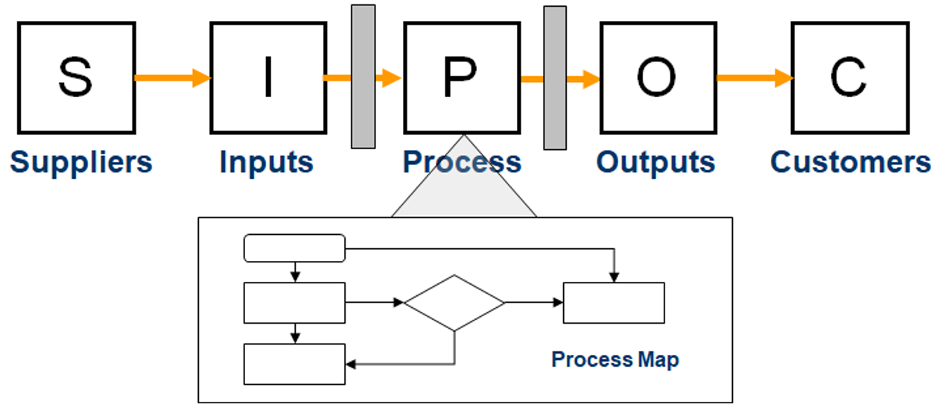
SIPOC

Here is a brief overview of VSM process mapping model template overview as per Lean standard, with brief explanations on how to create it,

Lean VSM Model

Here is a brief overview of VSM process mapping model example overview as per Lean standard,
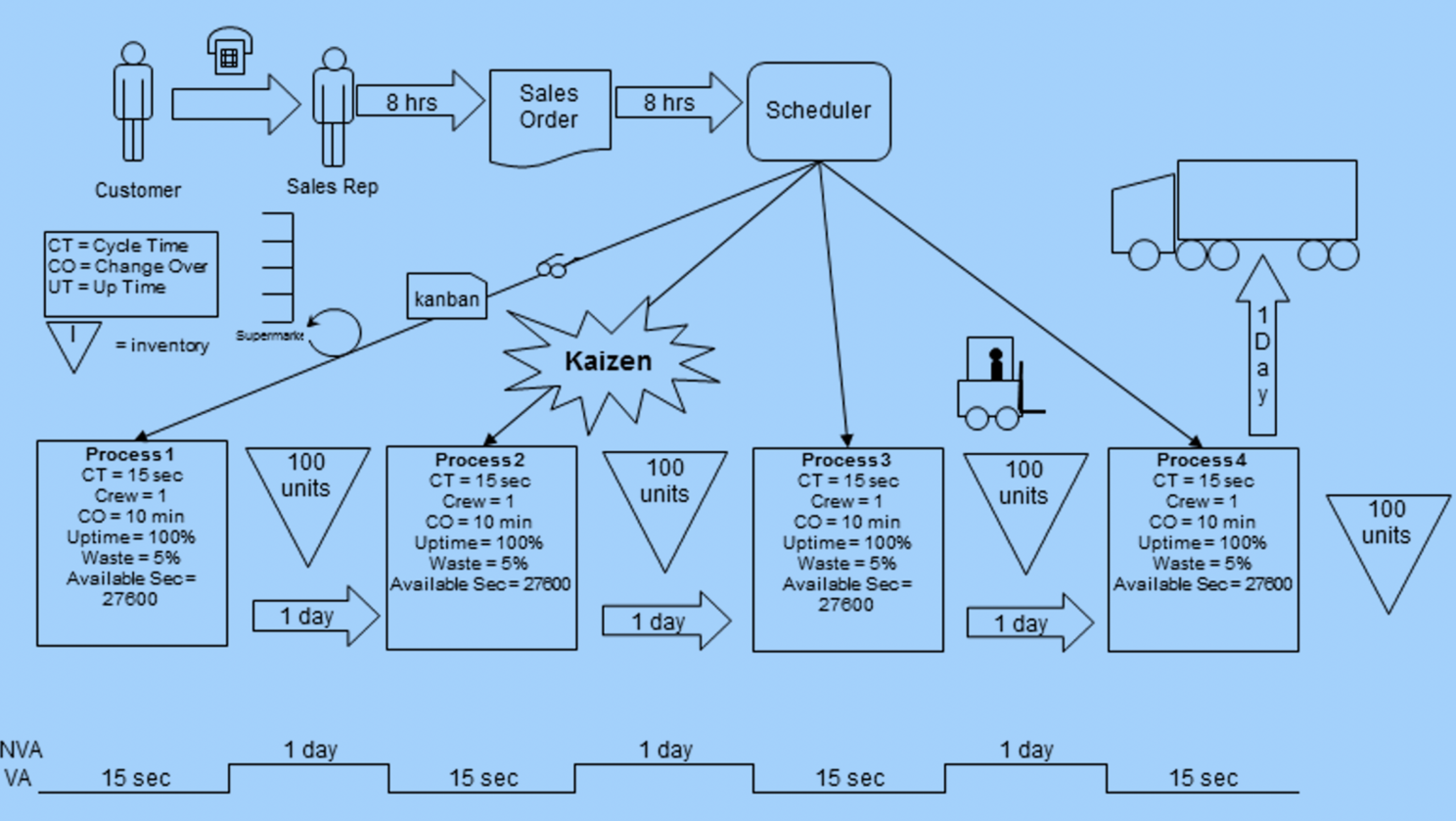
VSM Process Map Example

How is VSM arranged

VSM consists of all the key stakeholders of the value stream at each stage. It is generally arranged as a half day to 3 days workshop depending on the size and complexity of the value stream mapping.

The process is initiated with the current process map which starts with ensuring the need for VSM is clear for every one involved.

For making the VSM need clear to all, before the workshop a core team arranging the VSM creates a VSM charter consisting of a one-page overview (similar to project charter) specifying the problem, purpose, who will lead the session, who needs to be involved, who is sponsoring etc.

Here is formal process steps for achieving VSM,

VSM Process

1.     Define the need – This step focuses on defining the need for value stream mapping session. It includes identifying stakeholders, define VSM charter, planning the event schedule and participants, complete all the preparations (like high level process views, logistics, prints, post its, markers, stickers) etc.

2.     Map The Current State – This stage starts in the VSM workshop where the team begins with,

a.     High level SIPOC process overview specifying process stakeholders, inputs, output and major steps. This helps everyone understand the current state at high level easily.

b.     Next the team starts working on detailing out entire value chain with more granular details like who is involved, what is the throughput time, what gaps or issues are faced, what is done well and what needs improvement.

c.     The focus is always on process and delivering value to customer, there is no pin pointing on any individual or team names.

d.     Lean wastes in the process are identified and documented along with possible action.

e.     The process is managed using post its and stickers for voting as well as capturing inputs.

f.      At the end of the day or during breaks the core team of process or VSM leads collate all the inputs either as pictures or even electronically drawing it and capturing possible actions.

3.     Create The Future State – This stage starts in the VSM workshop part 2 and sometimes day 2, where the team begins with,

a.     Creating the future state map together as a team. The major steps might be same or changed or reduced based on current state see.

b.     The team collectively goes through the lean wastes identified and how those can be removed to make the process (value chain) effective and efficient.

c.     The future state can also be largely automating all possible non value added manual steps in the value chain and hence achieving improved speed with reduced resources needed to manage.

d.     The process is managed using post its and stickers for voting as well as capturing inputs.

e.     At the end of the day or during breaks the core team of process or VSM leads collate all the inputs either as pictures or even electronically drawing it and capturing possible actions.

4.     Prepare the Implementation Plan – This stage starts in the VSM workshop part 3 and sometimes day 3, where the team begins with,

a.     Reviewing the action plan and ensuring each action has an owner and date attached to it.

b.     The team also prioritizes the actions in order of which action will create how much value for the customer.

c.     The team also prepares the high-level future state readiness schedule with owners and dates for completion.

d.     Both the action plan and future state readiness schedule are agreed with all participants of the workshop and the stakeholders.

e.     The VSM leads, work out the report out deck capturing full workshop details inputs, outputs and actions moving forward. Part of the deck is also the costs and resources needed, work cadence and reporting schedule post workshop.

This marks the end of the workshop but the actual work starts post workshop to close the gaps and implement the future state process flow. The team continues the cadence and implements the future state. Post that continuous improvement cycle starts with Kaizen, Daily Management and PDCA (Plan Do Check Act) cycle.

The VSM sessions are revisited every 9 to 12 months to review and improve the process value chain continuously to adapt and deliver superior value to the customer.

VSM has many benefits for the organization. VSM Benefits include, bringing people together as one team, improved understanding of the value chain and what matters most for the customer, removal and reduction of lean waste across the value chain.


Learn and Grow – The 21 Good Management Lessons

Here are the 21 good management lessons from 2021. Please take it to learn, share and relate to your own experiences.

  1. Always be your honest and absolute very best in everything you do. 
  2. Make suer you have solid values and clear conscience to lead, coach and genuinely help people grow.
  3. Only do things that will help the team and business grow in legit ways as per organization’s core values, purpose and vision.
  4. Dare to challenge the status quo and bring the change that others are overlooking or afraid to do.
  5. Use your connections and build your network of team members who can team up to make the difference.
  6. Manage and support your boss as well as management team in achieving the overall organization goals.
  7. Build Trust and Empower your team members. Trust and support team members and the team will reciprocate by delivering a much greater value in return.
  8. Ensure that the team players and their workloads are closely monitored to balance it in such a way that everyone has at least 10% to 15% time per week to balance their work, learn, share and grow themselves.
  9. Team building in smaller teams focused on specific programs or goals is essential. Team building must happen at work as part of the work. The real team building doesn’t need special high spending (costly) events as team members stick together and find time to bond and enjoy together as a team on their own.
  10. Recognition awards and some time off for members that have over worked for delivering results is a much better way of rewarding and creating work life balance.
  11. Refrain from calling team members after office hours, on public holidays and over weekends as that is not very professional unless that is required for specific preplanned events or activities.
  12. Appraisal is the time that should be seen in a positive way to give and receive feedbacks as well as to ensure every 2-3 years based on performance people are promoted and well paid for their efforts year on year. 
  13. Let the team participate in suitable internal and external competitions to shows the best of the best solutions. Support the team by allowing them time to prepare and do the needful on their own but with your and other guidance where required.
  14. Ensure individual team members are well recognised for their work and role model behaviours. Make sure right team members get the needful credit for the work done.
  15. If the team has done a great job in delivering value then ensure each of them get their shining moment in the organization as well as encouraged to continue their journey of delivering more greater value.
  16. Teaming up is much less about dividing & conquering and much more about taking joint ownership to deliver on commitment.
  17. Take teams credit to get the award from top management & in return give the actual team players close to nothing but more complex assignments.
  18. Hiring interns and contract staff to bring new generation & different nationalities on the team is a great step forward but ensure that they have a good career prospect for long term. Groom them well to identify talents and hire them for long term success.
  19. Keep a transparent environment and let team members have skip level meetings or lunch sessions with top management to share their views and ideas.
  20. Be as transparent as possible and be open with team members, never lie to them about organization changes as they will eventually know if you lie. Being transparent will ensure team members are fully aware and well prepared to move forward as a team.
  21. Always remember that as a leader or even a manager you have careers of your team members in your hands. Be the honest leader your team wants you to be.

There are many Good management lessons for sharing. The above list is just my observations from year 2021. I hope you will be able to relate to it and use it for the betterment of everyone in the team.

Learn to Unlearn – The 21 Bad Management Lessons

Learn the 21 bad management lessons to unlearn. Take it in a fun way to learn and relate to your own experiences and share your own views and lessons.

  1. Always be on your boss’s favourite list. Being the top favourite will ensure fully secured career and growth path. Just do whatever your boss says doesn’t matter if that’s a wrong thing to do. Because the Boss is always right.
  2. Use connections to get ahead as it doesn’t matter if you really know the job you are hired for. You get new positions purely based on your connections.
  3. Just manage upward (your boss and your bosses boss) as they are most important for your growth and not your team. Use your team to secure your own growth.
  4. Track your team members. Hire & put few people in team, responsible of tracking others.
  5. Load team players with so much work that they will have no time & life left outside work.
  6. Once every quarter choose 2-3 people that worked 60/70 hours per week and give them $100 vouchers for their 100 hours of extra work.
  7. Call up team players after work hours and over weekends to give them additional work as urgent top priority. This will ensure you can relax while you take every hour of your team players family life.
  8. When it’s appraisal time, talk about demotions coming, budget cuts for all to scare everyone. This will ensure no one ever asks for promotion & salary increases.
  9. Buy awards for systems that are not even in use and showcase as the best award ever to improve your own image & credibility with top management.
  10. Take teams credit to get the award from top management & in return give the actual team players close to nothing but more complex assignments.
  11. If a team player is doing a great job on a complex program/project then remove them after the program has crossed most complex milestones and put your own favourites. This will ensure favourites shine and get great image.
  12. Snatch team players’ work (Divide & Conquer) and pass it to your favourites. This will ensure team players fall flat & loose all the remaining motivation and your favourites grow.
  13. Hire lots of interns and contract staff even if you don’t really need them. This will create great image with top management that you are employing and creating value.
  14. When you are asked to reduce headcount, you just need to remove all the hired interns and contract staff that you hired earlier and meet your reduction target.
  15. For growing the team size, just remove the most hardworking players and then hire 6-10 new people to fulfil the same needs. This will automatically increase team size and budget.
  16. For the skip level meetings with your bosses boss, train the team with who can ask what questions, which questions are allowed, who is allowed to talk, what to say and what to hide. In addition join the meeting even after being asked not to join. This will ensure the team will only speak what’s discussed and not ask any meaningful questions.
  17. To ensure you are able to track who has submitted the employee engagement survey when and whether or not all have participated; make it mandatory to share screen print of when you submitted the survey. This will ensure full participation in the survey.
  18. To ensure only your favourites win the lucky draw at team events, ensure only their names are announced doesn’t matter who’s name really comes out from the draw chit.
  19. Ensure only your favorite and friends company receives contracts so that you can benefit and get your % cut. It doesn’t matter if their prices are high till the time you are benefiting. Create multi (3) years blanket POs which will make you gain even more.
  20. To meet your value creation KPIs, simply count in previous year value in this year. No one will know and no one will ask as everyone likes bigger numbers. Even if people get to know, so what, you are the Boss.
  21. To scare team members remove the hardest working, honest and experienced team players and block them from getting a new job. This will ensure no team member dares to speak about wrong things and no one will dare to leave either.

I hope you enjoyed reading these lessons and some of you smiled as well. Please unlearn these 21 bad management lessons, if you are doing any of these. Please help others incase you see anyone still doing any of these.

Look forward to my next article of 21 Good Management Lessons. Catch up with you all soon.