Raise the Standard with Lean Problem Solving – Part 2

In the previous article you have seen why use lean problem solving, what are the types of problem solving and some examples. In this article let’s understand the process of Lean Problem Solving.

Once you have identified the type of problem faced in the value stream or value chain, they next step is to understand how to structurally work on detailing, analyzing, find the root cause, implementing resolution and monitoring it to ensure the value stream or value chain  works as per expected.

By removing the obstacles the organization continues it trajectory of becoming better at delivering customer value and eliminating waste across the entire value chain.

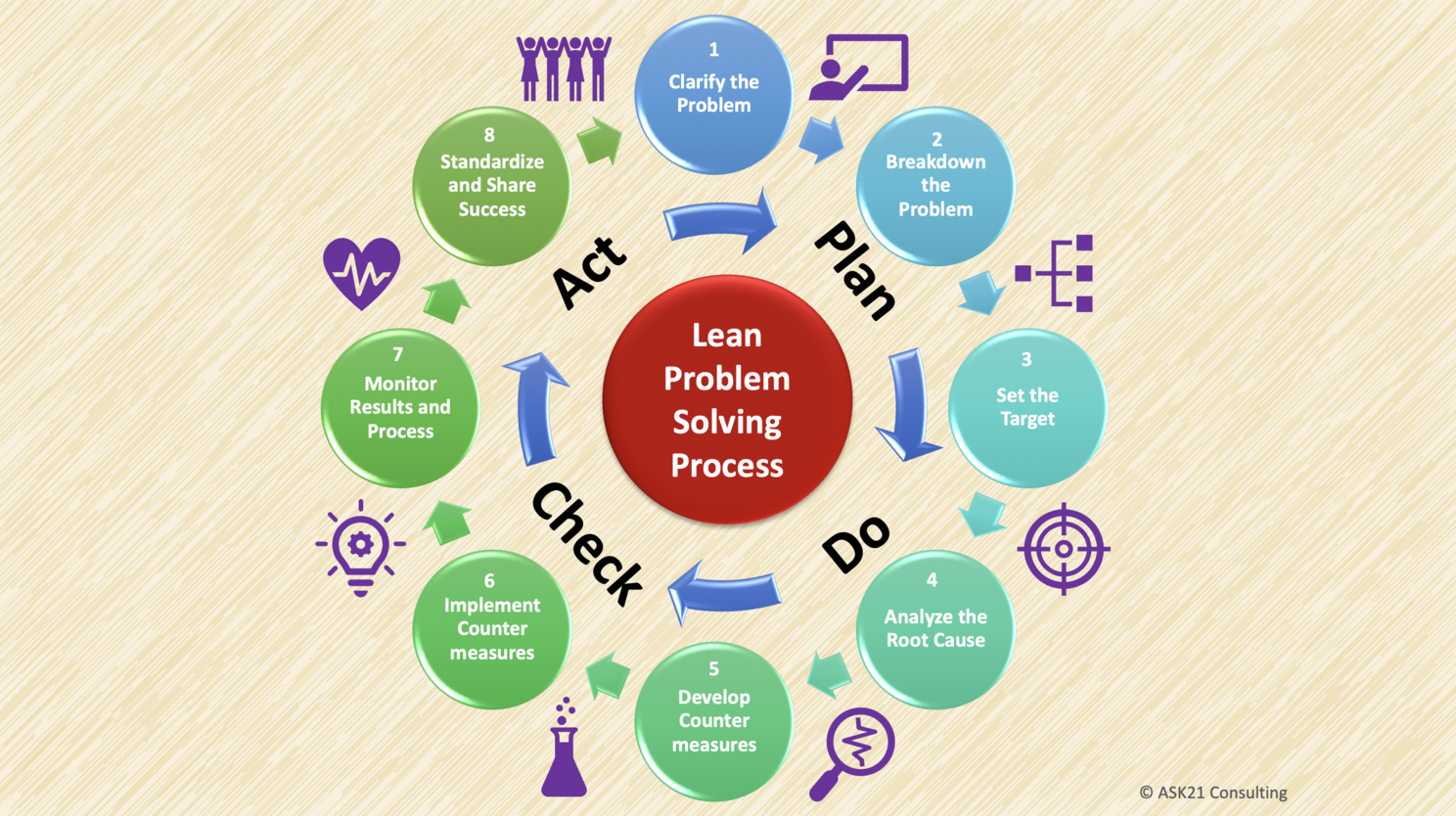
For effectively solving the problem, lean management prescribes an eight step structured process to be followed. The steps can be , there are The steps in the Lean problem-solving process are as follows:
Problem Solving Process

1. Clarify the Problem – In this step the team needs to go to gemba and identify the type of problem as well as do necessary clarifications to ensure the problem is clearly articulated and understood by all in the same way. Always keep in mind that different people will see the same problem differently and this is why this step is critical in ensuring everyone see the problem correctly.

2. Breakdown the Problem – The easiest way to solve the problem is to break it down in smaller pieces and then analyze each piece with respective team members to understand the cause and effects clearly. During the earlier step different set of areas might have been reported related to same problem. Breaking down the problem in to smaller areas or smaller pieces makes it easier to go through each with the right focus and tools.

3. Set the Target – Based on the type problem, it is important to set a realistic target to get it resolved with speed and accuracy. The target must be established keeping in mind the impact of the problem on the entire value chain and how fast it needs to be addressed to remove the blockage. It is also equally important to understand capacity and capability of the team in resolving the problem. People with right expertise and experience must be involved to set the target and resolve the problem.

4. Analyze the Root Cause – This is an important step in problem solving where the root cause analyses needs to be performed. The root cause analyses can be performed using fishbone diagram and 5 Whys method. There can be other tools and techniques also applied like the Problem Tree method to clearly articulate the core problem, it’s possible root causes and impact or effect of those. This needs to be done with the team to ensure all inputs are correctly captured and documented.

5. Develop Countermeasures – After the root cause analysis is completed, the team can focus on identifying and developing counter measure to remove the obstacles and resolve the problem. The focus should be on having counter measures for each root cause or even better one countermeasure that can address and resolve multiple root causes. It is important that the effect of counter measure must be thought through as well to ensure they do not create more impacts and/or gaps in the value chain outputs.

6. Implement Countermeasures – One of the important steps in the problem solving process is to test and implement the counter measures. Before implementing it, the counter measures must be tested and validated with a possible dry run to ensure they will work as per planned and not create any new impact to the value chain. Upon successfully testing and validation the counter measures can be implemented as per planned schedule.

7. Monitor Results and Process – Post implementation close monitoring and reporting must be enabled for capturing the results from the value chain and especially the impacted area. The entire value chain process must be kept under monitoring to confirm that the before and after implementation of countermeasures have standardized the output results.

8. Standardize and Share Success – After a pre-defined period of monitoring and reporting, the problem can be marked as fully resolved and completed. At this stage the standardised process can be replicated across in case there are more similar instances of the process running (E.g., an application with multiple instances). The success can be also shared widely in the organization to ensure everyone is kept informed about the problem and how it was resolved.

Along the entire problem solving process there is an underlying Deming’s Cycle (PDCA) in work. Deming’s cycle (Plan-Do-Check-Act) helps in ensuring continuous improvement is on everyone’s mind. Here’s a quick overview of Deming Cycle stages,

PDCA Cycle

1. Plan: Plan focuses on identifying, articulating and planning improvement. If we look at it from the problem solving process steps, Clarify the Problem, Breakdown the problem and Set the Target are part of Plan stage.

2. Do: Do is also about executing the change or improvement. We can also relate it to Design, Build and Test and Implement parts. If we look at it from the problem solving process steps, Analyze the root cause, Develop Countermeasures and Implement Countermeasure are part of Do Stage.

3. Check: Check comes after implementing the improvement to monitor and report results. Check is all about monitoring and reporting to confirm that the improvement, change or problem solving is working fine across the value chain. If we look at it from the problem solving process steps, Monitor results and Process step is part of Check stage.

4. Act: Act is focused on making the change or improvement stick and making it a best practice by adhering it across the organization. If we look at it from the problem solving process steps, Standardize and Share Success step is part of Act stage.

The PDCA cycle continues as the improvements are never over. For the problem solving part also the problem is resolved but further improvements and standardization as well as raising the standard to the next level continues.

Lean Problem Solving is important for all organizations. It helps to remove the obstacles in the value chain / value stream and brings the organization to the new standard, reducing costs, improving efficiency, effectiveness, and value for the customer.

Daily Management with Lean

One of the important tools in Lean Management is Daily Management. Daily management is achieved using a visual dashboard. The dashboard can be manually prepared, printed and presented or even electronically published each day to share progress with all involved stakeholders and participants.

Daily Management visual dashboard is used to track and monitor progress of key performance indicators, targets and goals that are important for the organization. It is used on especially those areas where impact is high and the team needs to ensure that they do not slip agreed targets. It is also used to quickly identify and visualize areas of attention and issues that must be resolved to achieve the targets.

Daily Management helps in comparing performance improvements on daily basis at a glance look. It shows the areas with colors to bring attention (E.g., red could mean target is not achieved, green means target achieved and on track, orange or yellow means target will be achieved with in agreed threshold of some %).

Daily management needs standardized processes, templates and possibly automated systems to generate and share daily progress at a specific time each day. It requires efforts and commitment from the organization stakeholders and key team players, to ensure they stick to the cadence and review progress each day.

Over a period of time, it becomes a habit and when it’s done well, it helps in ensuring key targets are achieved and exceeded across the organization. Lean prescribes some standards on how daily management should be done to achieve efficient results.

Daily Management (DM) Process

Daily management consists of four areas that must be done. These four areas help to check and understand how the organization is progressing and which areas need attention to keep on track. Here are the four areas,

Daily Management Process

1. Daily Accountability Process Meeting – The daily accountability process meeting is arranged to visualize progress and identify areas of concerns as well as run through the issues and actions.

In the meeting a check is done to ensure everyone on the team has everything they need to perform and achieve that day’s targets. It also allows people to speak up and ask for help wherever they need attention and help from the team and senior stakeholders.

The DM (Daily Management) visual dashboard used is to track the overall targets and attention areas. The DM board also captures key issues and actions on a daily basis. The DM boards can be automated to save repetitive efforts and a big TV screen can be used to visualize tracking of KPIs and review of issues and actions.

Daily Accountability Process (DAP) meeting helps the participants visualize the entire progress transparently, collaborate and brainstorm together.

The meeting is a stand-up meeting as it is supposed to be a quick review of 15 to 30 minutes followed by next steps of actions.

2. Leader Standard Work – Leader standard work is set of work culture and behaviors that the lean leaders must adhere. Lean leaders are tasked to ensure every member of the team contributes to best of their abilities in achieving the results.

Part of the work is also to ensure Lean standards and ways of working are followed by all team members. Leaders check the progress on daily basis to ensure ways of working are modelled and used by all.

In case of gaps or issues found in ways of working, Lean leaders coach and train the members to lift them up and bring them back on track.

3. Gemba Walks – Gemba walks are attached to going to place where the work is done and action is ongoing. Gemba walks are done to places where its important to check and seek opportunities for improvements to become more efficient and effective in delivering superior value to the customer.

Lean leaders and drivers take the gemba walk to observe how the processes are functioning in real life on the ground Vs how they are being presented. The insights help them think about better ways to do things as well as identify best practices that can be applied to other parts of the organization.

4. Process Confirmation – Best on the observations from the Gemba walk, the team can confirm if the process is working as defined or they see variations of it and need for improvements.

The process confirmation can be also be done as period internal or external audits without notice to check and confirm that standard operating procedures (SOPs) are fully adhered to as well as Segregation of duties are well maintained as per defined roles not allowing conflicting roles managing tasks or stages that they are not supposed to manage.

This results in ensuring the entire organization functions as per defined as well as fully adheres to process changes and standards.

Daily Management (DM) Board

The DM Board can be designed to have KPIs that matter most for the organization as well as department or division (level) at which the DM board is prepared. There is no point having top level or even region level KPIs on the department’s DM board if those are not actioned and in control of the team members. The KPIs used for tracking must be meaningful and in control of all the team members.

The DM board can have or look for KPIs from SQDCP areas(Safety, Quality, Delivery, Cost, and People). The DM board must be placed near to the work area where all team members and stakeholders can easily look at it. This will ensure the board is kept latest and remains on everybody’s mind for regular review and actions. It will improve collaboration and discussions amongst team members to help each other with new ideas on making things easier and efficient for all.

Let’s understand how the DM board can be arranged for effectiveness and efficiency.

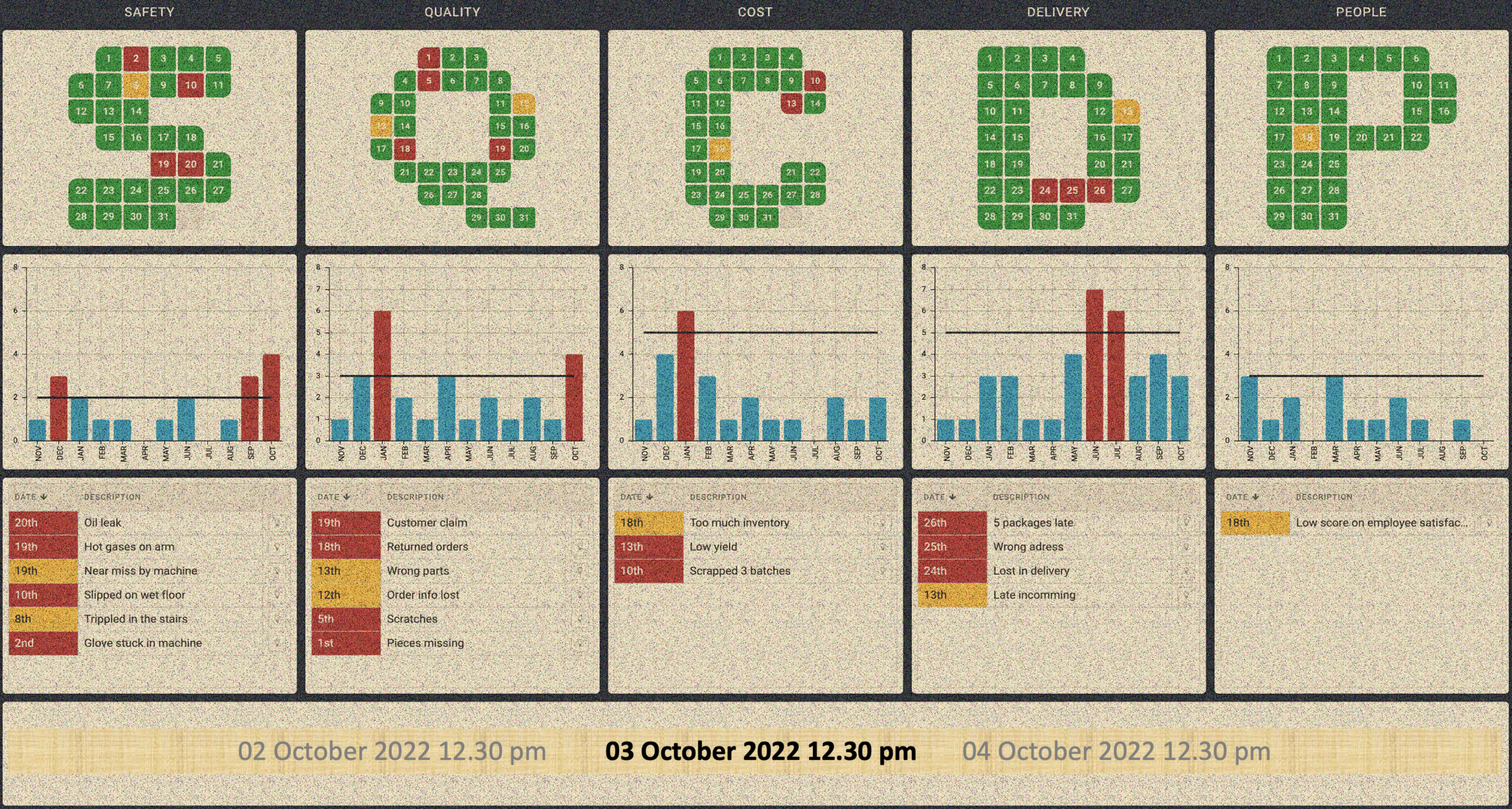
1.     In the DM board SQDCP areas always have 31 short cells representing 31 days of the month.

2.     In case of weekly DM board, each cell can be representing the weeks and in such case 52 cells will be required to track weekly hit or miss of respective targets.

3.     The cells can be filled with Red, Green, Orange/Yellow and Grey colors.

a.     Red means the target is missed for that day and generally there will be an issue reflected in the board under issues section.

b.     Green means the target is achieved and everything is on track.

c.     Orange/Yellow can be used to show is target is missed but still within defined threshold and controllable to get it back on track.

d.     Grey can be used for non-working days or for days that are extra in the month (e.g. if Sep is 30 days, 31st cell will be in grey color).

4.     The issues occurred for red cells are discussed in the Daily Stand up meeting and action(s) are assigned to ensure those issues are resolved and does not repeat.

5.     It is not mandatory to place all the SQDCP areas on the board. The team can select only those they need to track depending on mutual agreement and alignment with stakeholders.

6.     The SQDCP areas can be also arranged flexibly (e.g., PCDQS or SQCDP etc.) based on the organization, department or division’s priority focus areas.

7.     There are other areas that can added as well for tracking, E.g., Inventory (I), Productivity (P), Bugs (B), Environment (E), Tickets (T) etc. This means the letters can KPIs to track for hit or miss are flexible as per team needs.

8.     Here are two examples of the SQDCP DM board. One example is using simple excel or white board based template while the other is a fully automated online dashboard.

a.     Excel or white board Based Tracking Dashboardb.

Excel DM Board

b.     Fully Automated Tracking Dashboard

DM Digital Board

Benefits of Daily Management

Let’s understand the benefits of using Lean, Daily Management and Visual Dashboards,

1.     Visualize the progress of important targets and KPIs on daily or weekly basis, at glance with in few minutes.

2.     Visualize the issues faced by the team in respective key performance areas within few minutes.

3.     Understand actions taken by the team, action owners and by when the issue will be resolved to bring the team back on track.

4.     Improved transparency and empowerment as the DM boards are maintained by the team members and bring full transparency to the team on progress made as well as issues faced.

5.     Team collaboration improves as team members discuss, brainstorm and come up with new ideas to get things done and achieve targets.

6.     Lean and Daily management culture gets embedded in every one’s way of working leading to significant improvements and

7.     Full compliance on regulatory audits as entire team follows and complies with the standardized operating procedures.

8.     Customer experience and value increases as the team continuously improves.

Lean Daily Management and Visual Dashboard helps organizations achieve and exceed their targets swiftly as everyone in the team thrives to do the best by adhering to Lean ways of working.