The Good and Bad perspectives of Deepfakes

Deepfakes have emerged strongly only in the past few years. The name comes from Deep (Deep Learning) and Fakes (virtual, imaginary computer visuals). Deepfakes are an existing image or video created using artificial intelligence (AI), machine learning (ML) and deep learning techniques by the computer system that can mimic to look & feel 98% similar to our actual image and videos.

Deepfakes are created using AI and ML to create visual and audio content that can easily deceive people. The key technology and learning methods used come from deep learning and involve use of generative neural network architecture for training machine and generating output. It uses autoencoders, decoders and generative adversarial networks (GANs) from deep learning. 

Here is a brief overview of the Deepfakes are created and operated,

Deepfakes Creation

1.     Deepfakes work based on an autoencoder which is part of neural network in deep learning architecture. 

2.     The autoencoder reduces a person’s image to a low dimensional latent space. 

3.     The latent space captures the key features of person’s face and body postures etc. 

4.     This is then used by the decoder to reconstruct the image from its latent representations.

5.     The decoder works as part of generative adversarial network (GAN). The GAN trains the output generator consisting of the decoder and discriminator.

6.     The generator constructs the image from the latest representation while the discriminator checks and determines if the image constructed is matching to the source.

7.     The model then places the reconstructed image and features on top of the person’s video or image to mimic like the real person itself.

8.     As the entire architecture is functioning with AI, ML and Deep learning the model continues to take feedback, learn and evolve and it becomes so perfect that it’s almost impossible to differentiate between original source and deepfake reconstruct.

Now that we understand how deepfakes are created and operated, let’s understand why they are worse than good for society and organizations.

Deepfakes are not just be used on image and videos but also for mimicking audio. Deepfakes are not just be used for one person but even the entire group of people can be mimicked in an image, audio and visual. This is what makes them very dangerous as we can’t easily interpret fake Vs real on our electronic devices.

Deepfakes are generally used for mimicking others. They are often used by bad people targeting celebrities and leaders. The internet is full of bad examples of deepfakes. Some are even so shameful that we can’t even imagine.

There are some good sides of Deepfakes too. On the good end deepfakes can be used for,

1.     Reviving memories of people who have left the world and bringing them to life with virtual images and videos of them.

2.     Reviving memories of patients with short memory and memory loss.

3.     Marketing and Creative agencies are using deepfake to save time and costs on advertisements where the celebrity can shoot the ad just once and the audio content of the ad can then be mimicked and targeted towards respective target audience in their language making it more personalized and effective.

E.g., one such ad was from the leading food delivery company that is targeting its customers in different states and cities in different language using the Deepfake technology. The Deepfake celebrity is mimicked so clearly and accurately that the viewers can’t make out any difference and ad became very personalized and highly successful.

4.     Mobile Phone and website based apps for online learning of concepts by mimicking the actual creators of those concepts. 

E.g., Einstein teaching his theories to school and college students using online learning videos.

Deepfakes require strong internet connections and generally with weaker connection the lag can easily show up that the video is fake. But as the technology improves and countries move from 4G to 5G as well as the AI platforms and solutions becoming stronger along with Metaverse possibilities, it can lead to serious problems for many areas.

The solution to protect ourselves from bad sides of Deepfakes is to be careful,

1.     Using your photos, voice and videos on social media and storage platforms openly.

2.     We must ensure everything is well encrypted and securely stored. 

3.     Always be vigilant in day-to-day life and be alert and aware while using internet. 

4.     Stay away from using open (unsecured) and free access wireless network points. 

5.     Ensure you always use strong password on all your devices and change it periodically this will ensure your devices and accounts are always secured.

6.     Stay away from mobile apps and websites offering Deepfake free trial or even paid trials.

Artificial Intelligence (AI), Machine Learning (ML), Deep Learning (DL) and many other new technologies have many benefits for organizations, society and people. But its very important to have a solid and secured good governance on how these new technologies can be used for the greater good of all.

Understanding the perspective of Digital Twins

The need for digital twins was foreseen way back in 90’s when we started using computers for automation. In the past two decades our society and organizations have gone to great lengths in making hyper automation possible and we live in a gadgets world where every it connected and have some part of it managed through digital technology. We have actually started using Digital Twins meaningfully only in the past 5 to 7 years.

Digital Twins, when you hear these words for the first time, the first thing that you think is, it must be some sort of digital replica of physical things. You are half way there in understanding Digital Twins. 

Digital Twin is an exact virtual (digital) replica of physical product, object, system, process and even human beings to some extent. Digital twins is used for simulation, prototyping, testing and maintenance as well as for investigations of cause and effects for any major issues and risks we face in products, objects, systems, processes etc. 

Digital Twins are of three broad types based on their usage needs,

1.     Digital Twin Prototype (DTP) – As the name suggests this is not a real digital twin but a prototype and generally used for all types of digital prototyping giving a feel of the product, object, system or process.

2.     Digital Twin Instance (DTI) – DTI is an actual Digital Twin (virtual instance) of a  product, object, system or process. DTI is used for carrying our multiple scenario simulations and testing on the virtual instance.

3.     Digital Twin Aggregate (DTA) – DTA is combination of multiple instances (samples) of the same product, object, system or process. This is used to carry out detailed simulations and tests on aggregated instances. It is very useful for validating how the hundreds of thousands of instances of digital twins could work and what challenges and issues we might face as we ramp up or ramp down the instances, upgrades, maintenance and support. 

Digital Twins are used in 3D modelling, architecting, construction, manufacturing, retail, healthcare, automotives, aviation, shipping, smart cities and many more industries. Here are some major examples,

1.     Retail – Digital Twins are used in the retail industry to model consumers and study their behaviors to enhance user experience.

2.     Healthcare – Digital Twins are used in the healthcare industry for multiple areas,

a.     For products simulations and tests

b.     For patient simulations and tests

c.     For Hospitals and Clinics process simulations

d.     For staff trainings using digital twins

3.     Automotives – Digital Twins are used in the automotive industry for parts simulations as well as product simulations and testing

4.     Manufacturing – Digital Twins can be used to simulate how industry and manufacturing lines can perform in various scenarios.

5.     Architecting – Digital Twins can be used for 3D modeling and architecting simulations and tests.

6.     Aviation and Shipping – Digital Twins can be used for aircraft, spacecraft and ships simulations and testing

7.     Construction – Digital Twins can be used for major construction modelling and simulation testing.

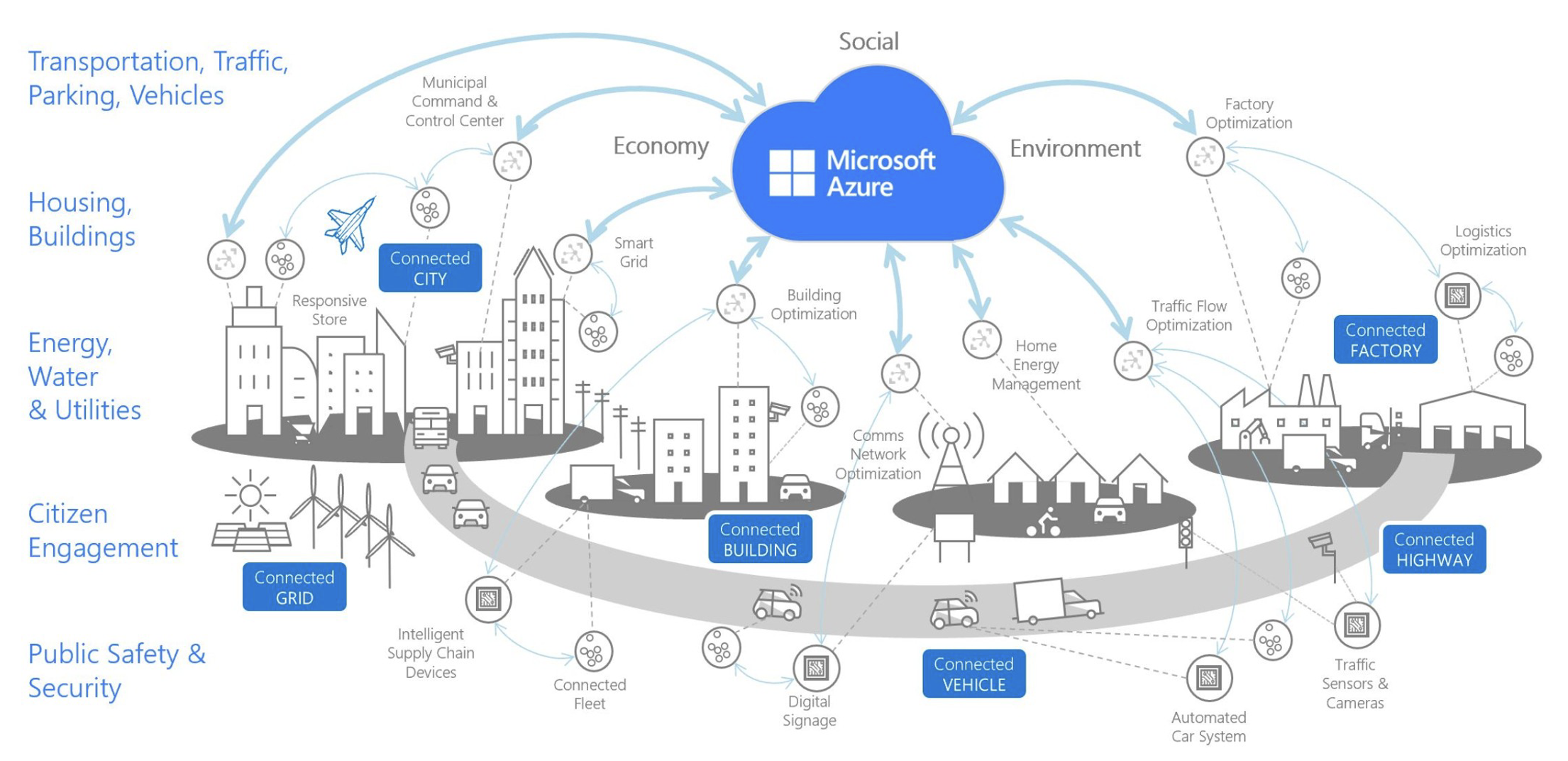
8.     Smart Cities – Countries and Governments can use Digital twins for simulating smart cities and how they can meet their growth and sustainability goals.

Microsoft Azure Digital Twins Overview for Smart Cities

The need for digital twins is clear from above examples. Please also check above picture of Microsoft Azure Digital Twin Overview of a Smart City. Digital twins help in ensuring before we launch the new product, object, system or process as well as before we upgrade we do a thorough virtual simulation and testing to understand the quality, impact, issues and risks. The outcome helps in addressing all the areas sufficiently before launching. Here are some real examples specifying why we need digital twins,

1.     Imagine the impact for an airline company of recalling its aeroplanes for any parts defects post product launch.

2.     Imagine the impact of healthcare device recall post launch and how much it will impact organization’s brand and finances.

3.     Imagine an automotive company recalling its cars to address defective part which did not get sufficiently tested.

4.     Imagine a space rockets company having its rocket failure due to insufficient simulation tests.

5.     Imagine a trading company launching a defective trading app and how much of impact it can create for its customers.

6.     Imagine a construction company building a construction project without full simulation and tests.

These are only few examples why we need digital twins to improve simulation and testing with virtual instances. There are many more examples across all industries and sectors.

Here is a quick understanding on how the digital twins are setup and how do they function,

1.     Digital twins are setup and created as virtual instance(s) that get(s) data feed from the physical instance(s). 

2.     The data is fed using system interfaces or data loads for specific scenarios simulations and tests. 

3.     The results are collected and recorded from different parts of the respective product, object, process or system.

4.     The results are collated and visualisations are created for concluding on insights.

5.     Insights lead to actions and possibly some more simulations and tests until the respective product, object, process or system meets all criteria.

Digital Twins can be created using company proprietary or market standard platforms. Microsoft, Nvidia, IBM, Siemens, Cisco, Oracle, Ansys, General Electric and many other companies offer Digital Twin platforms, solutions and services.

Digital Twins are an essential part of Industry 4.0 and Digital Transformation for organizations’ digital value chain. Digital twins are also closely attached and work in conjunction with the IoT (Internet of Things) and IIoT (Industrial Internet of Things) ecosystems. Digital Twins can also be understood as Metaverse made for the reverse engineering of investigations and simulations.

Digital Twins are very useful for organizations, industries, sectors and countries. As it costs to have a Digital Twin, it is important to not apply Digital Twins for every product, object, process and system. Digital Twins should be applied to only mission critical, high impact and high risk products, objects, processes and systems.

Digital Twin are a necessity for organizations as their products and value chain becomes digital through digital transformation and digital business models. In near future more easy to use platforms, solutions and services will emerge that will make using Digital Twins simpler and faster for all.

The What, How and Why of Internet of Things (IoT)

The Internet of Things (IoT) is a term that came in real use more than a decade ago. It arrived when our mobile devices became more powerful and gained ability to connect to internet and communicate information. IoT opened a new world of connected eco systems for tracking, monitoring and reporting on all possible aspects of our lives.

IoT is the ability of mobile devices, scanners, sensors and tokens to connect to internet or to an internet enabled device to share useful information collected by the device, scanner, sensor and token. The information can be then be collated and stored on a cloud hosted systems that can then analyze the data and share insights and actions.

The IoT ecosystem consists of many devices connected to the IoT Hubs which are connected to the IoT Cloud Platform that collects and analyzes data which is accessed by the organization using their devices to gather insights and make decisions. The IoT ecosystem can be briefly described as follows,

Internet of Things

1.  IoT Devices – IoT devices consists of sensors, trackers, scanners either on their own or as part of products like smart band, smart watch, smart cars, smart phones, smart thermometers, smart weighing machines and many more. The devices are built in to communicate with IoT Hubs using protocols like IPv6, LoRaWan, ZigBee etc.

2.  IoT Hub – Each IoT device has ability to connect to the nearest possibly IoT Hub. The IoT Hub has the ability to receive and translate the data from IoT devices. It translates and tags it properly as well as encrypts it to send it to IoT Cloud Platform.

3.  IoT Cloud Platform – The cloud platform is a large storage space with suite of applications to store, analyze and interpret data patterns. It prepares the insights and visualizations for the organization to access the data and results to make effective decisions.

4.  User Devices – The data and insights stored in the IoT Cloud platform can be accessed by respective authorized users using mobile, tablet or PCs to make decisions and take necessary actions as well as do required communications.

There are many IoT Communication Standards as different manufactures and industries need different types and standards are not fully underpinned by one global entity. Here are some of the known standards that are generally used by IoT devices for communications.

1.  Long Range Wide Area Network (LoRaWAN) is a protocol for wide area networks (WANs) designed to support big size networks. It is generally used for large scale environments like smart cities with ability to connect and enable communications for millions of low-power devices.

2.  Low-Power Wireless Personal Area Networks (6LoWPAN IPv6) – It is an open standard that enables low-power radio frequency to communicate to the internet, includes Bluetooth Low Energy (BLE) and Z-Wave used for home automation.

3.  ZigBee – It is also a low-power, low-data rate wireless network used mainly in industrial settings.

4.  LiteOS – It is an operating system used for wireless sensor networks. LiteOS can be used with  smartphones, smart watch, smart bands, smart cars, smart homes and intelligent industrial.

IoT operates in the cloud (internet) so it needs a robust architecture platform and framework. The world known cloud providers have also their own cloud-based platform and framework for organizations to effectively operate IoT ecosystem. Here are some well-known examples of IoT platforms and frameworks.

1.  Brillo / Weave by Google – Google has developed Brillo and Weave platform for rapid implementation of IoT applications. Brillo is Android OS based platform that helps develop apps for managing and tracking embedded low powered devices. Weave is messaging protocol used between the IoT device and google cloud.

2.  AWS (Amazon Web Services) IoT platform – It offers services that enable interaction with IoT devices and enables ability to receive data from IoT devices. The platform also doubles up in analyzing the data and sharing visualization as well as insights for decision making.

3.  Azure IoT platform by Microsoft – The Azure IoT platform offers services that allow interaction with IoT devices as well as ability to receive data from IoT devices. The platform also offers data analysis, visualizations and insights from the collected data.

4.  HomeKit for iOS by Apple – Apple devices have several sensors as well as products like Air Tag, Smart Watch and Air Pods have several IoT services. The HomeKit is proprietary platform that can be used for iOS apps development to interact and receive data from Apple devices and sensors.

Here are some examples for you to better understand what IoT can do and how it helps in efficiency, effectiveness and continuity of services, 

1.  A sensor in the rental printer can communicate cartridge usage status and auto dispatch refill/replacement cartridge in time to ensure continuity of the printing services.

2.  A sensor in the smart watch can monitor and detect your health and predict your health conditions improvements over a period of weeks and months.

3.  A sensor in the smart watch can monitor and detect your fall and automatically call the emergency services to support you.

4.  A sensor in the logistics pallet can track and share the exact location of the pallet throughout its journey from warehouse to delivery. It can also help track areas where it takes longer than usual for clearance and movement of stocks.

5.  A sensor in the car can track your driving speed and alert you when you are crossing a certain speed limit.

6.  A sensor in the mobile phone can monitor battery health and suggest when it’s time to charge and or change batteries.

7.  Smart sensors in the manufacturing production line can track the performance and effectiveness of the production line and report alerts when its either too fast or too slow.

8.  Smart sensors in the retail shop can track how many customers come to the product booth, how many spend time trying the product to check the effectiveness of instore excellence and promotions.

9.  The sensors in the aircon can alert service provider for gas top or air con cleaning based on its usage.

10.  The sensors in the hospital MRIs can track and auto order parts replacement in advance to avoid any downtime of MRIs and impact to patients.

11.  The smart patch sensors put on patients’ body can track and monitor their heart rate, oxygen level, blood pressure and diabetes. The data can be then collated and accessible for the patient and care givers for review and actions.

Above list was just a few examples that you can relate easily. The IoT examples and usage is far vaster and there are many more examples. We use IoT across most of our home appliances, entertainment devices and health devices.

IoT has many benefits for organization. Benefits range from automation of repetitive tasks to productivity increase, from insights to costs savings and faster fact-based decision making. Here is a brief overview of key benefits from IoT,

1.  Automation of tracking and monitoring activities without any room for human errors.

2.  Time savings and productivity gain

3.  Cost savings and 7×24 monitoring, tracking and reporting

4.  Faster, Accurate and Facts driven insights and decision making

5.  Improved quality and customer experience

IoT also has some areas to be well taken care, as anything that is on internet is prone to possible cyberattacks and hacking. Here are a few areas to look out for,

1.  The data from IoT devices if not well encrypted can be hacked and even manipulated by hackers. 

2.  The IoT devices can be hacked or virus implanted which can make them malfunction and report bad data.

3.  IoT devices and sensors must be managed for effectiveness as over a period of years the organization could have thousands of such devices all over their customer base and its very difficult to track and manage all of them with speed.

4.  As the amount of data increases its important for organizations to have a policy on how to archive the data periodically to avoid systems from slowing down and increase in costs due to increase storage and computing power.

5.  Regular firmware upgrades and security upgrades for IoT devices and systems to avoid having any security holes making them vulnerable for cyber-attacks.

6.  Another important area for IoT is to ensure full adherence of Data Privacy and regulatory compliance especially for personal, healthcare and confidential data.

IoT has slowly and silently slipped in our daily lives. We all use it every single day and benefit from it to make our lives better. The usage is wide and almost every industry and every person uses IoT in one or the other form. The most common form is smart phone, smart watch and smart bands we use daily.

IoT devices and ecosystems will continue to remain and become even more smarter in the coming years to make our lives super effective and highly efficient.

11 Important areas for effective Digital Transformation

Digital Transformation framework and digital value chain deployment is a huge effort for large organizations as there are too many factors to be taken care for becoming successful.

Organizations’ depending on their size need a multiyear program to full achieve the transformation. For smaller and medium size organizations it is relatively simpler to achieve due to their smaller size and much lower complexities involved.

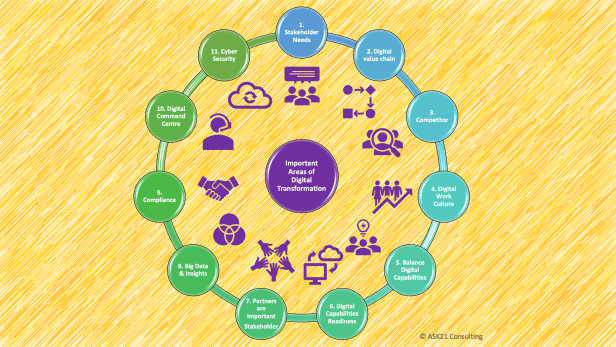
Alongside the Digital Transformation Framework, we must ensure entire digital value chain (value stream) is well equipped to function smoothly. This requires taking care of following 11 important areas while doing digital transformation of your digital value chain,

Important Areas of Digital Transformation

1.     Stakeholder Needs – Identify, Involve and Evaluate that all your stakeholder needs both internal and external are met. This must include your partners (e.g., suppliers, supply chain, marketing agencies etc.)

2.     Digital value chain – Clearly articulate your digital value chain. Define and measure your expected outcomes. Easier said than done, this will take a lot of efforts from all in the organization, especially leaders and management team. Focus is not just on what is the value chain but on what outcomes you want to achieve, for whom and how it will be measured for success.

3.     Competition – Evaluate what your top 3 to 5 competitors are doing and how digital transformation can give you an edge over them. Also, to maximize results, check where your specific industry or market is going and align to it. Use market research and industry papers from top consulting firms and government.

4.     Digital Work Culture – Define and Design work culture changes needed to adapt the digital mindset across the organization. Digital transformation is much more of work culture change then simply changing systems and processes. To be digital the culture must have aspects of digital behaviors embedded and articulated with examples.

5.     Balance Digital Capabilities – Ensure proper digital technical capabilities are in place with a good balance of inhouse and external resources/partners to deliver and run the ongoing digital journey. Also do a check whether your partners (SCM, Suppliers, Retailers, etc.) are well equipped to move in the digital space. There is no point having digital transformation done while rest of your ecosystem is not ready to adapt.

6.     Digital Capabilities Readiness – Establish full set of digital capabilities in terms of people, process and products. The emphasis here will be on people, to check and ensure digitally trained people are onboard to manage the value chain. Existing people can be trained. New people or positions should be opened and hired (e.g., if you don’t have digital marketing leader, you will need one for sure, you don’t have digital data analysts then know that you will need them too). HR must have a Digitally savvy TA Manager that really understands Digital needs and how to acquire the right talent. Lastly there has to be a good balance between how many people you really need inhouse and how much you can manage using your external partners (for Manufacturing, Marketing, SCM, Finance, Procurement, HR and IT).

7.     Partners are important – For digital transformation to be successful all your partners (e.g., suppliers, supply chain, marketing agencies etc.) must be fully onboard and equipped to move towards digital ecosystem. Often partners technical capabilities and system landscape standardization and connectivity for seamless transactions management becomes a major issue. This is one of the most challenging areas where organization’s core systems are not seamlessly connected using industry standard messaging platforms resulting in lot of manual work and Lean waste if not identified and handled in advance as part of the transformation. Challenge is generally faced with manufacturing suppliers, supply chain partners and eCommerce hub (shop in shop) partners.

8.     Big Data and Insights – One of the other major areas to watch out are related to Data and Insights. Going Digital means, the organization will now have a lot of data in various systems and these data must be used to generate meaningful insights using near real time online dashboards. Key value indicators (KVIs) and Key performance Indicators (KPIs) as well as various aspects of industry 4.0, digital marketing and online sales must be well defined and measured for growing the business and creating sustainable value.

9.     Compliance – As you embark on the Digital value chain, all the compliance needs must be redefined as per the digital value stream. Data privacy and online compliance regulations from global as well as local country specific compliance must be fully acknowledged and implemented.

10.  Digital Command Center – The more digital the organization becomes the more the organization would need digital command centers to check and manage their online presence and customer touchpoint platforms (likes of company websites, campaign websites, facebook, youtube, twitter, Instagram, Pinterest, LinkedIn and many more). One mistake on these platforms can cost a lot to the organization and its brand image globally (e.g., it can directly impact share prices).

11.  Cyber Security – Going digital brings a lot of positives but it also has its own negatives. If systems are not well architected and digital platforms are not secured with cyber security. System authorizations and authentications must be handled with end-to-end encryptions. All people must be trained in understanding basics of cybersecurity related to use of strong passwords, keeping the devices locked when not in use, authorizations are maintained and segregation of duty conflicts are vouched to ensure right people get right information (nothing more and nothing less). All servers, devices, systems and digital equipment are periodically scanned and patched for avoiding virus attacks and hacking.

Digital Transformation is like implanting a new brain in the organization (body) to make it more effective and efficient while still keeping its vision & purpose (soul) intact. Digital transformation helps to change the strategy of an organization on how it can unlock its full potential to achieve its vision, purpose and goals (north star).

The Digital Transformation Framework

Digital Transformation is a large commitment for organizations to change how it works, thinks and generates its business. Everything has to change to think, work and act digitally across the entire organization.

For being successful in making the leap for digital transformation, the organizations must follow a solid framework along with talents from both inhouse employees and outside partners. The digital transformation scope must also cover the landscape of the business partners to ensure they are equally digital equipped to work and deliver seamlessly.

The digital transformation framework provides a well thought through roadmap steps that can be applied to any organization to achieve transformation goals with agility, speed and accuracy. Digital transformation framework along with organizations’ digital value chain helps define organizations full path to succeed digitally.

Let’s do a quick run through on Digital Transformation Framework steps and supporting areas for achieving first time right successful transformation across the organization.

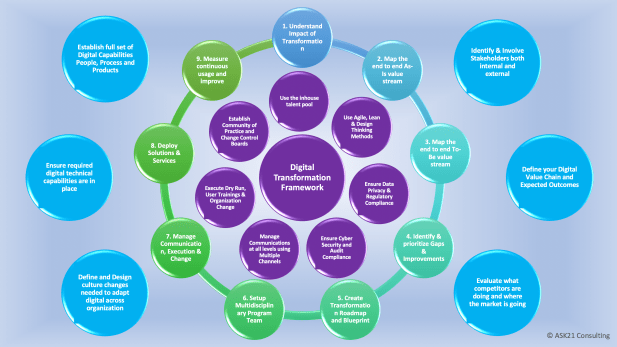
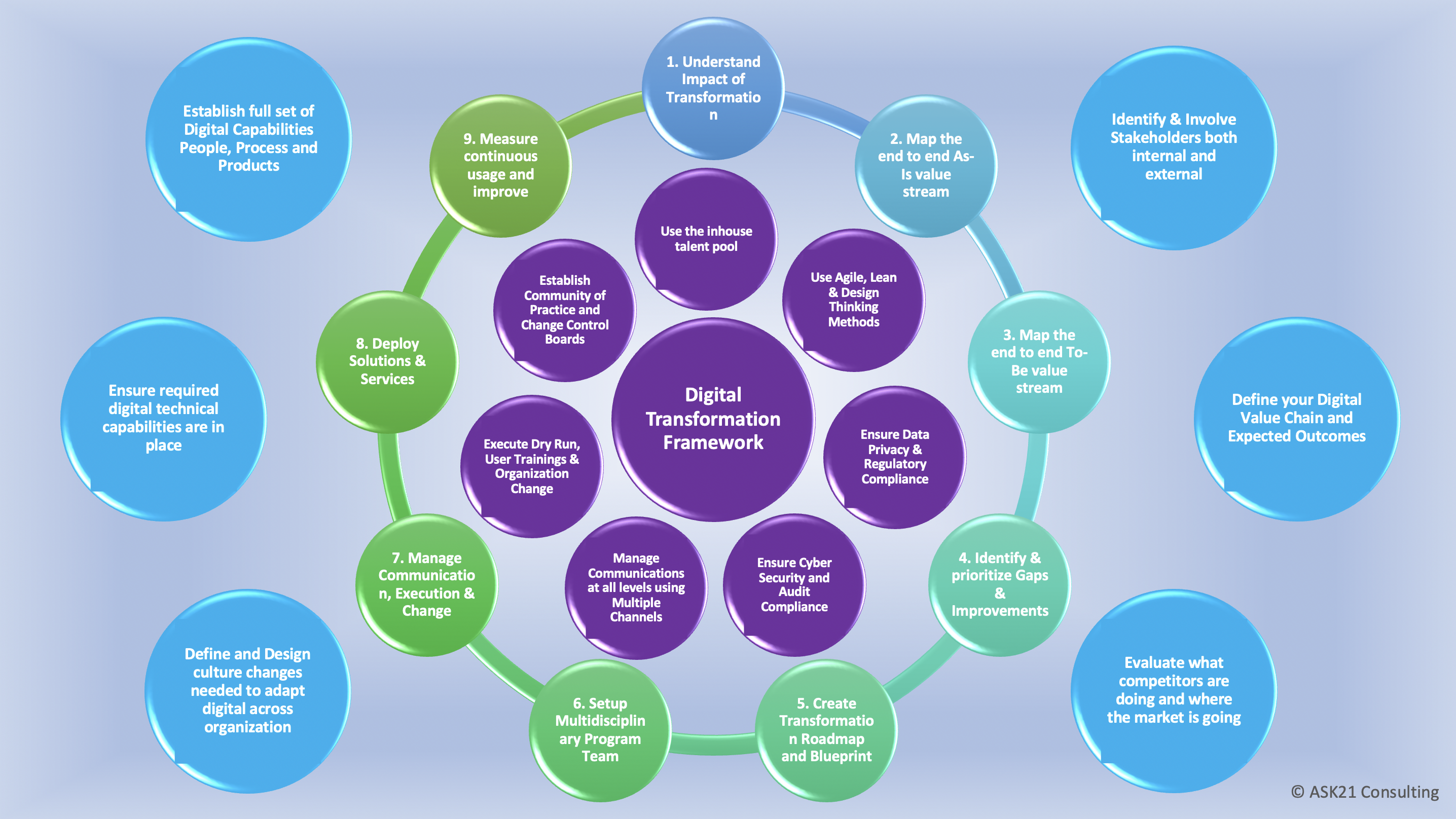
Digital Transformation Framework

Step 1: Understand Impact of Transformation – Organization must clearly articulate and know what’s in it for them, why do they need to transform and what will be its impact across the organizations, taking in account all internal and external stakeholders involved. Eventually part of this is what the board of management will use for communicating towards the entire organization.

Step 2: Map the end to end As-Is value stream – This is an important step where the organization lays down its as is value stream on how their current business works. Full End to End mapping must be done involving talents from all divisions. It will also be useful to map the processes up to 3 sub levels deep to make it meaningful to understand processes and eventually gaps and improvements.

Step 3: Map the end to end To-Be value stream – Once the As-Is flows are mapped the important and often difficult step is to map the To-Be value stream. This can be achieved by taking input and lead from external partners hired for digital transformation. It can be also achieved by identifying gaps, manual steps, Lean waste in the processes and repetitive as well as duplicate work. The To-Be process map should result in automation and standardization of work. It should improve productivity and efficiency as well as competitive technology edge.

Step 4: Create a full list of Gaps and Improvements identified – Ensure the list is prioritized and owners assigned to ensure who would own and help drive which gaps and improvements. Eventually it will be a team work and many more people including technical IT inhouse and outside team members will be involved. The prioritization will set the tone for which are the important must have items that will create most of the impact and must be done first. As the list could be long, MOSCOW method can be applied to come to a shortened must have list.

Step 5: Create Transformation Roadmap and Blueprint – The information collected from step 1 to step 4 can now be converted to a transformation roadmap and blueprint documents. As this will be a long program involving multiple projects and tasks with dependencies, it will need to be well defined and executed with Lean, Agile and Design Thinking methods. The roadmap and blueprint will also ensure all compliance and audit related activities are well covered in the scope.

Step 6: Setup Multidisciplinary Program Team – Once the roadmap and blueprints are approved, the core program team can now setup the full Multidisciplinary program team required for various phases and projects to initiate execution. Inhouse talents as well as external partners must be onboarded to form the team.

Step 7: Manage Communication, Execution & Change – Initial communication of the program roadmap and blueprint must be shared widely across the entire team. The Daily dashboards and tracking and weekly/bi-weekly steerco updates and measurement metrics along with the definition of done must be communicated. The execution standards like Agile (Scrum or Scaled Agile) and Lean methods must be well communicated and ensure the team is trained to operate seamlessly. This is also the step where most of the technical execution and readiness takes place. So this step will require a lot attention and energy from everyone in the program.

Step 8: Deploy Solutions & Services – Once various tracks and projects have completed their execution, the important step of testing, cutover and release management comes up. In this step user acceptance testing, rework and sign offs on definition of done are achieved for all projects and for the entire program as a whole. 

Cutover activities planning including data migration and phase in / phase out of systems / solutions / services is planned. User trainings are done for all. The interdependencies including exact sequence, date and time along with primary and backup owners for each cutover activity are confirmed. This also involves getting our partners ready to cutover and release. Communication of release and cutover command center for effective release management are put in place. Multiple checkpoint meetings and Go/No-Go signoffs are achieved. Point of no return is clearly mentioned and underpinned. 

Go Live is achieved and first set of end-to-end golden transactions are carried to ensure entire process, people and systems are working as expected. Upon completion of the golden transactions the ramp up towards business as usual gets kicked off and generally with in 1 to 2 weeks of go live full ramp up and business as usual stage is achieved. Alongside from the day of go live 24×7 support to fix any teething issues is put in place. All transactions are tracked and progress reported on daily basis to ensure full control and attention on priority basis to keep the business smooth. This is also the step where best teams and team members are awarded/rewarded for their efforts. Overall team’s success celebrations are done.

Step 9: Measure Continuous usage and improve – In general the program team and its support structures continue for 6 to 8 weeks post go live to ensure a full cycle of 1+ month or even 2 months are done before concluding the closure of the program. This is also the step where community for practice (CoPs) are setup for users to interact with key users and subject matter experts. CoPs are online discussion forums of specific function, division or process experts and users to interact even after the program is closed.

Change control boards are also implemented to ensure changes are submitted, reviewed and approved through a board consisting of multi-disciplinary team that can approve/reject the changes. It serves both the purposes, one it to ensure continuous improvements are done to keep the business running and second is reject any unwanted changes that can lead to Lean waste again.

The Digital Transformation Framework ensures a successful implementation of organization’s digital needs of installing a new brain that can change how the organization functions as a whole, how it innovates (thinks) and how it operates (acts) to achieve its results.

Do look out for my second article covering 9 important areas that must be taken care for effective digital transformation and to make it successful.

The What and How of becoming a Technopreneur

The word technopreneur is made of Technology and Entrepreneur. The new startups as well as existing organizations creating new innovation and products using technology is called technopreneurship.

The process of becoming a technopreneur requires entrepreneurs to know about what problem they are trying to solve, what is their value proposition, who are their primary customers, what assets and resources will be required, how will the funding and investments be taken care as well as what will be the time to market and product roadmap. 

There are several other important areas to check (e.g. competitors, regulatory compliance etc.) for a successful technopreneurship. It is easier said than done as often the devil is in the details and you require a lot of time to think through all the details.

The technopreneur’s journey can be started with following steps,

1.     Create a Lean Value Proposition Canvas – Detailing out each area and segment of the business and answering the most important questions that matter most to start.

2.     The value proposition can then be refined by presenting it to various stakeholders and taking their point of views.

3.     The next stage is to use an ideation workshop to initiate design thinking steps and execution for creating ideas, validating them and creating rapid paper prototypes, brainstorming and seeing the product from the best and worst customer’s point of views using surveys and interviews. This stage could take some time unless it is planned and timeboxed in a manner that will work well.

4.     The outputs and feedbacks received from Design Thinking stage can be fed back to further strengthen the value proposition and making it more crisp with every round of updates.

5.     Next the idea and solutions have to be presented to the board or angel investors to get their buy in to initiate the execution process.

6.     Again, execution requires a proper organization setup with right resources of each type which could take some time unless those are pre-identified in parallel which is normally not the case and might not be possible as well.

7.     The real work starts from this step when the organization starts working and must adapt Lean and Agile processes which can be flexible yet solid as a foundation to get things done.

8.     The cycle of daily, weekly and monthly progress reviews using online dashboards and decision meetings with stakeholders begin to ensure we make progress as per the plan and report issues and risks requiring action and attention from stakeholders and board members.

9.     While all this is in progress, the team needs to prepare for go-to-market strategy for launch and how to handle competition and regulations in the market. Next releases and speed to market along with desired quality are very important to make it successful.

Technopreneurs are all around us, some of them are big brands while others are in the process of becoming one and some others at start up. There are many examples (like apple, facebook, google, WhatsApp and many more) of successful technopreneurs who started and achieved great success.

Important to note that while there are several examples of successful technopreneurs, there are also many more examples of failures where technopreneurs are either ahead of time or behind time or addressing wrong market segment or having bad user experience etc.

The technopreneurship journey requires thorough checks and solid commitment to keep on going in toughest of times to make it. There is a lot from technopreneurs that went ahead of us and how they have survived the journey as it requires long term commitment and lots of trial and errors to get it right.

The entrepreneur and technopreneur lifecycles are almost similar except that technopreneur innovations, solutions and services are fully technology based and they change and transform with much larger speed then other innovations, solutions and services.

Achieve Hyper-automation using Robotics Process Automation (RPA)

Robotics process automation (RPA) is about using computer system for automating all possible repetitive and logical or rule-based tasks. These include tasks that humans have to perform repetitively daily/weekly/monthly.

RPA enabled systems and processes can automate almost all functions and industries repetitive and rule-based tasks. Important is to ensure that the tasks and business processes chosen for RPA are firm best practice and not changing often as all steps and scenarios have to be programmed and configured for successful execution.

Computer systems can be trained to execute tasks round the clock, resulting in a lot of productivity gain and time savings as many of these tasks can be done even on holidays, weekends, after office hours etc.

RPA can bring huge benefits in long run for organizations. Benefits start from the very day RPA is put to use. The benefits seen in RPA usage are as follows,

1.     Increase in productivity gain due to full process automation execution by RPA

2.     Increase in accuracy as there will be no more human errors and machine will do the activities exactly as per the rules laid down.

3.     Cost reduction as the organization will need a smaller number of people for executing the same set of tasks. 

4.     Volume of tasks won’t be an issue as it will only cost in terms of adding one or more computer system. 

5.     The entire process becomes scalable and flexible as the execution resources (computer systems) can be increased or decreased with speed within hours.

6.     Business process throughput time and turnaround become predictable, quicker and possibly increase over time as network and computer systems are getting faster and faster.

7.     RPA also ensures a full audit trail recording and error reporting by email and management report logs. This makes audit and regulatory compliance easier as all details remain fully transparent.

RPA can be envisioned as robotics in the manufacturing production lines where the robotic arms do complex assembling and product manufacturing automatically with full accuracy and agility. Robotics are used for manufacturing while RPA is used for computer systems business process automation and execution automation. RPA can be applied to many functions and areas. Here are some examples,

1.     Customer order processing – RPA can help automate execution of entire customer order entry and processing steps in online (eCommerce, B2B, B2C, D2B, D2C, EDIs etc.) as well as offline (ERP systems, POS systems, CRM systems etc.)

2.     Logistics and Delivery processing – RPA can help automate execution of entire logistics and delivery processing steps by ensuring all systems and records are well updated round the clock (7×24 hours).

3.     Month End Closing – RPA can automate execution of month end closing activities of finance team by reducing their burden of manually updating 1000s of records and reconciling them to find the gap and adjustments etc.

4.     Banking Systems – RPA can automate execution of various (like statement and account reconciliation) repetitive banking tasks by reducing workload on bank employees, allowing them to focus on customer needs.

5.     Finance systems (Payroll, Claims, Assets etc.) – RPA can automate execution of Payroll processing, claims processing, assets depreciation processing and many other processes.

6.     HR and Customer Service Systems – RPA can automate execution of customer service-related tasks and processes like call center operations, complaints processing, service center claims processing, customer insights processing etc.

7.     IT systems and support – RPA can automate execution of many IT tasks and processes like, helpdesk operations, infrastructure and system support, IT security management etc.

Like all projects RPA implementation must be also handled as a business project with clear business case, scope and goals. It’s important to upfront understand,

1.     What processes are we planning to automate?

2.     Why are we choosing these processes?

3.     How are we going to execute, for how long and how do we communicate about this?

4.     Who all need to be involved and communicated?

5.     When will we complete and measure benefits?

There are many RPA tools and organizations that help in deploying these tools. Major players as per Gartner’s magic quadrant are automation anywhere, blue prism and UiPath. Here are brief understanding of each,

1.    UiPath – It is used widely as it works smoothly with drag and drop features and built automation components reducing the need for customisation and development. It is highly preferred and used by many world known organizations for automating repetitive tasks.

2.    Automation Anywhere – Automation anywhere is owned by Microsoft and generally preferred for deployments across big enterprises. It can address wide range of complex automations. This is also largely used as its under Microsoft and equally efficient.

3.    Blue Prism – It is in many ways similar to UiPath having drag and drop features to get the automations done. It is used by medium and small enterprises for automations and it offers programming using C sharp language.

It is very important to choose a right fit for the organization keeping the long-term view in mind. As each of them have their own pros and cons in terms of features, time to market, costs etc.

RPA is not new for most organizations as all major MNCs have deployed RPA in one or the other part of their business, often more in Finance, Supply Chain, Human Resources and Information Technology divisions.

There is still a lot of room for automating repetitive tasks in all pockets of many organizations. The more we automate the more it makes the organization productive and agile allowing them to divert all their energy and focus on their customers, solutions and services.

Leading your way with Digital Transformation

Digital Transformation is often misunderstood as equivalent for technology adoption. Digital Transformation has a much bigger and broader purpose for any organization embarking on it. It is a multi-year journey and often continues even beyond the decade as the change in technology landscape continues to evolve itself rapidly.

It has become a necessity for all organizations to ensure they are continually digitally transforming as a large percentage of customers and consumers are digitally savvy and have a much more powerful mobile computer (mobile phone) in their hands. Generation X, Y and Z are comfortable using internet for searching and finding solutions and services online as their first and most important step.

The key purpose for Digital transformation is meet the need of customers and consumers, allowing them to find organizations solutions and services when they want and wherever they want it. Allowing them full flexibility of time and device and giving them ability to find, compare and choose the solutions and services that will best meet their needs.

Digital transformation impacts the very fabric of an organization by seamlessly and securely connecting all stakeholders with each other and automating various touchpoints of all stakeholders both internal and external. It needs a complete change in organization’s culture, thinking and ways of working where entire organization has to think and do things online digitally. It creates an entire digital ecosystem where organization, its supplier and customers of all types able to interact and do business using digital technology solutions and services.

The focus is largely on the outcome of all this for customers and consumers. The focus is on improving productivity, making the processes easier, seamless & automated, increasing time to market, increasing accuracy and ensuring full compliance across the end-to-end process of innovation, design, build, test, deploy, market, sell and support lifecycle of solutions and services offered by the organization.

Digital transformation in general has large benefits across the entire ecosystem for all involved stakeholders. Important is to understand that it is not a small undertaking of only some areas or divisions. It is certainly not about technology adoption. It is about bringing an end-to-end change on how any organization is designed to operate digitally and organization’s ability to adapt to the changing world of technology.

Digital transformation requires organizations to create new business models, new operating models and relook at upskilling employees or bringing new talent with desired new skills to operate the new business and operating models. The change starts from top and it requires the board of management to think and live digital. All the important organization metrics must be made digital and as real time as possible. It requires full commitment from all tiers of management staff to ensure they walk to talk of becoming digital.

Digital Transformation applies to all industries. Every industry and business sector need digital transformation. Here are some names Banking, Consumer Goods, FMCG, Healthcare, Investment, Insurance, Manufacturing, Logistics, Retail, Tours and Travel, Utilities etc. The list is long and digital transformation has been even adopted by governments to have better reach, communication and delivery of services for their citizens, business, employees and people.

Digital transformation means digital landscape and digital landscape means underlying new technology platforms, systems and gadgets that enable to seamless automation and user experience. Here are some of the new technologies used to build the digital landscape for the organization.

1.     Artificial Intelligence (AI) and Machine Learning (ML)– AI and ML systems are of many types where the systems handle complex set of data and help to get predictions and insights.

2.     Big Data and Analytics – Big Data and Analytics systems are meant to collect the data, clean it, structure it and feed it to create analytics for timely and meaningful decision making.

3.     Cloud Computing – Cloud computing platforms are generally used to deploy systems, store data and securely access them online from anywhere at any time. These are highly scalable and flexible pay per use platforms ensuring high reliability and speed.

4.     Internet of Things (IoT) – These are generally sensors and gadgets attached to product, machines and packages for tracking certain aspects and insights like usage, temperatures, date and time stamps, pictures, scanning etc.

5.     Robotics – Robotics are largely used in manufacturing and industry 4.0 digital transformation initiatives to automate production lines. Robotics are also used now a days in restaurants, food courts, warehouses, air ports and ports for automating food making, product handling (pick, pack, ships) etc.

6.     Robotics Process Automation (RPA) – Robotics process automation is used for automating business process execution. The entire process is handled by computer systems instead of any human interventions ensuring speed, scalability and accuracy.

7.     Social media and Digital marketing – Social media platforms and digital gamification are used for reaching customers through online campaigns, digital platforms and online shopping malls and hubs. It involves use of Metaverse and other gamification techniques to engage customers and sell their desirable products.

8.     Blockchain and Digital Currency – Blockchain is used in fintech for digital assets and digital currency management. Blockchain also have possible use cases in logistics, healthcare industries, and online auctions tracking and maintaining of records. Digital currency will open a lot of new opportunities for all. There is a need to move in this direction as our customers and we ourselves have been using less and less of physical currency. Everywhere we are able to pay online. Governments and monetary authorities are looking into this as it will ease the burden of printing and maintaining so much of physical currency across the world.

9.     Augmented, Virtual and Mixed Reality – Augmented, Virtual and Mixed Reality solutions open new doors for gaming, online training and learning, online try (visualize) and buy solutions. It helps create a virtual world which feels like real experience with real to life digital environments.

Digital Transformation as the name suggests is a transformation of an organization, its entire ecosystem and it’s a portfolio of offerings (products, solutions and services) using digital new technology solutions.

Many organizations have gone through digital transformation and some think it’s over for them but its far from over. It’s just the beginning and the transformation must continue as the world evolves and as the customer needs change.

Understanding Machine Learning and It’s How’s!

Machine Learning (ML) is part of artificial intelligence. In the background of most AIs there is machine learning at play. The term machine learning emerged in 1980s when computers started gaining their grounds. As the them name suggests machine learning, it is programs that help the machines learn and do statistical analysis and give results on probabilities and possible outcomes based on data.

Machine learning (ML) helps analyze large volumes of data based on several mathematical algorithms and share possible probabilities and possible outcomes within minutes. ML gives results based on algorithms and the results vary based on conditional variables and algorithm types we apply.

The results can’t be always called accurate because a lot varies based on what parameters and algorithms are applied to the data set. It also varies based on amount and quality of data used.

ML is used on large volumes of data which are impossible for humans to analyze with speed and accuracy. Machines can do this based on rules and programs set to produce results with speed. We can run the data through multiple algorithms and collect all the insights. Based on the insights collected further slice and dice can be performed and then we can decide the based way forward.

ML can also be used on any type of data, so not just text and numbers but also images and videos. In general, the ML process starts with,

1.     Cleaning the data set to ensure its consistency and no missing data. 

2.     Dividing the data set into training data set and data set for analysis.

3.     The training data set is used to train the machine learning algorithm on how to identify and what results to be expected. 

4.     The outcome of training data set is the trained model. To this model we feed the test data set to get the desired results. 

5.     The systems classify the test data set based on the patterns learned and logic used as part of the trained model.

6.     The prediction results can be verified with the trained model outcome to see the consistency. Based on the consistency the results and prediction outcomes can be accepted.

The machine learning is of 3 types. Namely Supervised Learning (SL), Unsupervised Learning (UL) and Reinforcement Learning (RL).

Supervised Learning (SL), as the name suggests, it is supervised means its trained with the labelled data set for identifying data sets and patterns to produce results based on the trained data set and other rules and algorithms to produce predictions. Supervised Learning (SL) works best for the classification problems, E.g., if we feed orange and other fruit images to the model as test data set along with the label specifying ‘its orange’ and for other fruits we ask it to label as “not orange”. Once the model is trained, we feed in the test data set with all fruits to check if it can identify and categorize fruits correctly in the outcomes.

Unsupervised Learning (UL), as the name suggests, it is unsupervised means it learns on its own from unlabeled data set. The algorithm automatically identifies various patterns in the data set and share the prediction outcomes based on the same. The full dataset if fed as input in the Unsupervised Learning (UL). UL identifies and creates its own group of data set based on various data attributes. E.g. if we feed multiple images of fruits to the data set, it can identify and group them based on attributes, like color, shape, weight, size etc. It will not know that this is a fruit or not but it will still efficiently group it and share the predictions and outcomes based on the data set attributes.

There is hybrid approach of combining Supervised and Unsupervised learning as Semi-Supervised learning where both SL and UL are used as certain attributes of dataset can be classified and trained while other remain unclassified and predicted using unsupervised learning. E.g. in the dataset if we know oranges clearly then we can train the model for identifying oranges accurately under supervised learning while all unknowns can be fed to unsupervised learning and that can group it and give predictions based on other attributes and features available in the data set.

Reinforcement Learning (RL), this works through a reward system where the system is rewarded for all right predictions and outcomes. This allows the system to learn based on its own actions that lead to rewards or penalties. Rewards are given for right predictions and penalties for wrong predictions. E.g., in a robotics factory every right action done by robot gets the reward and wrong actions gets the penalty. This allows the robotic system to learn the right and wrong actions based on the incentives (feedback) received.

Machine Learning (ML) has several algorithms and methods that are applied on the data set to build the complete model and share predictions that are impossible for human brain to manually achieve with in time limit of minutes and even hours.

Machine Learning (ML) is used for seemingly difficult predictions and probabilities to make effective decisions based on patterns identified by machine. Decisions like, 

1.     How many customers we must keep and which customer segment is most important for an organization in long term.

2.     Based on trends of past 2 decades when will be the predicted stock market crash.

3.     What age group purchases similar set of products

4.     We should tie up with which brand to combine our product bundles to increase sales

5.     Will Heart attacks increase and by what percentage

The results of the ML model can be verified using various performance metrics scores. In general, 6 performance metrics scores are checked to make a decision on viability of outcomes. The methods used are confusion matrix, F1 score, accuracy, precision, recall, and specificity.

As far as the tools are considered many of the ML capabilities are built in MS Excel. There are also standardized tools like Microsoft Azure ML, Google ML, IBM and many other preoperatory software tools. ML can be also managed using Python, R, Java, Julia, LISP programming languages.

Machine learning (ML) is heavily used in our day-to-day AI applications. ML is used by many market research, commercial, industrial organizations for identifying patterns and making difficult decisions. 

There is a lot of room for organisations for using ML to its fullest to make decisions. Opportunities are immense for all organizations and possibilities are wide spread across industries as we have big data available.

Understanding Artificial Intelligence and where it’s leading us!

It’s been almost a decade since we started recognizing the word artificial intelligence (AI) in our day-to-day life. AI has been around since many decades already but as it was more in the form known to us as computers and super computers only.

In the last decade it started to emerge more strongly as we started using artificial intelligence more widely in the form of search which after some years became voice enabled and even image enabled.

Artificial intelligence in simple terms is intelligence exhibited by machines and computers to do human like thinking, calculations, understanding and even day to day activities we carry out.

As the name suggests, artificial means not real human but it can more or less do everything that a human can do. Although we are still far from having 100% human like AI machines and robots but we are fast progressing in the direction of having it.

Artificial intelligence is of three types or we can call them having three different phases. The first one is Artificial Narrow Intelligence (ANI) followed by Artificial General Intelligence (AGI) and lastly Artificial Super Intelligence (ASI).

The ANIs (Artificial Narrow Intelligence) are initial use systems that perform normal tasks in one or two areas purely based on programmed rules. They can’t self-learn and can only execute specific tasks as per programmed. All their decisions and actions are pre-determined based on various options assigned to them. E.g., Google Translate, Email spam filter software, Chess app., Speech recognition etc.

The AGIs (Artificial General Intelligence) are more advanced than ANIs (Artificial Narrow Intelligence) and work seamlessly across multiple functional areas for problem solving, decision support and reasoning. E.g., Siri, Automatic Stock trading software that decide on multiple factors, statistics and news on when to buy and when to sell stocks for higher gains.

The ASIs (Artificial Super Intelligence) are not yet fully ready. As the name suggest super intelligence means human like abilities to multitask, decide, act, learn and relate things like humans do. There are trials ongoing and robots as well super computers are being made that can achieve this but we are still not full there and it might take still 1 to 2 decades to reach this level of AI solutions.

Artificial intelligence (AIs) solutions are very helpful in improving efficiency and effectiveness for almost all functions. Here are some examples,

1.     For industrial site solutions of robotics help improve production significantly. 

2.     For innovation and development, the solutions on product development, test automations and statistics decision-making help prepare viable solutions for meeting customer needs.

3.     For Commercial organizations, the solutions on robotics process automation, machine learning based statistical analysis for accurate decision making and real time dashboard with built automated decision guidance.

4.     For Consumers and Customers, the solutions on recommending right products based on their choices and know how in various areas and stages of life.

5.     For Customer Support, the solutions on full detailed understanding of their customer base and how to keep them as well as engage them to increase sales.

Similarly, there are also solutions based on industry specific needs. E.g., Your MD, Google DeepMind, Netflix, Snapchat, Apple Siri, Google Tools, Autonomous vehicles etc.

Artificial intelligence is used almost all of us in various shapes and forms. Simply put all our day-to-day apps we used in mobile phone and computers have AI built in to support us by enhancing our productivity and decision making.

AI has many positive sides but it also has worrying negative sides to it. The negatives are related to ethics and deception. How do we know that the AI is ethically deciding and making decisions as its all programmed, it can be designed to deceive. AIs can also be prone to hacking and manipulations of decisions and actions. There are still many open ends to AIs safe & secure usage and reliability. 

The other major worry for people is, if we automate everything with AIs and Robotics, then what will happen to current job market. There will be a significant shift of jobs needed as almost all of current manual jobs can be taken up by AIs with in this decade.

Possibilities are immense and when computers came there was a huge transition of jobs, a similar transition will take place in this decade with AIs becoming fully operational and even more when they evolve to Super Intelligence level in the coming decade.