Kaizen for Continuous Improvement

Kaizen is a Japanese word with meaning “change better” or “continuous improvement”. It is method used for continuously improving business processes and value chains through small meaningful increments which over a period of time result in big improvements across the entire value chain.

Kaizen focuses on eliminating seven types of lean wastes in the value chain. Kaizen was used for almost a century by manufacturing plants of Toyota. In the past 2 decades the usage and adoption has gone up across all business industry and sectors. The Kaizen process and workflow is fully digitized with online tools and workflows (E.g., Microsoft SharePoint Workflow).

Kaizens are also referred as following,

1.     Point Kaizen – The most commonly used kaizens are referred as point kaizen. These small improvements and doesn’t need a lot of efforts to implement while still having measurable impact.

2.     System Kaizen – As the name suggests, it relates to improvements brought to life using IT system. The second most used kaizens are system kaizens which are widely used by most of the organizations.

3.     Plane Kaizen – This is the 3rd most used Kaizen which is related to the improvements made to value stream or value chain.

Kaizen Types

If we come to discussing the types of Kaizens then there are actually five types of Kaizen methodologies, keeping in mind Kaizen means improvement (change for better) so its not necessarily small changes only but they can be large ones too:

1.     Kaizen Teian – In this type of Kaizen the improvements are done bottom up instead of top down. It means improvements start at the lowest level in the organization. For this to work the Lean management mindset (continuous improvement culture) must be already well deployed across the organization. Everyone in the organizations participates and submits their improvements to improve their work, when this is done across the entire organization, it leads to large improvement in removal of lean waste. Kaizen Teian can be called as Point Kaizen as well.

2.     Kaizen Events – Kaizen events are big and planned improvements in the value chain. These improvements are done by calling for a workshop with participants from the value stream planned for improvement. Participants work through VSM (value stream mapping) workshop to identify and prepare the plan to eliminate lean wastes. Kaizen events help improve the value chain significantly by improving efficiency, effectiveness and creating superior value for the customer.

3.     Kaikaku – Kaikaku is a radical change and it focuses on business transformation through radical changes to its value stream and value chain. It is not so much about identifying lean waste and eliminating it, instead this is about changing the entire process of how the organization does the business. It requires significant planning and focused efforts to achieve it successfully. Digital Transformation can be one of the examples of Kaikaku.

For Kaikaku’s success, these 10 commandments can be used,

i.         Throw out the traditional concept of manufacturing methods.

ii.         Think of how the new method will work; not how it won’t work.

iii.         Don’t accept excuses.

iv.         Totally deny the status quo, be ready to start new.

v.         Don’t seek perfection. A 50% implementation rate is fine as long as it is done on the spot.

vi.         Correct mistakes the moment they are found.

vii.         Problems give you a chance to use your brains.

viii.         Ask “why” five times.

ix.         Ideas from ten people are better than one person’s knowledge.

x.         Kaikaku knows no limits.

Post successful implementation of Kaikaku, continuous improvements cycle can start using Kaizen.

4.     Kakushin – Kakushin is break through innovation Kaizen. Kakushin is related to switching over the entirely new way of working in the value chain. It’s related to breakthrough innovation in how the organization functions in its value stream. It is entirely changing (not transforming) the value stream of the organization. E.g., switching production line from manual or semi-manual to a production line entirely managed by robotics and robots. Kakushin requires large risk taking to transform how an organization functions and does its business (E.g., We can say that apple has undergone Kakushin. Same can be said about Tesla cars manufacturing etc.)

5.     Kaizen Blitz – Kaizen Blitz are similar to Kaizen events but in smaller scale. Kaizen blitz are achieved by calling for small workshop of few hours to a day max to identify improvements. These improvements are then immediately taken up and deployed with in 3 to 5 days. Improvements are chosen in way that they can be done quickly with speed and deliver huge improvement.

Kaizen Principles

There are 5 Kaizen Principles that make the Kaizens efficient and effective. The 5 principles are:

1.     Know your customer needs – Focused on knowing what the customer needs and is willing to pay for, any additional process activities must be removed to make it effective and efficient.

2.     Let the Kaizen Process Flow – Embed Kaizen Culture in the organization to ensure everyone is involved in cleaning up their work processes and eliminating waste from the entire value chain.

3.     Go to Gemba – Go to Gemba means visit the place where the action is to find the improvements needed.

4.     Empower People – Empower people in the team to participate, submit kaizens and to track and measure improvements using tools.

5.     Be Transparent – Be transparent in progress made and sharing the results of before and after submission of Kaizens.
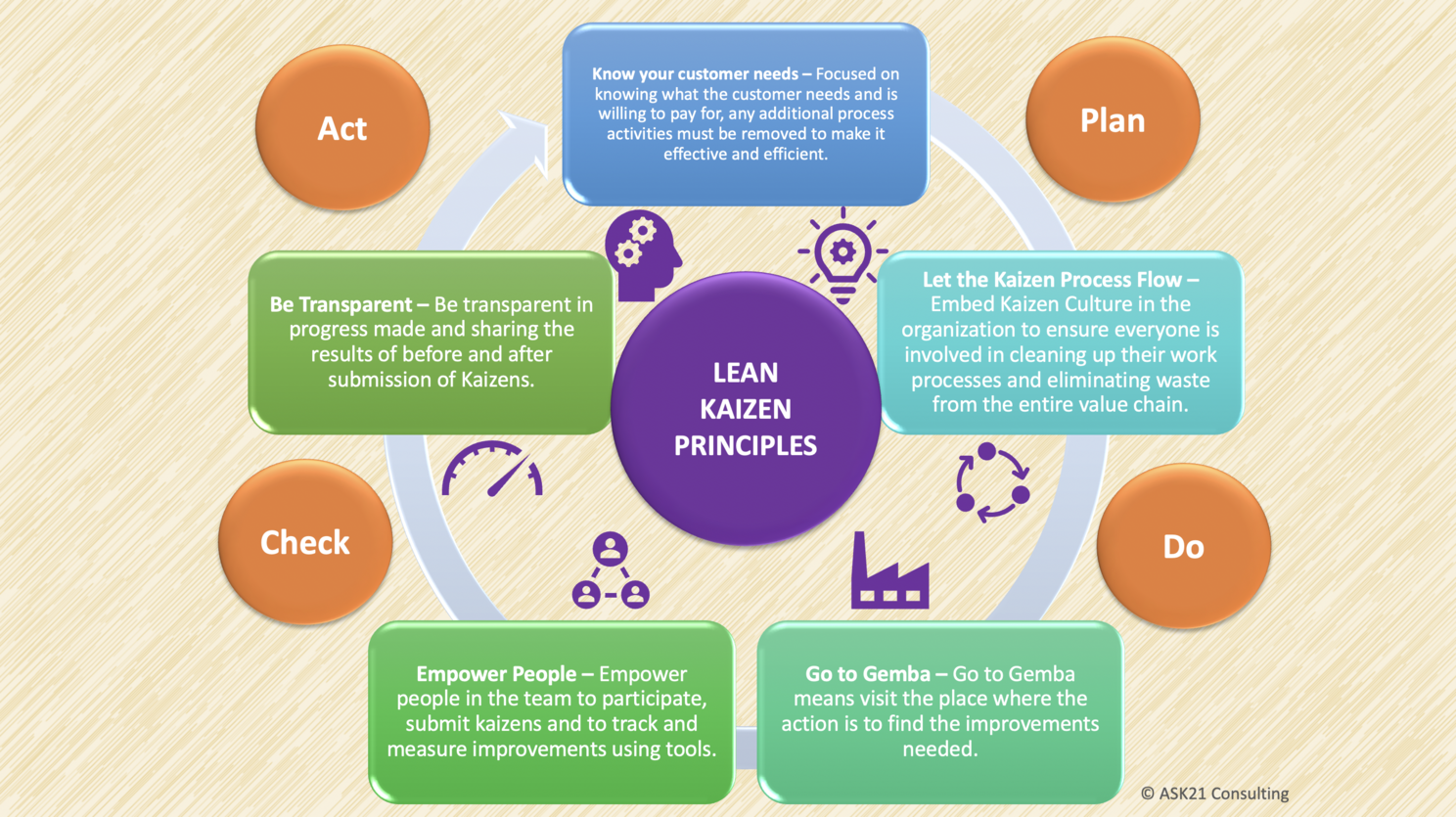
Kaizen Principles

Kaizen Process Flow

Kaizens can be managed using the following simple process steps,

1.     Identify the process and area of improvement

2.     Analyze the process and its current performance

3.     Identify & document wastes (gaps)

4.     Identify & document improvements

5.     Complete Kaizen plan, review and approvals for execution

6.     Execute and Test Kaizen Changes

7.     Implement tested improvement changes

8.     Measure results and report current vs new performance gains

9.     Mark the Kaizen as completed

10.  Maintain continuous improvement

Kaizen Process Flow and Tools

Kaizen Tools (Methods and Approaches)

For making Kaizens more effective and efficient several effective methodologies and approaches must be applied. Here are the methods and approaches that can be used,

i.         The 5 W + H Model – Use 5 the Why model (Who, What, Where, When, Why and How) for identifying the root cause, gaps and improvements.

ii.         Lean Wastes – Use TIMWOOD (Transportation, Inventory, Motion, Waiting, Over production, Over processing and Defects) waste identification to identify waste types and related improvements.

iii.         The Deming Cycle – Use Deming’s PDCA (Plan Do Check Act) cycle for the  effective execution of Kaizens.

iv.         The 5 S Framework – Use the Lean 5S framework (Seiri, Seiton, Seiso, Seiketsu, Shitsuke).

·       Seiri (Sort) – Sort only what is needed where is needed.

·       Seiton (Simplify) – A place for everything and everything in its place.

·       Seiso (Sweep) – Clean the workspace and keep it clean.

·       Seiketsu (Standardize) – Standardize the first three “S.”

·       Shitsuke (Sustain) – Stick to the first 4S.

v.         Ishikawa Method – Use the Ishikawa method of applying 5M’s (machine, method, material, man/mind power, and measurement/medium)

vi.         Lean Management 6P Method – Use the 6P method (Policy, Process, People, Plant, Program & Product) of Lean Management

vii.         Kanban Visualization Board – Use Kanban board for kaizen implementation actions tracking and monitoring.

Kaizen Template

A standard Kaizen template is useful for effective documentation and reviews. Here is simple sample template overview,

Kaizen Template

Kaizen Benefits

Kaizen culture and improvements have many benefits for the organization. Here is a quick overview of benefits,

i.         Elimination of waste in the value chain

ii.         Improved effectiveness and efficiency

iii.         Productivity gain across the organization

iv.         Sharing and use of best practices

v.         Costs reduction due to elimination of waste

vi.         Improved quality of outcomes and outputs

vii.         Improved customer experience

viii.         Better value creation for the customer

ix.         Improved teamwork and employee engagement

Once the whole organization starts to think about eliminating waste at their levels and finding better ways to do things, their productivity goes up significantly, quality of products/solutions/services increase, value creation for customer gets better, costs reduce and employee engagement goes up.

Kaizen is more of culture & mindset than just a framework or tool of Lean Management. Kaizen works well and result in massive improvements across the organization’s value chain delivering superior value to the customer.

Value Stream Mapping for Lean Management

Value stream mapping (VSM) is a lean management method and tool for analyzing the business process and/or the entire value chain (value stream) of the business. It consists of core business process review and optimization from its current state to future state by eliminating waste in the process.

VSM can be also considered as a process flow map consisting of product, people and tools reflected across the process stages including issues and gaps identification. It is generally drawn with a group of people that operate as part of the flow and play a role in managing respective process stage deliverables (outcomes). The process selected must be focused on delivering certain specific value to the customer.

The core purpose of VSM is to identify and remove waste in the value chain and in return increasing efficiency and effectiveness of the value chain. By removing waste the value chain becomes optimized and faster than before resulting in productivity gain and achieving its desired outcomes with in lesser time and reduced number of resources.

Lean focuses on creating superior value for the customer while still using fewer resources to get it done. In turn ensuring the entire value chain is streamlined for efficient performance and delivery.

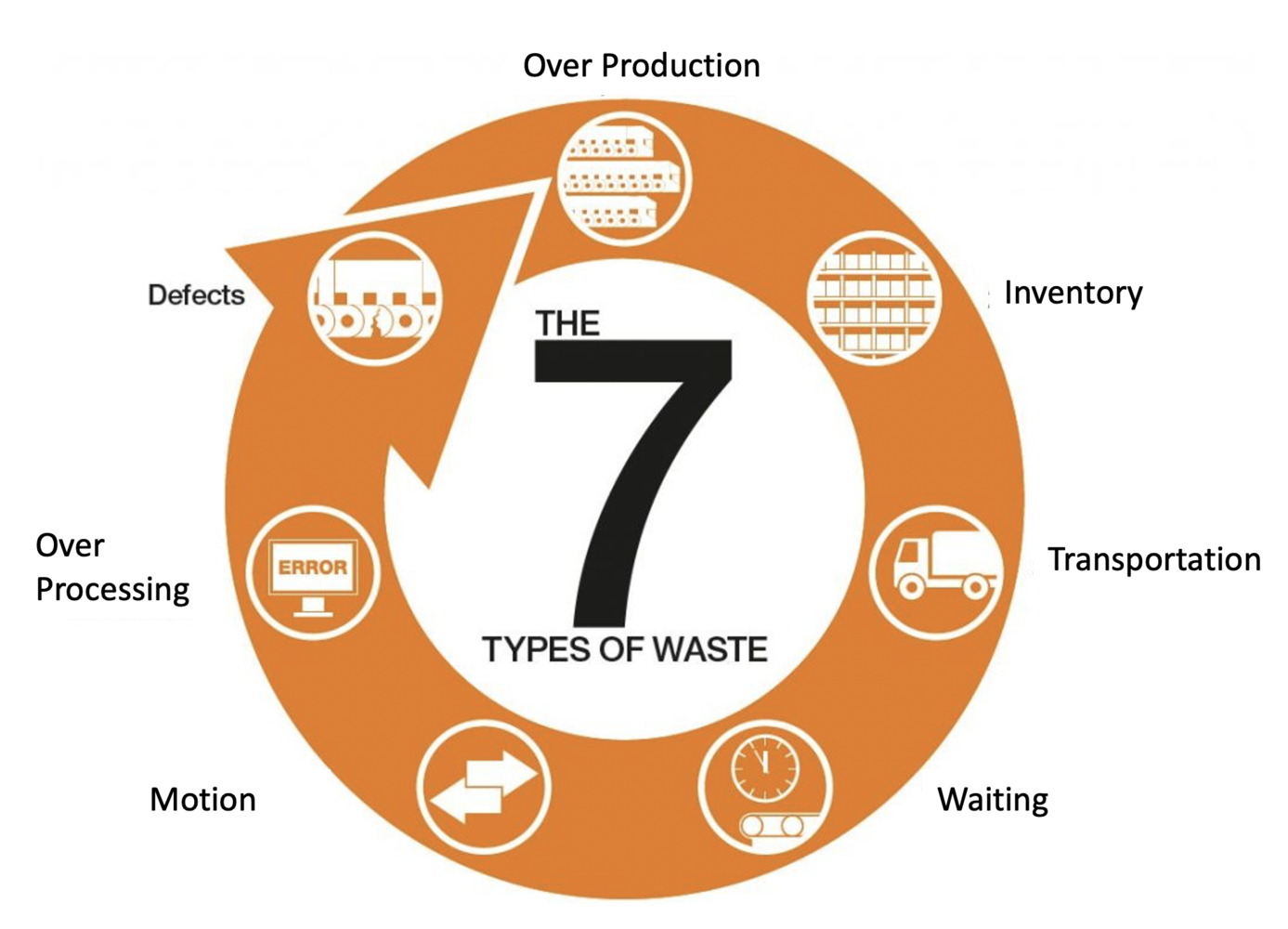
Identifying and eliminating waste is the core part of lean management. There are mainly seven types of waste in Lean management namely,

1.     Transportation – Transportation waste is related to any movement of materials, supplies and resources that does not add any value to delivering customer needs. E.g., Extra trucks, fork lifts, unnecessary movement of materials and supplies etc.

2.     Inventory – Inventory waste is related to any excess supplies that does not add any value to delivering customer needs. E.g., Excess stocks storage, Excess stock at production lines, Excess stocks in warehouse etc.

3.     Motion – Motion waste is attached to any unnecessary movement of resources, people and machines that does not add any value to delivering customer needs. E.g. People movements without need, machine movements without need, back and forth movement to get tools or parts resulting in waste of time etc.

4.     Wating – Waiting waste is attached to long periods of elapsed time waiting between tasks and stages for people, machine, materials that does not add any value to delivering customer needs. E.g., People waiting for machine or parts, People waiting for each other to start work, Poor planning having too much free time in the plan etc.

5.     Over Production – Over Production is attached to too much advance production of goods that are not requested by customer. E.g., Poor demand planning, Too fast production or advance production etc.

6.     Over Processing – Over Processing is attached to additional efforts put on task that does not add any customer to meeting customer needs. E.g. too many approvals for each request, endless analysis of needs etc.

7.     Defect – Defect is attached to rework needed to resolve defect in the product or service to meet customer needs. E.g. Product quality issues, non-standard work processes, no clarity and checks on customer needs etc.

TIMWOOD

While there are mostly only seven types of waste in the process, in real life situations there could waste in the process related to systems as well, E.g. Unsecured system, Wrong authorizations etc.

As VSM started as part of Lean its primary use has started in manufacturing and industrial processes. From past decade VSM has been used across all business sectors and divisions, E.g., Healthcare, Consumer goods, IT, Supply chain management, Finance, Customer Service, Logistics etc.

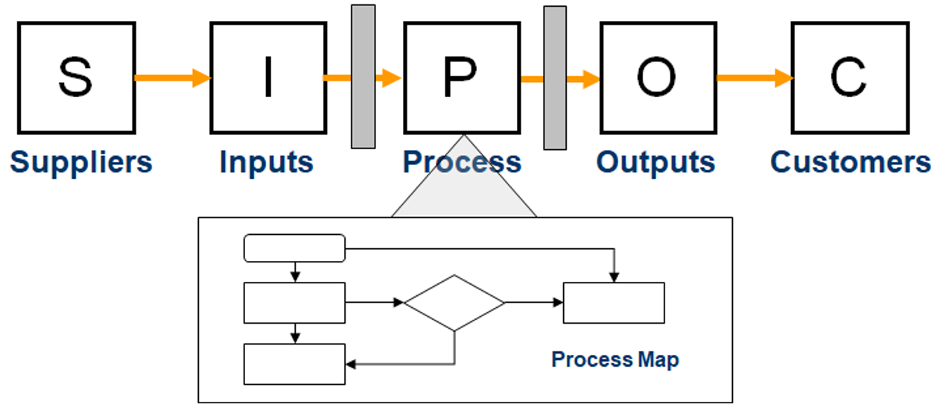
Value stream mapping starts with the use of SIPOC method considering Suppliers, Inputs, Process, Outputs and Customers are fully covered in the process map and reviewed. SIPOC is a high level view of a process consisting of Suppliers, Inputs, Process, Outputs and Customers.

SIPOC

Here is a brief overview of VSM process mapping model template overview as per Lean standard, with brief explanations on how to create it,

Lean VSM Model

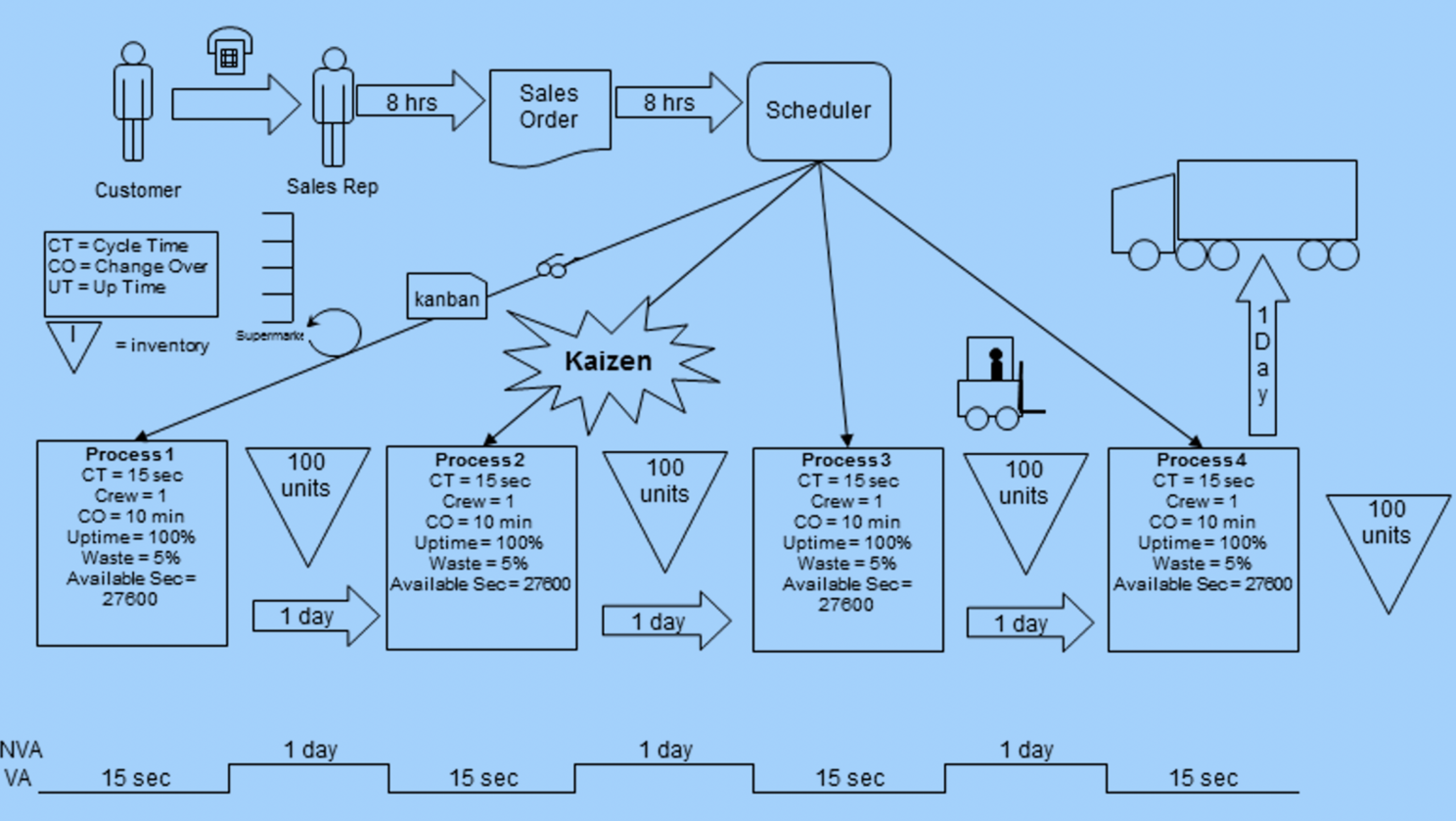
Here is a brief overview of VSM process mapping model example overview as per Lean standard,

VSM Process Map Example

How is VSM arranged

VSM consists of all the key stakeholders of the value stream at each stage. It is generally arranged as a half day to 3 days workshop depending on the size and complexity of the value stream mapping.

The process is initiated with the current process map which starts with ensuring the need for VSM is clear for every one involved.

For making the VSM need clear to all, before the workshop a core team arranging the VSM creates a VSM charter consisting of a one-page overview (similar to project charter) specifying the problem, purpose, who will lead the session, who needs to be involved, who is sponsoring etc.

Here is formal process steps for achieving VSM,

VSM Process

1.     Define the need – This step focuses on defining the need for value stream mapping session. It includes identifying stakeholders, define VSM charter, planning the event schedule and participants, complete all the preparations (like high level process views, logistics, prints, post its, markers, stickers) etc.

2.     Map The Current State – This stage starts in the VSM workshop where the team begins with,

a.     High level SIPOC process overview specifying process stakeholders, inputs, output and major steps. This helps everyone understand the current state at high level easily.

b.     Next the team starts working on detailing out entire value chain with more granular details like who is involved, what is the throughput time, what gaps or issues are faced, what is done well and what needs improvement.

c.     The focus is always on process and delivering value to customer, there is no pin pointing on any individual or team names.

d.     Lean wastes in the process are identified and documented along with possible action.

e.     The process is managed using post its and stickers for voting as well as capturing inputs.

f.      At the end of the day or during breaks the core team of process or VSM leads collate all the inputs either as pictures or even electronically drawing it and capturing possible actions.

3.     Create The Future State – This stage starts in the VSM workshop part 2 and sometimes day 2, where the team begins with,

a.     Creating the future state map together as a team. The major steps might be same or changed or reduced based on current state see.

b.     The team collectively goes through the lean wastes identified and how those can be removed to make the process (value chain) effective and efficient.

c.     The future state can also be largely automating all possible non value added manual steps in the value chain and hence achieving improved speed with reduced resources needed to manage.

d.     The process is managed using post its and stickers for voting as well as capturing inputs.

e.     At the end of the day or during breaks the core team of process or VSM leads collate all the inputs either as pictures or even electronically drawing it and capturing possible actions.

4.     Prepare the Implementation Plan – This stage starts in the VSM workshop part 3 and sometimes day 3, where the team begins with,

a.     Reviewing the action plan and ensuring each action has an owner and date attached to it.

b.     The team also prioritizes the actions in order of which action will create how much value for the customer.

c.     The team also prepares the high-level future state readiness schedule with owners and dates for completion.

d.     Both the action plan and future state readiness schedule are agreed with all participants of the workshop and the stakeholders.

e.     The VSM leads, work out the report out deck capturing full workshop details inputs, outputs and actions moving forward. Part of the deck is also the costs and resources needed, work cadence and reporting schedule post workshop.

This marks the end of the workshop but the actual work starts post workshop to close the gaps and implement the future state process flow. The team continues the cadence and implements the future state. Post that continuous improvement cycle starts with Kaizen, Daily Management and PDCA (Plan Do Check Act) cycle.

The VSM sessions are revisited every 9 to 12 months to review and improve the process value chain continuously to adapt and deliver superior value to the customer.

VSM has many benefits for the organization. VSM Benefits include, bringing people together as one team, improved understanding of the value chain and what matters most for the customer, removal and reduction of lean waste across the value chain.

Lean Management

Lean management is a framework for reducing waste in the process of delivering value for the customer(s). Lean thinking concept and framework came to existence in the 1990s. It became largely popular and adopted by most organizations in the last decade. Manufacturing plants adhered to lean thinking and management, way back since the 1990s decade.

It works on the philosophy of providing value to the customer through value creation process consisting of zero waste. It reduces costs, improves speed of delivery with quality output by getting rid of all non-value added activities in the process that the customer is not willing to pay. It is not a cost reduction program but it focuses on optimising the entire end to end value chain of the organization.

Lean management is largely related to creating a lean culture across the entire end to end value chain process of the organization to deliver superior value for the customer and reduce non value added activities that the customer is not willing to pay. By doing this enhance and optimize the entire end to end value chain, reduce costs and improve quality. Also freeing up time for people and resources to do more meaningful work that matters most for creating value for its customers.

Lean management opens doors for organizations that seek continuous improvement, organizations that want no waste manufacturing and for organizations and divisions that want their value chain processes improved to deliver superior value to the customers.

Lean focuses on identifying the waste in the process and uses five principles namely,

Lean Principles

1. Identify Value – Identifying value is attached to understanding that the customer want quality delivery and doesn’t want to pay for any waste along the entire process in the organization.

2. Map the Value Stream – Mapping the end to end value stream along with the time and resources it takes at each step. This helps in identifying and eliminating the waste (E.g. waiting time, time lapse etc.)

3. Create Flow – Creating the flow focuses on ensuring just in time creation and delivery. Organizations should not continuously create the flow and produce products, rather the flow must be created and kept efficient to delivery based on actual demand of the customer. Thus reducing the over production, transportation and storage cost burdens.

4. Establish Pull – Establish pull is also attached to just in time delivery thinking. Across the value chain the work must be done based on pull system to ensure based on actual need the work is done and not endlessly.

5. Seek Perfection – Seeking perfection is attached to continuous improvement across the entire end to end value chain. These improvements can be small size incremental changes to eliminate waste and optimize process. These improvements are done using Kaizen. Kaizen ensure lean thinking and culture get deeply rooted in the organization and people making it second nature to think lean.

Lean focuses on creating superior value for the customer while still using fewer resources to get it done. In turn ensuring the entire value chain is streamlined for efficient performance and delivery.

Identifying and eliminating waste is the core part of lean management. There are mainly seven types of waste in Lean management namely,

1. Transportation – Transportation waste is related to any movement of materials, supplies and resources that does not add any value to delivering customer needs. E.g., Extra trucks, fork lifts, unnecessary movement of materials and supplies etc.

2. Inventory – Inventory waste is related to any excess supplies that does not add any value to delivering customer needs. E.g., Excess stocks storage, Excess stock at production lines, Excess stocks in warehouse etc.

3. Motion – Motion waste is attached to any unnecessary movement of resources, people and machines that does not add any value to delivering customer needs. E.g. People movements without need, machine movements without need, back and forth movement to get tools or parts resulting in waste of time etc.

4. Wating – Waiting waste is attached to long periods of elapsed time waiting between tasks and stages for people, machine, materials that does not add any value to delivering customer needs. E.g., People waiting for machine or parts, People waiting for each other to start work, Poor planning having too much free time in the plan etc.

5. Over Production – Over Production is attached to too much advance production of goods that are not requested by customer. E.g., Poor demand planning, Too fast production or advance production etc.

6. Over Processing – Over Processing is attached to additional efforts put on task that does not add any customer to meeting customer needs. E.g. too many approvals for each request, endless analysis of needs etc.

7. Defect – Defect is attached to rework needed to resolve defect in the product or service to meet customer needs. E.g. Product quality issues, non-standard work processes, no clarity and checks on customer needs etc.

Lean Wastes

While there are mostly only seven types of waste in the process, in real life situations there could waste in the process related to systems as well, E.g. Unsecured system, Wrong authorizations etc.

Lean uses various tools to manage wastes. Here is a list of them with one liners,

1. 5S + 1 – Consists of Seiri (sort), Seiton (Simplify), Seiso (Sweep), Seiketsu (Standardize), Shitsuke (Sustain) and Safety.

a.     Seiri (Sort) – Sort only what is needed where is needed.

b.     Seiton (Simplify) – A place for everything and everything in its place.

c.     Seiso (Sweep) – Clean the workspace and keep it clean.

d.     Seiketsu (Standardize) – Standardize the first three “S.”

e.     Shitsuke (Sustain) – Stick to the first 4S.

f.      Safety – Provide a safety environment for everybody.

2. Value Stream Mapping – Value stream mapping is the process of full end to end value chain mapping of current state and future state process. The emphasis is on identifying and eliminating waste in the process to make it optimised and efficient to deliver superior value to the customer.

3. Kaizen – Kaizen is used for continuous improvement across the entire value chain. Improvements are generally small and incremental. Kaizen tools like PDCA (Plan Do Check Act) cycle, 5 Whys, Ishikawa diagrams are used.

4. Kaizen Blitz – Kaizen blitz is also called as Kaikaku, it is short timescale kaizen. Focused on events, small and rapid improvements.

5. Takt – Takt time is used for pull scheduling and improving efficiency.

6. Jidoka – Jidoka is used for improving quality at source through Autonomation (Intelligent automation) as well as for defects and alerting.

7. Kanban – Kanban is card based system for just in time scheduling for efficient pull system.

8. Poka-yoke – Used for defect prevention of three types (contact, fixed value and motion)

9. SMED – Single-Minute-Exchange of Die – Used for quick changeover of dies for improving the flow.

Lean also has problem solving and daily management tools for effective problem identification and resolutions while daily management ensure adherence and tracking of metrics for improving processes and results with close daily monitoring cadence.

Lean management can applied to all industries and sectors as well as all business functions and divisions. Lean is cultural change where the entire organization adheres to continuous improvement mindset by using Lean management principles and tools.

Enterprise wide agile with Scaled Agile Framework (SAFe)

Agile frameworks like scrum can only serve agile project management and agile product development to some extent. But when it comes to apply agile across the entire organization, a different approach and framework needs to be used.

The scaled agile framework is used as enterprise level agile framework by large organizations (Multi-National Corporations). It addresses the enterprise level portfolios, programs and projects management approach and guidelines.

The scaled agile framework (SAFe) consists of its prescribed principles, values, processes and templates. The roles used in the framework upto the level of projects are same as scrum. The product manager, scrum master and scrum team remain, but it also adds more roles and people to take care of scaling agile for the entire organization.

The scaled agile framework was created in the last decade and it has gained popularity in past 5-6 years. The adoption and usage increased as SAFe still complies with many of the agile scrum mindset and methods. SAFe is also adopted largely as it helps the entire organization adoption and not just some pockets and divisions. It covers the entire portfolio, programs and projects including embedding important parts of lean, Kanban and agile way of working across the organization.

The scaled agile framework prescribes adherence to 5 core values and 10 principles for it to work smoothly in the organization,

Core Values of SAFe Framework,

1.     Alignment – Alignment of priorities, purpose and goals across the portfolio ensuring right sizing of resources to fulfilling portfolio needs.

2.     Built-In Quality – Ensure clearly articulated “Definition of Done” at all levels of work. Ensuring quality is given importance for the first-time right delivery.

3.     Transparency – Full transparency on progress and updates across the entire portfolio.

4.     Program Execution – Focus on efficient execution and delivering results that will create business value.

5.     Leadership – Lead the organization and team with lean and agile leadership mindset. Ensure the core values and principles of lean and agile are well understood and embedded across entire organization.

Key Principles of SAFe Framework,

1.     Take an economic view – Operate with lean and agile mindset, adhering to lean budget and agile delivery with time box approach. Ensure what creates value gets prioritized and delivered first.

2.     Apply systems thinking – Systems thinking and use of value stream mapping to understand dependencies, gaps and waste is important.

3.     Assume variability; preserve options – SAFe prescribes maintaining multiple design options for long to ensure easier switch to new options during execution. This allows the organization to adapt the right path as it learns what will work best from the execution deliverables.

4.     Build incrementally with fast, integrated learning cycles – It is important that the learning and adaption is done faster by the organization. The team must build with speed (timeboxing) and have faster learning loops and feedbacks to adapt and change on the move.

5.     Base milestones on objective evaluation of working systems – The working systems results must be shared with stakeholders to evaluate if the objective is really met by the team.

6.     Visualize and limit WIP, reduce batch sizes, and manage queue lengths – Visualizing and limiting work in progress is Lean Kanban methods to check and limit how much work can be done at each stage and pay priority attention to the stages where work in piling up.

7.     Apply cadence, synchronize with cross-domain planning – Applying a standard cadence and cross-domain synchronizing helps ensure progress is closely tracked and reported as well as dependencies and issues are identified and resolved with speed.

8.     Unlock the intrinsic motivation of knowledge workers – Empower and motivate the team members to unlock their full potential and bring their best to work.

9.     Decentralize decision-making – Part of empowerment is also to ensure decentralize decision making. Allow the team to make decisions for their areas while still maintaining some control. Step in only where leader has to make the decision.

10.  Organize around value – All work must be done to ensure there is full focus on creatin value. Prioritize things that create more value and focus on delivering them first time right with speed and quality.

Organizations can apply and adapt to scaled agile framework (SAFe) in different stages,

1.     Essential SAFe – Applied and used for individual projects and products management. Here is a quick overview of the same.

Essential SAFe

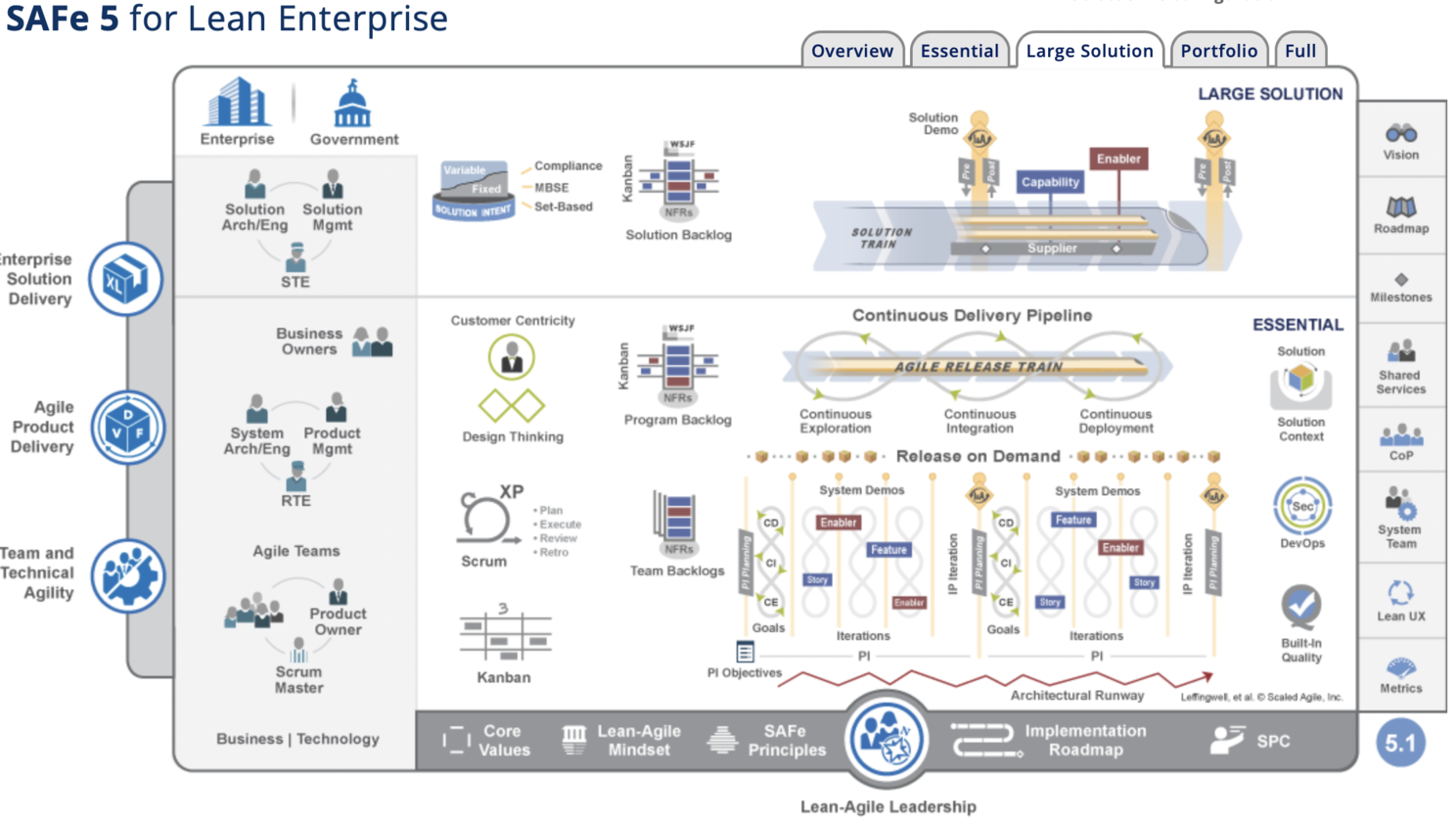
2.     Large Solution SAFe – Applied and used for Programs management referred as large solutions. Here is a quick overview of the same.

Large Solution SAFe

3.     Portfolio SAFe – Applied and used for entire Portfolio management consisting for programs and projects. Here is a quick overview of the same.

Portfolio SAFe

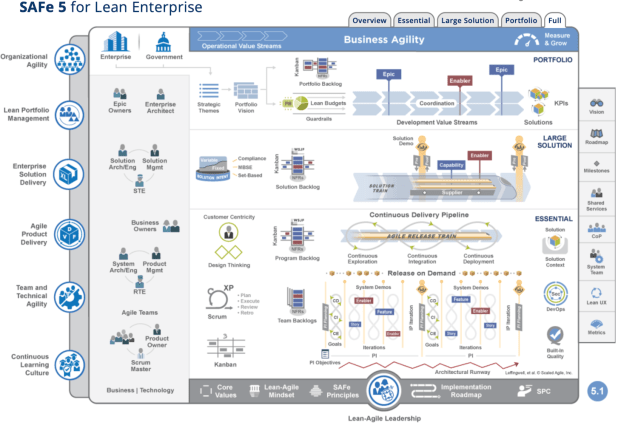
4.     Full SAFe – Applied and used for managing entire organization (mission, vision, strategy) including portfolio, programs, products and projects management. Here is a quick overview of the same.

No alt text provided for this image

Agile Kanban Framework

Kanban system was created by Taiichi Ohno from Toyota. The purpose was to have a card system for Just in time (JIT) lean manufacturing on the product floor. The idea originated to ensure short cycles of production based on actual demand with speed and accuracy.

It involved ensuring the factories spare parts (from suppliers) and finished goods (on the shop floor and warehouse) are just in time received and processed based on actual demand. This reduced the need for stocking of parts as well as finished goods by the manufacturing units. It also reduced all the resources costs to manage all the unwanted additional resources.

The Kanban system was made in such a way that at each stage of the production line the inventory is maintained as per the capacity limits. Any ups and downs are reported and addressed to ensure the end-to-end system remains smooth. The whole system worked based on bins and card system. The bin consisted of parts and the cards represented the number of parts requested at what time at which point etc.

Kanban prescribes a strict set of rules to be adhered to ensure it functioned well. The rules were as per below,

1.     Every process must create request (Kanban) to its suppliers only when it has used all its existing supplies.

2.     Quality and Sequence of incoming requests takes precedence and production is strictly followed based on incoming requests.

3.     Without a formal request, no shipments and transports are allowed.

4.     The items transported must have the request cards attached to ensure full transparency.

5.     Quality is of utmost importance so no defective parts should be sent as they will impact the production and finished goods.

6.     If there are pending requests above the threshold limit setup for the production line then those would need to be addressed on priority as they will impact production throughput.

Over the past decade the entire Kanban systems of cards and bins have been computerised by all manufacturing plants worldwide. In many ways the manufacturing Kanban systems are also integrated to enterprise resource planning systems (ERP). The computerised Kanban systems use messages, bar codes, scanners, emails and systems.

In the electronics Kanban system the bins interact with each other through the electronic cards specifying the parts, the inventory quantity, time slot and stage etc. There are two type of Kanban systems in the manufacturing plant,

Production Kanban: The production Kanban produces a fixed amount of parts or products as per the requests received and the parts are placed the requested bin consisting the Kanban request.

Transportation Kanban: The transportation Kanban as the names suggested related to the transportation of the requested parts. It is used to ensure full container loads are transported to the requested production workstations.

In the past 7 to 8 years the Kanban framework for Agile product, project, program and portfolio management has been introduced and is used by several organizations worldwide.

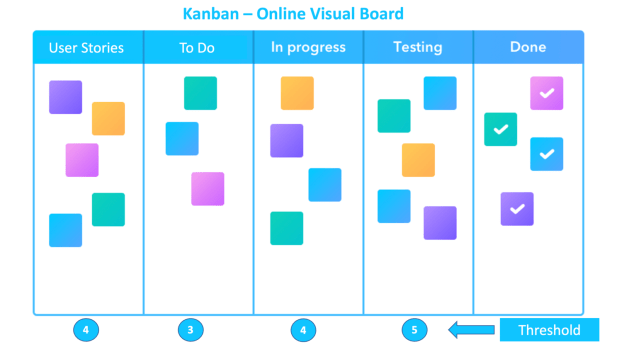
The Agile Kanban Framework works with visual dashboards consisting of Agile stages and progress update. Each stage also has a threshold which when crossed, requires attention and resolution to avoid it becoming a bottleneck. The steps can be defined as follows,

Kanban Visual Dashboard

1.     We can consider the visual board as a workflow consisting of electronics cards (look like post it notes).

2.     The cards are actually user stories that need to be developed, tested and delivered.

3.     The stages and stage names can be altered as per the product, project or program team needs.

4.     Each stage (E.g. User Stories, To Do, In Progress, Testing and Done) has its own threshold based on the upper capacity of that stage resources. The stages can be also taken as columns in the swim lane of workflow (flow of work/cards).

5.     The cards are moved from one stage to the next by the respective team member or owner of the Kanban board.

6.     The board helps to visualize progress of various stories as well as track any bottlenecks requiring attention (e.g., in the Testing stage if there are more cards waiting then the Threshold, then it points the attention to resolve any issues faced to speed up testing)

7.     Threshold is nothing but maximum amount of work the respective stage team can manage. So if a stage says 5, it means the maximum number of cards (user stories or tasks) the team can manage is 5 and anything beyond that would become a bottleneck.

8.     If more than one stage crosses their maximum threshold then the work is stopped and all attention is given to the two stages to clear the bottleneck and backlog.

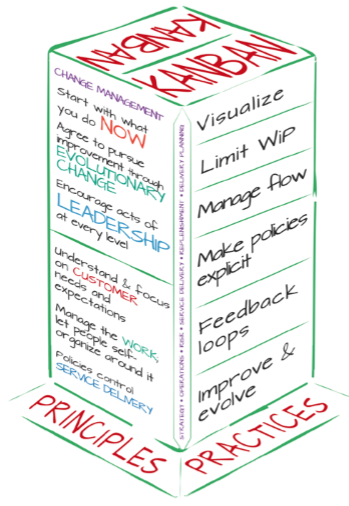
Here is a glance overview of Kanban principles and practices prescribed by Kanban university,

Kanban Principles by Kanban University

Kanban for Agile project management is more simpler than Scrum or any other Agile framework. This is because it works with a simple visual dashboard and requires no stipulated roles. The team decides how many stages and what roles they will need to operate the dashboard. Kanban is considered a continuous process and so it is not bound by project management principles. Instead it works on its principles of workflow with push and pull mechanism to move tasks across the board to completion.

This makes the Kanban approach effective but more relaxed and open ended while for agile there is timebox approach and speed are necessary. So to make Kanban based agile product, project and program management more effective and efficient, a hybrid approach is used by many organizations.

One such hybrid approach is called Scrumban which is mixture of Agile Scrum and Kanban Frameworks. The combination improves the efficiency of both the models. Scrumban consists of Scrum User stories, Sprint planning, Sprint reviews, along with Kanban principles of visual dashboard for progress tracking, push – pull mechanism to move tasks, work in progress threshold limits and just in time availability.

It also helps tighten the loose end on time using timebox approach. Scrumban removes all Scrum roles and follows Kanban principle of every one is considered to be at same level in the team.

Here is a quick overview showing comparison of Scrum, Kanban and Scrumban Frameworks.

Scrum Kanban Scrumban Comparison

In a similar manner, scaled agile framework (SAFE) has Kanban applied to its portfolio, program and project management stages to improve its efficiency, flexibility and visibility of progress across the enterprise.

Kanban agile project management can be electronically achieved with ease using solutions and application platforms like Jira, Trello, Monday and Kanban flow. Jira and Trello are the best platforms for online agile project management.

Kanban is widely recognised and started two to three decades back for Lean JIT (Just in time) Manufacturing. The adoption of Kanban for Agile project management is easier as many organizations already use it for their manufacturing sites. The Hybrid approach of combining Agile and Kanban Frameworks allows new opportunities for more flexibility and scalability in product, project and program deliveries.

Agile Scrum Framework

Scrum is an agile project management framework that was developed for speedy software development in 90s. The Agile Scrum framework started being used from 2001. It became largely famous and almost every organization’s IT teams have started using it from 2011.

The framework is not just used for IT projects but it’s also used by business projects due to its ease of use, empowering methods, flexibility and speedy progress and delivery. There are many Agile Frameworks but the one largely used by all is Scrum. Here is the list of current famous five Agile frameworks used for project management, program management, Portfolio management and software development worldwide.

1. Scrum and Scrum @ Scale – Used for Projects, Program and Product Management.

2. Scaled Agile Framework (SAFe) – Used for Projects, Program, Product and Portfolio Management at Enterprise level.

3. Large Scale Scrum (LeSS) – Used for Large Scale Program Management at Enterprise level

4. Disciplined Agile (DA) – Used at Enterprise Level

5. Enterprise / Portfolio Kanban – Used for Projects, Program, Product and Portfolio Management at Enterprise level.

Let’s get back to Scrum. The Scrum term was introduced by Hirotaka Takeuchi and Ikujiro Nonaka for product development. In the millennium decade the Scrum Alliance was formed by Schwaber and team. This is when Scrum came to the corporate world for adoption and use for project management. As the years passed we moved in the information economy.

In the last decade adoption of Agile Scrum went up across the world but along the line also the need for how to scale it for the entire enterprise increased. This is when in last 7 years several agile frameworks emerged for adoption at enterprise level. Scrum remained in use for projects and programs while new agile frameworks like Scaled Agile Framework (SAFe) became more famous and adopted by many enterprises across the world.

Now let’s focus on understanding Scrum Framework and how it works,

The Agile Scrum Framework

The Scrum Framework is relatively easily formed and consists of roles (team), product features, meetings and deliverables. The entire project is done using small sprints to ensure focus, timeboxing and speedy delivery of features in every sprint. Let’s understand the scrum roles first then we can move into product features, meetings and deliverables.

Scrum Roles – Scrum consists of 3 roles. The product owner, scrum master and the team.

1.     Product Owner – Product owner is the most important role of scrum team. The product owner as the name suggests owns the product, project or program. The product owner has the product, project or program vision. The product owner is also the sponsor. The product owner defines what is important and must be delivered first and what should be delivered in what order. The product owner supports the entire team in ensure they understand what deliverables and features are required. The product owner is generally the business owner or sponsor and sometimes the business owner’s delegate who understands the business needs clearly and able to decide and drive them.

2.     Scrum Master – The scrum master is second most important role of the scrum team. The scrum master is normally one of the team members who is well respected and who can work well with all the team members. The primary job of the scrum master is to remove obstacles and impediments from team members work. The scrum master is also responsible to discuss daily progress and issues resolution.

3.     Scrum Team – The scrum team consists of all the members of the team. This includes every role needed for the project and the respective sprint. The scrum team members are empowered to choose the features and stories they want to work on in the project. The scrum team updates their daily progress and issues and impediments in the scrum meeting.

Agile Product Artefacts – The scrum framework doesn’t work with any large documentation and knowing every detail of the product upfront. This is what makes it easier and flexible to start and change as the team progresses. Here is a quick overview of the Product Artefacts Model,

Agile Product Artefacts Model

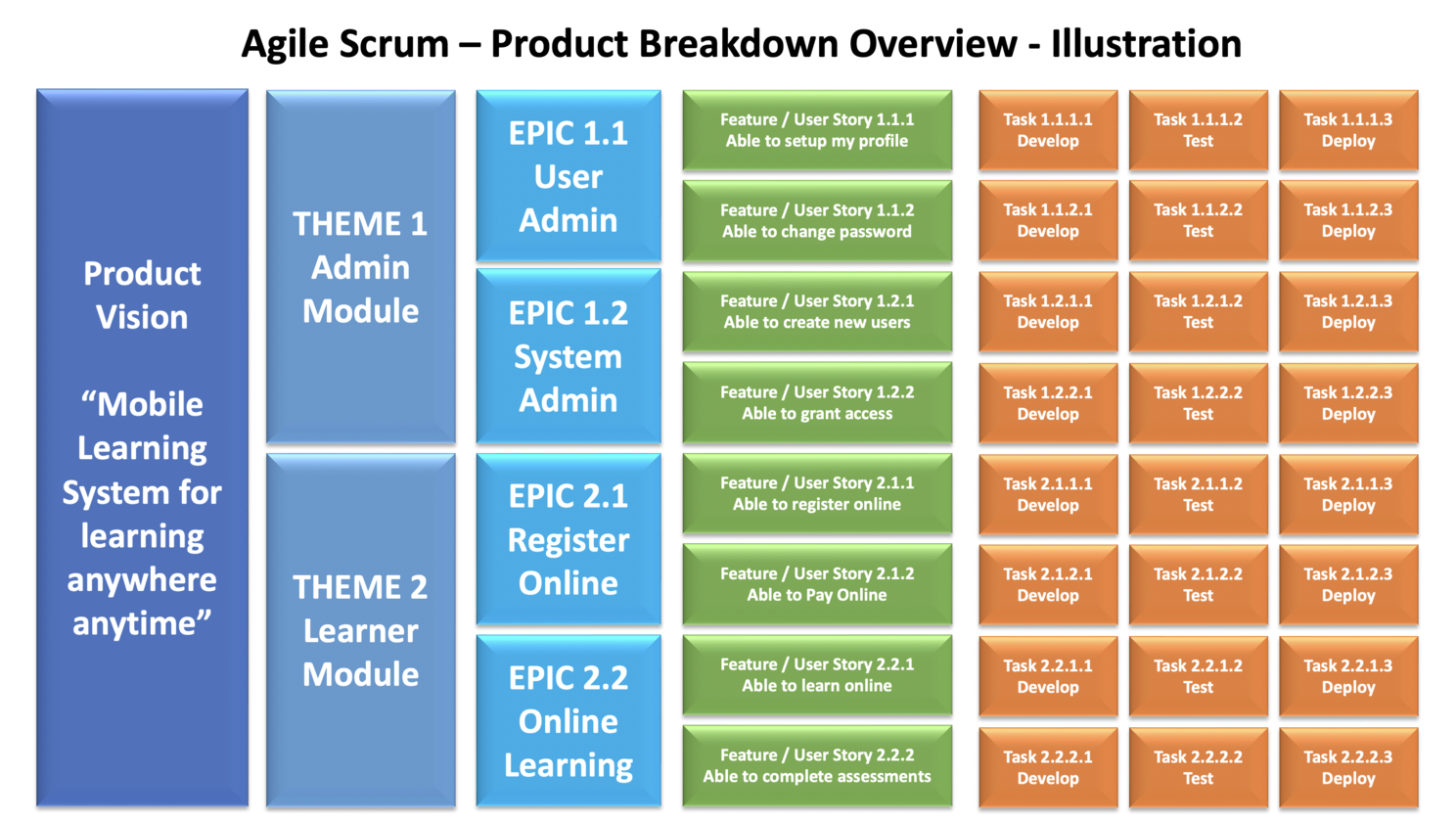
Product Vision – The product artefacts start with the product, project or program vision. The vision is what the product, project or program will achieve in 1 or two simple sentences.

Themes –The vision leads to Themes, the themes are major modules of the product, program or project. The themes are broken down to Epics.

Epics – The epics are sub modules of the product, program or the project. The Epics are then broken down to product features.

Features / User Stories – The product features are then either broken down or converted to one or more user stories. User stories clearly articulate what input, action and result is expected from each user story and how it will help the user.

Tasks – The user stories are broken down to tasks. The scrum team members generally work on the user story level and they execute the tasks to deliver the working user story. Here is a brief model overview and its illustration.

Agile Product Artefacts Illustration

Due to space limitations you will only short text is used in the illustration. In general all user stories have to be written in the format of “As a user [persona], I [want to], [so that]”. E.g. The User Registration feature can be written as “A an online user I want to be able to register online so that I can login and register for online learning courses”.

Similarly the tasks can be detailed out to specific actions needed to achieve the user story readiness. They might not be specified just as Develop, Test and Deploy.

The user stories are prepared by the product owner. Once the product features and user stories are ready, the team ready to the estimation for them.

Agile Scrum Process – Let’s understand the way of working and how the project management is done using scrum,

Product Backlog – All the user stories along with Themes, Epics and Features are put up in a product backlog by the product owner. The Product Backlog is list of all the features that must be made ready for achieving the product vision.

User Story Estimation – User stories are reviewed and estimated by the entire team. The Scrum Master arranges the estimation meeting along with the product owner and all the scrum team members. The estimation is done using a point system (1, 3, 5, 7 etc.) or size system (small, medium, large and extra large etc.).

The scrum master and the team first decides how much weightage each point of size has in terms of number of hours of work. This is done using teams past experience and improved as the team moves forward with sprint executions. The weightage helps the team decide how much time each user story will take to get it ready. Based on the combined size of all stories under one epic, the epic’s size is determined and same applies to themes.

The estimation is done using consensus model where for each user story the scrum master asks each member to score the points the scoring is then discussed and a consensus is reached to finalize and assign the points or size to the story. The cycle continues until all stories are assigned with points and size.

Sprint and Sprint Planning – As the user stories are ready and prioritized product backlog is fully in place, the team can begin with sprint planning. A sprint is cycle of 2 to 4 weeks in which the team picks up the stories from the product backlog in the order of priority and puts them in the sprint specifying in which sprint what stories will be made ready.

Each sprint then gets its own sprint backlog consisting of user stories to be delivered. Each sprint must ensure that a fully working user story is delivered at the end of the sprint. The sprint deliverable must be fully working and demo able to the product owner. The product owner must signoff and accept the features delivered to mark that user story complete.

The team works out the entire sprint planning to ensure they know how to execute, how many sprints (equals to how many weeks and months) and how much resources will be required to get there.

The deliverable from each sprint is referred as increment and at the end of all sprints, all the must have user stories should have been delivered for the product vision to be marked as achieved.

The Agile approach is a timebox approach to ensure the team reaches its product vision with speed and agility. The emphasis is on delivering results and not so much on detailed documentation, long workshops and long meetings. The focus is on working in small size teams in each sprint to deliver results.

During the sprint 1 to 6 team members can work together to pick up their respective stories. The scrum team members working on the user story, define and execute tasks for the readiness of respective stories.

Daily Scrum Meeting – On a daily basis at a fix time the entire scrum team meets up to share progress made, progress planned, issues and impediments. The scrum master arranges the meeting and ensures all scrum team members join in including product owner. The product owner might not join every day but based on the needs can be pulled in for discussion and guidance.

The meeting is called “Daily Scrum” and its only 15 to 30 minutes max. It is also called as a stand-up meeting, means the team only focuses on sharing what’s important and where they need help. Based on the updates shared, the scrum master reaches out to respective team members separately to understand their issues / impediments and help them resolve it with priority.

The Daily scrum meeting ensures that the scrum team doesn’t lose motivation and they are able to time box and move with speed to deliver.

Increment – At the end of each sprint a working set of user stories are demoed to the product owner to seek the acceptance for completion. The combine set of users stories in the sprint are referred as “Increment” as they make only part of the product vision. Eventually when all sprints are completed, all increments combined make the product vision come through.

Sprint Review – At the end of each sprint, the scrum team come together to review how the sprint execution and deliverables faired against the plan. It is possible that some user stories took longer impacting some other stories that couldn’t be completed. It is also possible that some user stories couldn’t be done due to dependency and / or impediments from other user stories. The incomplete users stories are then prioritised and moved back to the product backlog to be taken up in the next sprints.

Burn-down Charts – The burn-down charts acts as a daily weather forecast report for the team to see how they are progressing jointly against the plan they have agreed.

The scrum master and the scrum team also maintain a burn-down chart that shows them their planned progress and how they are actually progressing for each day. In the burn-down chart it is possible that there are some peaks and valleys seen as the execution of sprint and efforts spent might not be exactly same all across.

The scrum master and the team together strives to make sure they keep their commitments, help each other and achieve the needed results.

Sprint Retrospective – The scrum retrospective meeting is also held at the end of each sprint after the sprint review meeting. The purpose of the scrum retrospective is to focus on individuals, collaboration process, tools and definitions of done (deliverable as per acceptance criteria). The team discusses how things went, what worked well, what needs to improve. The improvements are then taken up by the scrum master and team members to improve and feed in for the next sprints to improve collaborations process, tools and deliverables.

The team then moves on with next sprint and any incomplete sprint backlog from previous sprint is also taken up in the next sprint or sprint after next depending on team’s decision. The execution cycle continues in the same manner for each sprint.

Agile Scrum Framework works very well because of its focus on results, empowerment for team members, no detailed documentation cycles, flexibility to adapt and change as we move sprint by sprint and most importantly, breaking down the product into smaller increments that work and allow the product owner to see results in short cycles (sprints) of 2-3 weeks, without waiting for months.

Agile Scrum Framework is used across the world by thousands for organizations to team up and deliver great results. Many Organizations have even moved further with scaling up the agile way of working by using the enterprise agile models of scrum and other frameworks. Some organizations have also gone ahead with a hybrid model mixing Agile, Waterfall and Lean, Kanban frameworks to fit their needs.

The Entrepreneur Framework

The new startups as well as existing organizations are creating new innovative products, solutions and services using hackathons, innovation bootcamps and innovation hubs and innovation competitions to support innovators of all types. These innovative startups are run by Entrepreneurs. 

Entrepreneurs can be any age group of people from diverse background with radical ideas that can, create new solutions to existing problems, create new solutions for addressing future needs, create innovative products, solutions & services that can disrupt the existing industry, sector and market segments.

The process of becoming an entrepreneur requires entrepreneurs to know about what problem they are trying to solve, what is their value proposition, who are their primary customers, what assets and resources will be required, how will the funding and investments be taken care as well as what will be the time to market and product roadmap. 

There are several other important areas to check (e.g., competitors, regulatory compliance etc.) for a successful entrepreneurship. It is easier said than done as often the devil is in the details and you require a lot of time to think through all the details.

The entrepreneur’s journey starts with the following framework,

Entrepreneur Framework

1.     Create a Lean Value Proposition Canvas – Detailing out each area and segment of the business and answering the most important questions that matter most to start.

2.     Refine Value Proposition – The value proposition can then be refined by presenting it to various stakeholders and taking their point of views in account.

3.     Apply Design Thinking – The next stage is to use an ideation workshop to initiate design thinking steps and execution for creating ideas, validating them and creating rapid paper prototypes, brainstorming and seeing the product from the best and worst customer’s point of views using surveys and interviews. This stage could take some time unless it is planned and timeboxed in a manner that will work well.

4.     Update Value Proposition – The outputs and feedbacks received from Design Thinking stage can be fed back to further strengthen the value proposition and making it more crisp with every round of updates. Finalize the Mission, Vision, Purpose and end to end value chain.

5.     Build Roadmap, Blueprint and Secure Stakeholder Buy In – Next the idea and solutions have to be presented to the board or angel investors to get their buy in to initiate the execution process. This must include the detailed roadmap and blueprint.

6.     Initiate and Engage Resources – Again, execution requires a proper organization setup with right resources of each type which could take some time unless those are pre-identified in parallel which is normally not the case and might not be possible as well.

7.     Start Execution (Design, Prototype, Build, Test cycles) – The real work starts from this step when the organization starts working and must adapt Lean and Agile processes which can be flexible yet solid as a foundation to get things done.

8.     Apply Lean and Agile methods – The cycle of daily, weekly and monthly progress reviews using online dashboards and decision meetings with stakeholders begin to ensure we make progress as per the plan and report issues and risks requiring action and attention from stakeholders and board members.

9.     Prepare Go to Market Strategy and Plan Execution – While all this is in progress, the team needs to prepare for go-to-market strategy for launch and how to handle competition and regulations in the market. Next releases and speed to market along with desired quality are very important to make it successful.

10.  Measure Results and Do Continuous Improvement – Ensure results are measured to track what works and what needs to improve. Apply tracking, monitoring and continuous improvement cycles.

Entrepreneurs are all around us, some of them are big brands while others are in the process of becoming one and some others are just starting up. There are many examples of successful entrepreneurs who started and achieved great success. Here are some examples,

1.     Flipkart – Disrupting the retail market

2.     Amazon Prime – Disrupting retail and day to day consumable (groceries)

3.     Astons and Udders – Entrepreneurs in Singapore Food industry

4.     Zomato and Deliveroo – Entrepreneur in food delivery

5.     Ninja van and Lala move – Entrepreneurs in parcel deliver services

If we would add technopreneurs to the list then there will be many more names in the list.

Important to note that while there are several examples of successful entrepreneurs, there are also many more examples of failures where entrepreneurs are either ahead of time or behind time or addressing wrong market segment or having bad user experience etc.

The entrepreneurship journey requires thorough checks and solid commitment to keep on going in toughest of times to make it. There is a lot from entrepreneurs that went ahead of us and how they have survived the journey as it requires long term commitment and lots of trial and errors to get it right.

The entrepreneur and technopreneur lifecycles are almost similar except that technopreneur innovations, solutions and services are fully technology based and they change and transform with much larger speed then other innovations, solutions and services.

The Technopreneur Framework

The new startups as well as existing organizations are creating new innovative products, solutions and services using hackathons, innovation bootcamps and innovation hubs and innovation competitions to support innovators of all types. These innovative startups are run by Technopreneurs. 

Technopreneurs can be any age group of people from diverse background with radical ideas that can, create new solutions to existing problems, create new solutions for addressing future needs, create innovative products, solutions & services that can disrupt the existing industry, sector and market segments.

The process of becoming a technopreneur requires technopreneurs to know about what problem they are trying to solve, what is their value proposition, who are their primary customers, what assets and resources will be required, how will the funding and investments be taken care as well as what will be the time to market and product roadmap. 

There are several other important areas to check (e.g., competitors, regulatory compliance etc.) for a successful technopreneurship. It is easier said than done as often the devil is in the details and you require a lot of time to think through all the details.

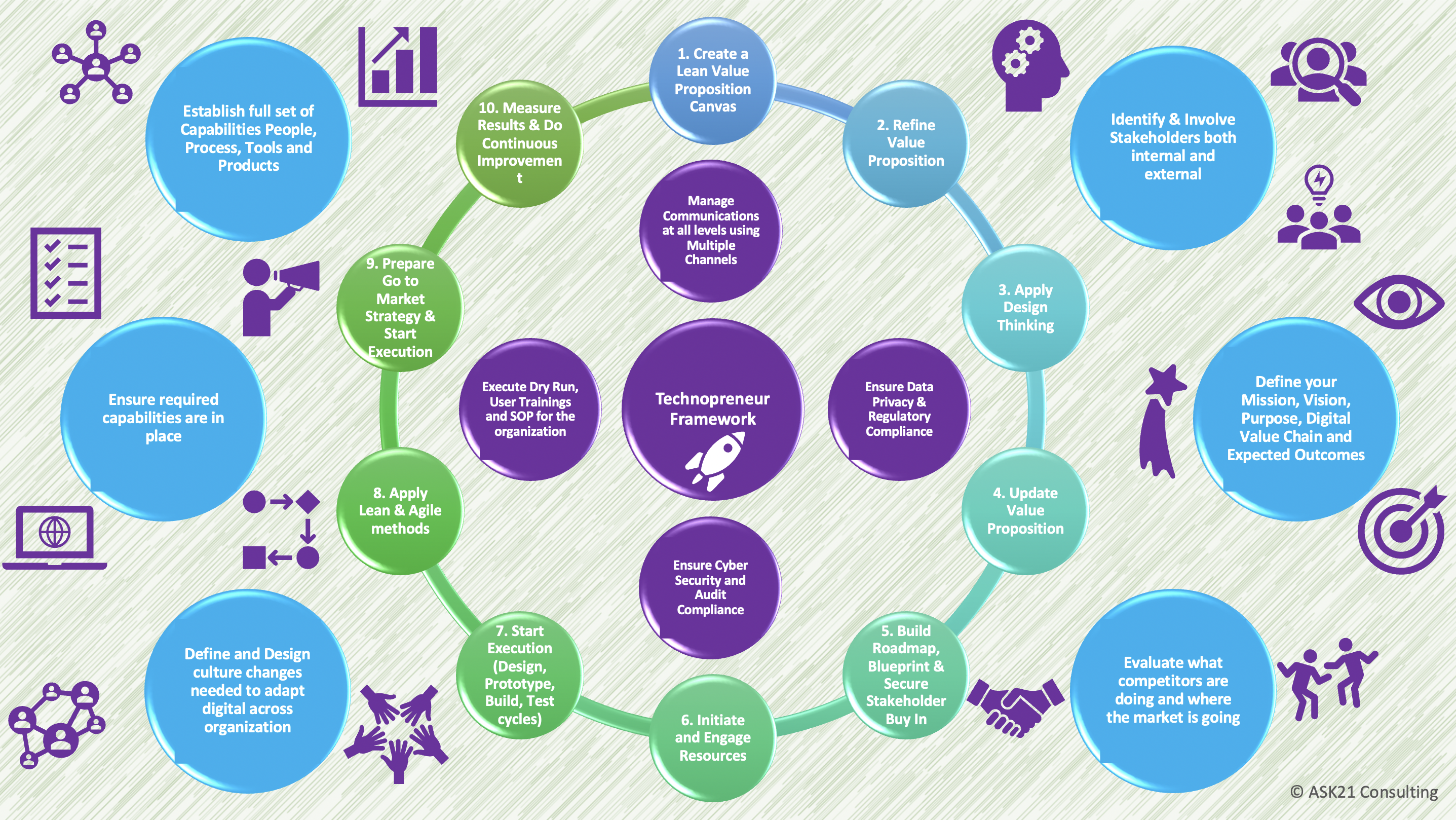
The technopreneur’s journey starts with the following framework,

Technopreneur Framework

1.     Create a Lean Value Proposition Canvas – Detailing out each area and segment of the business and answering the most important questions that matter most to start.

2.     Refine Value Proposition – The value proposition can then be refined by presenting it to various stakeholders and taking their point of views in account.

3.     Apply Design Thinking – The next stage is to use an ideation workshop to initiate design thinking steps and execution for creating ideas, validating them and creating rapid paper prototypes, brainstorming and seeing the product from the best and worst customer’s point of views using surveys and interviews. This stage could take some time unless it is planned and timeboxed in a manner that will work well.

4.     Update Value Proposition – The outputs and feedbacks received from Design Thinking stage can be fed back to further strengthen the value proposition and making it more crisp with every round of updates. Finalize the Mission, Vision, Purpose and end to end value chain.

5.     Build Roadmap, Blueprint and Secure Stakeholder Buy In – Next the idea and solutions have to be presented to the board or angel investors to get their buy in to initiate the execution process. This must include the detailed roadmap and blueprint.

6.     Initiate and Engage Resources – Again, execution requires a proper organization setup with right resources of each type which could take some time unless those are pre-identified in parallel which is normally not the case and might not be possible as well.

7.     Start Execution (Design, Prototype, Build, Test cycles) – The real work starts from this step when the organization starts working and must adapt Lean and Agile processes which can be flexible yet solid as a foundation to get things done.

8.     Apply Lean and Agile methods – The cycle of daily, weekly and monthly progress reviews using online dashboards and decision meetings with stakeholders begin to ensure we make progress as per the plan and report issues and risks requiring action and attention from stakeholders and board members.

9.     Prepare Go to Market Strategy and Plan Execution – While all this is in progress, the team needs to prepare for go-to-market strategy for launch and how to handle competition and regulations in the market. Next releases and speed to market along with desired quality are very important to make it successful.

10.  Measure Results and Do Continuous Improvement – Ensure results are measured to track what works and what needs to improve. Apply tracking, monitoring and continuous improvement cycles.

Technopreneurs are all around us, some of them are very big brands while others are in the process of becoming one and some others are just starting up. There are many examples of successful technopreneurs who started and achieved great success. Here are some examples,

1.     Amazon – Leader in cloud computing

2.     Apple – Disrupted the mobile phone, apps and entertainment market

3.     Netflix – Disrupted the DVDs, Cinema and Entertainment market

4.     Google – Disrupted the internet search and browser market as well as the leader in cloud computing

5.     Microsoft – Leader in enterprise computers, software and cloud computing

6.     Uber and Grab – Disrupted the taxi and private care market

7.     Facebook (Meta) – Leading Social media platform

If we would add entrepreneurs to the list then there will be many more names in the list.

Important to note that while there are several examples of successful technopreneurs, there are also many more examples of failures where technopreneurs are either ahead of time or behind time or addressing wrong market segment or having bad user experience etc.

The technopreneurship journey requires thorough checks and solid commitment to keep on going in toughest of times to make it. There is a lot from technopreneurs that went ahead of us and how they have survived the journey as it requires long term commitment and lots of trial and errors to get it right.

The technopreneur and entrepreneur lifecycles are almost similar except that technopreneur innovations, solutions and services are fully technology based and they change and transform with much larger speed then other innovations, solutions and services.

The New Tech Paradigm of Blockchain

Blockchain in simple terms is a very long and distributed chain of blocks of transaction information. It uses the distributed ledger technology (DLT) which consists of continuously growing (endless) list of transaction records which are called Blocks (blocks of information).

Blockchain first came to existence in 2008, to make it secure the blocks were interlinked with a unique identification include date/time stamps and a trusted party digital signature/stamp. The blocks were also distributed across worldwide large pool of computers to ensure it is impossible to erase or alter any recorded block of information. The conceptual model was then introduced for use for crypto currency bitcoin from year 2009 and since then it served as public DLT for all bitcoin transaction records.

Let’s understand how blockchains work,

Blockchain Process Overview

1.     As Blockchains use the distributed ledger technology (DLT), they are managed using peer-to-peer (P2P) network of computers spread across the world.

2.     The computers called as nodes are generally running the digital ledger of transaction records called as blocks.

3.     Each node (computer) uses the consensus algorithm protocol for adding and validating new transactions records called as blocks.

4.     Every block is distributed across the world involving many computer systems. Each block has the previous blocks unique identification information for validation and integrity of blocks.

5.     Blocks hold information of transactions records in an encoded Hash Tree format where each leaf of the hash tree (in this case the block) has the encoded cryptographic hash of pervious block.

6.     The information on the blocks is interlinked to each other using this unique cryptographic hash and other relevant information about the transaction, date and time when the block was created and recorded.

7.     The blocks once recorded can’t be deleted or altered in any way. They permanently remain on the chain of records and remain retrievable.

8.     Blocks can be created but only the longest forming blockchain confirms the reliability of the block. In additions the entire network of computers can validate and confirm if the block and block chain is valid as per their records or not.

9.     As each block is replicated across the entire blockchain network of computers and each computer stores all the blocks information, it takes a lot of time for the blocks to be created and validated across the network. 

10.  As the size of the DLT (distributed ledger network) increases the speed of the block creation and validation reduces. E.g., a block creation for bitcoin having very huge network and extra-large size ledger could take up to 15 minutes while for the new bitcoins it can be done within 30 to 60 seconds as the ledger and size of network is limited.

11.  The blockchains can’t be altered so incase of new regulations or rules introduction from a specific date and time, will result in a New Hard Fork creation to identify and use the blockchains under that specific fork.

Now that we understand what blockchains are, let’s move to the types of blockchains. Here are the types of blockchain,

1.     Public Blockchain – Public blockchains are open to all decentralized blockchains. All people with internet access can use such blockchains to send their transaction records as well as become the node using consensus protocol to be able to validate records for their authenticity. Such blockchains work based on incentive mechanism where each node gets some incentives for the storage and validations done. E.g., Bitcoin and Ethereum are examples of public blockchain.

2.     Private Blockchain – As the name suggests, the private blockchain is restricted access blockchain. The access is strictly restricted for both creator and validator nodes. Such blockchains use distributed ledger technology (DLT) and can called as centralized blockchain to a large extent. E.g., Banking organizations can use Private Blockchain

3.     Hybrid Blockchain – A combi of Public and Private can be called as hybrid blockchain were certain areas of the blockchain can be kept public with open access and remaining areas private with restricted access. E.g., Healthcare organizations can use Hybrid Blockchain

4.     Consortium or Side Blockchain – These are blockchain where a ledger of blockchain transaction records (blocks) run parallel to primary blockchain. Entries from primary blockchain are linked to the side blockchain. Consortiums and Groups or even group of countries, companies etc. can use this type of blockchain. E.g., Monetary authority can run consortium blockchain with all banks and financial institutions, allowing banks to have their separate side blockchain with links to the primary consortium blockchain.

Here are some pros and cons of blockchain technology,

Pros for Blockchain include,

1.     Increased transparency and authenticity – Blockchain verify information across worldwide nodes to ensure transaction is authentic. The ledger in public blockchain is open to all for easy access and full transparency.

2.     Permanent Ledger of blocks – Blocks of transactions records never get old or archived. They always remain available in the blockchain across the world. So there is no chance of having any lost transaction records on the blockchain unless all nodes (computers) in the blockchain are altered.

3.     Easy Track and Trace – All blocks in the blockchain are always interlinked in such a way that entire chain of blocks remain fully intact. This makes tracking and tracing easier.

4.     Cost Savings – This depends on how the blockchain is used. E.g., if blockchain is used for smart contracts of real estate ownerships in a country. It will ensure the entire process is digitalized and contracts are put in blocks with all relevant information making them always available. Savings come from paper, archive stores and people.

Cons for Blockchain include,

1.     Implementation Challenges – Blockchain functions using distributed and often decentralized network of nodes spread across the world. It is difficult to trace, monitor and maintain the nodes efficiency and effectiveness. In addition, the adoption and usage itself could be also challenging depending on the area of use.

2.     Regulatory Compliance – Blockchain are still not widely accepted technology by major institutions. Although it functions well for crypto currencies and several other trails. For crypto currency itself regulatory compliance issues exist across the world.

3.     Technology complexity – Blockchain upgrades, maintenance and support as well as patching and security upgrades for nodes across the world can be very complex to achieve.

4.     Future Technology – While blockchain is one of the newest technologies but its adaption has been slow due to unforeseen future of what next and how the entire ecosystem can evolve.

There are many blockchain platforms in use across the world. Here some of the top ones,

1.     IBM Blockchain – IBM platform offers a fully managed blockchain-as-a-service solution which can be configured, developed and deployed by organizations for their own use.

2.     Ethereum – Ethereum is a decentralized blockchain platform that can be used for smart contracts and in many ways, it operates similar to the bitcoin blockchain platform.

3.     Ripple, Tron and Stellar – These are three different blockchain providers but they have similar capabilities as Ethereum.

4.     Chainalysis KYT (Know Your Transaction) – KYT blockchain platform is one of the latest and easy to use platforms with latest technology gaining a lot of popularity.

5.     Hyper Ledger – Fabric and Sawtooth – These are two different blockchain platforms that offer application creation ability. Sawtooth is an opensource version while fabric is not.

6.     Multichain – It is an open source blockchain platform for use by organizations with ability to create both public and private blockchains.

7.     Kakao Klaytn Blockchain – It is a blockchain platform by Kakao, its modular network design and architecture makes it easy to use for businesses to configure, customize and operate service-oriented blockchains based on the proprietary Klaytn framework.

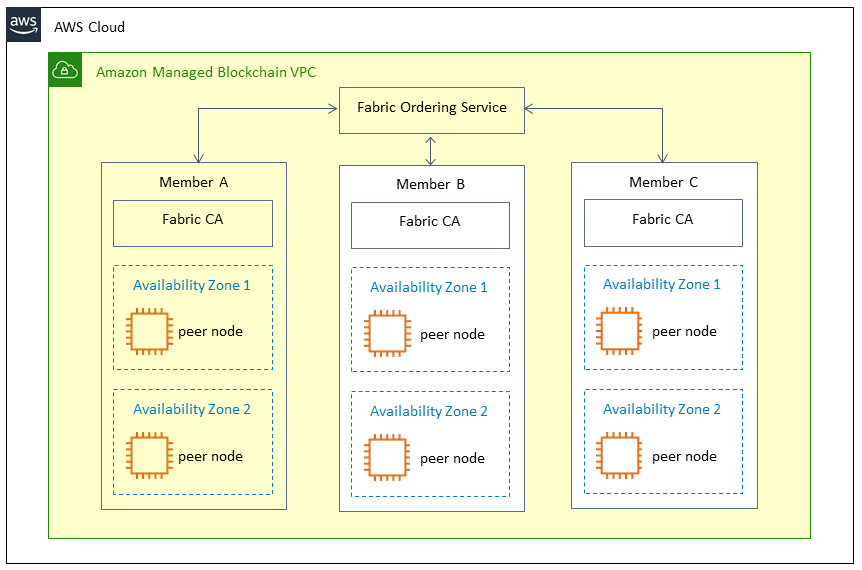
8.     Amazon, Azure Quorum and Google Blockchain – The top 3 cloud providers also offer blockchain as a service platform for quick configuration and use by organizations. Here a simple overview of AWS Blockchain architecture as a reference.

Amazon Blockchain aș a service architecture overview

Over the years the acceptance and use of various types of bitcoins increased and still continuing to increase. This resulted in financial institutions, monetary authorities and governments to start thinking in the direction of how to control and add good governance model around bitcoins. Many countries are thinking of bringing digital currency (similar to bitcoin) but under governance and control of respective monetary authorities and governments. It is very likely that the underlying technology and ecosystem to be similar or enhanced version of Blockchain making them universally accepted and usable across the world.

For the year 2019 Gartner reported that only 5% of CIOs believed blockchain technology was a ‘game-changer’ for their business as blockchain usage is largely recognized for use only for FinTech organizations, the likes of banks, investment firms, credit card companies and finance divisions.

As we are now in 2022, Blockchain is used in various shapes and forms by almost all the major industries and sectors. Confirmed usage and use cases can be found for Automotive, Banking, Financial services, Government, Healthcare, HealthTech, life sciences, Insurance, Media, Entertainment, Retail, Consumer goods, Logistics and Telecommunications.

Everything you need know about ChatBots

The word chatbot is made up of “Chat” and “Bot”, it means chat powered and executed by bot (computer system). ChatBot actually emerged from “Chatterbots” back in 1990s. As it was too early to use them, the usage didn’t come to life until last decade. ChatBots were started to get used by organizations more effectively from 2015 onwards. In past 7 years the usage and industry for chatbots have grown by leaps and bounds.

A ChatBot is a computer software which helps organizations handle their customer queries automatically ay anytime (7×24 hours) anywhere (across the globe) using any device (mobile, tablet, laptop, PC, smart tv etc.) connected to the internet. 

ChatBots interact with diverse customer groups using messaging platforms which are designed to work and act as if a human customer service assistant is answering the queries based on keywords identified in the question and their model answers.

ChatBots require continuous update and learning as they are meant to answer customer queries related to product, organization, compliant, enquiry for information etc. There is also a need of having active human customer service agents behind the ChatBot to step in for situations where it is difficult for the ChatBot to answer further questions.

ChatBots are of many types, they can be very simple keyword based, rule-based Bots as well as sophisticated self-learning artificially intelligent (AI) Bots with built in natural language processing (NLP) capabilities as well as machine learning and deep learning abilities.

Here is a brief overview of Chatbot process and architecture,

ChatBot Process Overview and Logical Architecture

1.     The user generally opens a website or app to search for their need or to get support and guidance.

2.     The ChatBot popups with welcome greetings and either it starts by giving standard options that the user can choose to decide which area he needs help on or it allows the user to ask the query.

3.     User places the query which the ChatBot receives and processes. The processing is done through NLP (natural language processing) service consisting of NLU (natural language understanding) that helps understand users intent of the query based on keywords and phrases asked. The query is processed by the dialog manager and the response is given by Dialog manager to NLU (Natural Language Generation) which answers users query either in written or voice response.

4.     The user can see the response and ask further questions or after a waiting time of 1 minute the ChatBot can do the Thanks greeting to ask further questions and close the chat.

5.     In the background there are multiple technical architecture blocks and systems that operate to make the ChatBot work including storage systems, Knowledge base, API message Interfaces, Business Process Interfaces, IoT interfaces and ChatBot front end as well as back end conversational query engine.

We all are very familiar of ChatBots and use them in our daily lives. Here are some everyday examples of ChatBots including their types,

NLP Based ChatBot Overview

1.     AI based ChatBots – These chatbots are advanced and have NLP (natural language processing) capabilities. Some of them also have built in self learning abilities attached with machine learning and deep learning neural network algorithms.

a.     Siri on Apple Devices – The simplest form of AI ChatBot is NLP based Siri on Apple devices meant to serve our voice commands and answer our queries. Other than answering our queries, it is able to do many of our tasks, remember important events and remind us at the right time.

b.     Amazon Echo and Alexa – Alexa and Echo are voice enabled AI ChatBots and are enabled using NLP (Natural Language Processing) and AI capabilities. Other than answering our queries, it is able to search and order food, groceries and other items we need. Able to recommend the best price and online site to buy from.

c.     Google Home – Google Home is also voice enabled AI ChatBots and are enabled using NLP (Natural Language Processing) and AI capabilities. Other than answering our queries, it is able to search and book flights, movie tickets, hotels as well as suggest what is the best places to visit, with best time and price.

2.     Online Virtual Agent ChatBots – The other simpler form is the virtual assistant popup window we get on most of the websites greeting us and asking how can it help us. These are most common and seen across all business websites. Every sector and industry have their own ChatBots. E.g., Banking, HealthCare, eCommerce, Government Services, Logistics, Retail, social media etc.

3.     SMS Based ChatBots – There are also chatbots that are SMS based which are basically rule-based ChatBots that answer queries based on our questions and answers.

4.     Phone Call Based ChatBots – Phone call based chatbots are similar to SMS based chatbots but with voice enablement for communicating and handling user queries. During Covid Pandemic we have seen the use of these for managing online enquiries. We can also see them in use largely by banking, credit card and government services enquiry lines.

5.     Offline ChatBots – These are ChatBots used within organizations boundaries (E.g., HR, IT) and in some case for educational purposes by schools and universities. These ChatBots operate within specific knowledge domain to help manage queries from employees and students.

Now that we understand the type of ChatBots, Let’s understand the Pros (Benefits) and Cons (Downsides) of using them. 

Here are the benefits of using ChatBots,

1.     Improved 7×24 Customer Service – saving time and efforts for customers to find answers to their queries anytime anywhere with any device connected to internet.

2.     Standardized and automated processes – ChatBots make the respective customer service or query handling process fully optimized and automated for all possible scenarios. The process also undergoes continuous improvements and ChatBots continue to learn and feedback for corrections. Eventually making the organization more efficient and effective.

3.     Cost Savings – ChatBots can handle 1000s of customer queries at once using the same standard mechanism. This results in cost savings for the organizations’ operational costs as they will not need so many customer service agents working in multiple shifts and locations.

4.     Ability to Gather Customer Needs and Information – ChatBots can help gather customer needs and information through the questions and answers. The information gathered can then be used by sales, marketing and customer service divisions to engage with respective customers.

5.     Ability to generate leads – ChatBots can also help in generating leads on campaign sites and company websites by collecting interests and information of customers.

6.     Ability to Upsell and even cross sell – ChatBots can be setup to identify customer needs for products and services. Based on the identification, they can upsell and even cross sell products and services that can complement and better fit for the customer.

7.     Ability to sell extended warranty, accessories and CRP (customer replaceable parts) – ChatBots can be setup to identify customer needs for products and accessories. Based on the identification, they can sell extended warranty, accessories and parts to increase sell.

8.     Improved Compliance – ChatBots unlike humans are always well behaved in their answers to customer queries and every step of the discussion is recorded and audit log can be easily emailed to customers and stored in company logs for compliance purposes.

Here are some downsides and limitations of ChatBots,

1.     Limited Knowledge base – ChatBots can only handle limited set of queries and questions, as they are setup with a fixed set of keywords and questions identification and answers.

2.     Handle One Query at a time – In most cases ChatBots can only handle one question at a time. So if a user asks multiple questions the ChatBot will be able to answer only 1 question impacting user experience.

3.     Limited number of instances – ChatBots efficiency depends on the load and number of instances running parallelly. So organization must be vigilant to ramp up computing capacity for ChatBots based on their usage threshold.

4.     Complex Scenarios – There are complex scenarios in customer chat which ChatBot won’t be able to understand, answer and resolve. For such case the human service agents must keep a check on ChatBot discussions and step in to takeover such discussions.

5.     Need for Human Agent – It is normal that most humans would like to speak to a human services agent instead of ChatBots as conversing with ChatBots could take longer time especially on SMS and Phone based conversations.

6.     Language and Slangs – ChatBots understand normal language with correct grammar and slangs. They would not recognize certain slangs and language shortcuts that we normally use as humans.

7.     Over Loading – ChatBots can be attacked and kept loaded by hacking bots putting a lot of load on system capacity by opening many instances and asking many types of questions. Eventually impacting efficiency and effectiveness of the system and in some cases even crashing the system.

8.     Hacking – ChatBot platforms can be prone to hacking and hackers can alter the answers and language which can impact organization’s brand image as ChatBots are front face of organizations online presence.

There are many ChatBot software and platforms. Some of the famous ones are Hubspot, Zendesk, Intercom, Tidio, Mobile Monkey, Drift, IBM Watson and QlikSense. In addition, social media platforms like Facebook (Meta) also offer their rule based chatbots for business pages and ecommerce. Similarly, eCommerce Hubs like Shopee also offer their own ChatBot for online shops running on their own platforms. The top 3 Cloud providers Amazon (Amazon ChatBot), Microsoft Azure (Azure ChatBot) and Google (Google Dialog Flow) also have their own pay for use ChatBot platform offerings that can be easily built-up using scenario-based conversation flow configurations without any need of complex coding and development.

ChatBots are very much in use across the world by all industries and sectors. They are here to stay and they will become much more artificially intelligent in the upcoming years. AI based ChatBots combined with Deep Learning will open many more opportunities for their use to make our lives far more advanced, efficient and effective.