Demystifying ISO 27001:2022 – Understanding the Clauses and Controls
ISO 27001:2022, the latest version of the internationally recognized standard for Information Security Management Systems (ISMS), provides organizations with a comprehensive framework for protecting sensitive information assets. Central to ISO 27001:2022 are its clauses and controls, which outline the requirements and best practices for establishing, implementing, maintaining, and continually improving an ISMS. Let’s delve into each clause and explore the corresponding controls outlined in ISO 27001:2022.
1. Context of the Organization (Clause 4)
Clause 4 sets the foundation for the ISMS by requiring organizations to define the scope, objectives, and context of their information security management efforts. This includes understanding the internal and external factors that may affect information security and identifying relevant legal, regulatory, and contractual requirements.
Controls: The controls associated with Clause 4 include:
Documenting the scope and boundaries of the ISMS (4.1)
Identifying the internal and external issues relevant to information security (4.2)
Understanding the needs and expectations of interested parties (4.3)
Determining the scope of the ISMS (4.4)
Establishing information security objectives (4.5)
2. Leadership (Clause 5)
Clause 5 emphasizes the importance of leadership and commitment in driving the organization’s information security efforts. Top management is tasked with establishing a clear policy, allocating resources, and promoting a culture of security awareness throughout the organization.
Controls: The controls associated with Clause 5 include:
Establishing an information security policy (5.1)
Assigning information security roles and responsibilities (5.2)
Providing adequate resources for information security (5.3)
Communicating the importance of information security (5.4)
Establishing a process for addressing information security risks and opportunities (5.5)
3. Planning (Clause 6)
Clause 6 focuses on planning and risk assessment, requiring organizations to identify and assess information security risks, define risk treatment plans, and establish measurable objectives for improving information security.
Controls: The controls associated with Clause 6 include:
Conducting a risk assessment (6.1)
Identifying and evaluating information security risks (6.1.2)
Developing a risk treatment plan (6.1.3)
Establishing information security objectives (6.2)
Planning changes to the ISMS (6.3)
4. Support (Clause 7)
Clause 7 emphasizes the importance of providing adequate resources, competence, awareness, communication, and documented information to support the ISMS effectively.
Controls: The controls associated with Clause 7 include:
Providing resources for the ISMS (7.1)
Competence and awareness (7.2)
Communication (7.4)
Documented information (7.5)
5. Operation (Clause 8)
Clause 8 focuses on implementing and operating the ISMS, including the execution of risk treatment plans, the management of information security incidents, and the implementation of controls to mitigate identified risks.
Controls: The controls associated with Clause 8 include:
Operational planning and control (8.1)
Information security risk treatment (8.2)
Information security controls (8.3)
Incident management (8.4)
Business continuity management (8.5)
6. Performance Evaluation (Clause 9)
Clause 9 emphasizes the importance of monitoring, measuring, analyzing, and evaluating the performance of the ISMS to ensure its effectiveness and identify opportunities for improvement.
Controls: The controls associated with Clause 9 include:
Monitoring, measurement, analysis, and evaluation (9.1)
Internal audit (9.2)
Management review (9.3)
7. Improvement (Clause 10)
Clause 10 focuses on continually improving the effectiveness of the ISMS through corrective actions, preventive actions, and lessons learned from incidents and audits.
Controls: The controls associated with Clause 10 include:
Nonconformity and corrective action (10.1)
Continual improvement (10.2)
Conclusion
ISO 27001:2022 provides organizations with a systematic and holistic approach to managing information security risks and protecting sensitive information assets. By understanding the clauses and controls outlined in the standard, organizations can establish a robust ISMS that meets the highest standards of information security governance, risk management, and compliance. As organizations navigate an increasingly complex and interconnected digital landscape, ISO 27001:2022 serves as a invaluable tool for safeguarding against evolving cyber threats and ensuring the confidentiality, integrity, and availability of information assets.
Exploring the Diverse Landscape of Generative AI: A Guide to Types and Applications
Generative AI has emerged as a transformative force in the realm of artificial intelligence, enabling machines to create new content that mirrors and, in some cases, surpasses human creativity. From generating lifelike images and music compositions to crafting compelling narratives and virtual environments, generative AI encompasses a diverse array of techniques and models that have revolutionized various industries. Let’s embark on a journey to explore the different types of generative AI and their applications in today’s digital landscape.
1. Generative Adversarial Networks (GANs)
Generative Adversarial Networks (GANs) are perhaps the most well-known and widely used type of generative AI. GANs consist of two neural networks—the generator and the discriminator—that engage in a game-like framework. The generator generates synthetic data, such as images or text, while the discriminator evaluates the authenticity of the generated samples. Through iterative training, GANs learn to produce increasingly realistic outputs, making them popular for tasks like image synthesis, style transfer, and image-to-image translation.
2. Variational Autoencoders (VAEs)
Variational Autoencoders (VAEs) are another type of generative AI model that operates on a different principle than GANs. VAEs are based on the concept of encoding input data into a latent space and then decoding it back into the original data format. Unlike GANs, which focus on generating realistic samples, VAEs learn a probabilistic distribution of the input data and generate new samples by sampling from this distribution. VAEs are commonly used for tasks like image generation, anomaly detection, and data augmentation.
3. Autoregressive Models
Autoregressive models are a class of generative AI algorithms that generate sequences of data one element at a time, with each element conditioned on the previous elements. Examples of autoregressive models include recurrent neural networks (RNNs), long short-term memory networks (LSTMs), and transformers. These models are particularly well-suited for generating sequential data such as text, speech, and time-series data. Autoregressive models have found applications in natural language processing, speech synthesis, and music generation.
4. Flow-Based Models
Flow-based models are a relatively newer class of generative AI models that operate by transforming a simple distribution into a more complex distribution. These models learn a series of invertible transformations that map samples from a simple distribution, such as a Gaussian distribution, to samples from the target distribution. Flow-based models are known for their ability to generate high-quality samples and perform exact likelihood estimation. They have applications in image generation, density estimation, and generative modeling.
5. Transformer Models
Transformer models, originally developed for natural language processing tasks, have also been adapted for generative AI applications. Transformers are based on a self-attention mechanism that allows them to capture long-range dependencies in sequential data. Variants of transformer models, such as GPT (Generative Pre-trained Transformer) and BERT (Bidirectional Encoder Representations from Transformers), have achieved remarkable success in tasks like text generation, language translation, and dialogue generation.
Applications and Future Directions
The diverse landscape of generative AI offers a myriad of applications across various domains:
Creative Industries: Generative AI is transforming creative industries such as art, music, and literature by enabling artists and creators to explore new forms of expression and push the boundaries of creativity.
Content Generation: Generative AI is used to automate the generation of content for websites, social media, and marketing campaigns, helping businesses streamline their content creation processes and engage with their audiences more effectively.
Healthcare and Life Sciences: In healthcare, generative AI is being used to generate synthetic medical images, simulate biological processes, and discover novel drug candidates, accelerating the pace of medical research and drug development.
Simulation and Virtual Environments: Generative AI is revolutionizing the creation of virtual environments and simulations for training, gaming, and entertainment purposes, providing immersive and realistic experiences for users.
As generative AI continues to evolve, researchers and practitioners are exploring new techniques and models to push the boundaries of what is possible. From enhancing human creativity to solving complex problems in science and industry, generative AI holds the promise of shaping a more innovative and interconnected future.
Exploring the Power of Generative AI: Unlocking Creativity and Innovation
In recent years, the field of artificial intelligence (AI) has witnessed remarkable advancements, with one of the most intriguing developments being generative AI. Unlike traditional AI systems that are designed for specific tasks, generative AI has the remarkable ability to create new content, ranging from text and images to music and even entire virtual worlds. This revolutionary technology holds the potential to revolutionize various industries and unleash a new wave of creativity and innovation. Let’s delve into the fascinating world of generative AI and explore its applications, challenges, and implications for the future.
Understanding Generative AI
Generative AI refers to a class of algorithms and models capable of generating new data that resembles, and in some cases, surpasses, the examples it was trained on. Unlike traditional AI, which operates based on predefined rules and patterns, generative AI leverages sophisticated neural networks to learn the underlying patterns and structures present in the training data and then use this knowledge to generate novel content.
Applications of Generative AI
Art and Creativity: Generative AI has found widespread use in the creation of digital art, generating visually stunning images, animations, and graphics. Artists and designers can leverage generative AI tools to explore new creative possibilities and push the boundaries of traditional art forms.
Content Generation: From generating realistic human-like text to creating immersive virtual environments, generative AI is transforming content creation across various domains. Content creators, writers, and game developers can use generative AI to automate the generation of text, dialogue, and even entire narratives.
Media and Entertainment: In the entertainment industry, generative AI is revolutionizing the creation of music, videos, and special effects. Musicians can use AI-generated algorithms to compose melodies and harmonies, while filmmakers can employ AI-driven tools to enhance visual effects and create lifelike characters.
Healthcare and Drug Discovery: Generative AI is also making significant strides in healthcare and pharmaceuticals. Researchers are using AI-generated models to analyze medical images, predict disease outcomes, and even discover new drugs and treatments.
Simulation and Modeling: Generative AI enables the creation of highly realistic simulations and models, facilitating advancements in fields such as engineering, architecture, and urban planning. Engineers and designers can use AI-generated simulations to test and optimize designs before they are built.
Challenges and Considerations
Despite its immense potential, generative AI also poses several challenges and ethical considerations:
Bias and Fairness: Generative AI models are susceptible to bias present in the training data, which can lead to biased outputs and reinforce existing inequalities. Addressing bias and ensuring fairness in generative AI systems is crucial to prevent unintended consequences.
Quality and Fidelity: While generative AI has made significant strides in generating realistic content, achieving high-quality and fidelity remains a challenge, particularly in domains such as natural language processing and image synthesis.
Ethical Use: The proliferation of generative AI raises ethical concerns regarding its potential misuse, including the creation of deepfakes, fake news, and malicious content. It is essential to establish guidelines and regulations to govern the ethical use of generative AI technology.
Privacy and Security: Generative AI models trained on sensitive data may inadvertently reveal confidential information or compromise privacy. Robust security measures must be implemented to safeguard against potential breaches and misuse of AI-generated content.
The Future of Generative AI
As generative AI continues to evolve, its impact on society, culture, and the economy is poised to grow exponentially. From transforming creative industries to revolutionizing scientific research and healthcare, generative AI holds the promise of unlocking new frontiers of innovation and discovery. However, realizing this potential requires a concerted effort to address the technical, ethical, and societal challenges associated with this groundbreaking technology. By fostering collaboration between researchers, industry stakeholders, and policymakers, we can harness the power of generative AI to shape a more creative, equitable, and prosperous future for all.
Unveiling ISO 27001:2022 – The Definitive Guide to Information Security Management
In today’s interconnected digital landscape, safeguarding sensitive information is more critical than ever before. As organizations increasingly rely on technology to store, process, and transmit data, the risks associated with cyber threats and data breaches continue to escalate. In response to these challenges, the International Organization for Standardization (ISO) has released ISO 27001:2022, the latest iteration of the globally recognized standard for Information Security Management Systems (ISMS). Let’s delve into what this updated standard entails and how it can help organizations fortify their defenses against evolving cyber threats.
Evolution of ISO 27001
Since its inception, ISO 27001 has served as the gold standard for establishing, implementing, maintaining, and continually improving ISMS within organizations of all sizes and industries. Originally published in 2005 and revised in 2013, ISO 27001 has undergone a series of updates to reflect emerging cybersecurity threats, technological advancements, and evolving regulatory landscapes.
The release of ISO 27001:2022 represents a significant milestone in the evolution of information security management. This latest version builds upon the foundation laid by its predecessors while introducing updates and enhancements to address contemporary cybersecurity challenges and align with current best practices.
Key Updates in ISO 27001:2022
Integration with Risk Management: ISO 27001:2022 places greater emphasis on the integration of information security risk management into the organization’s overall risk management framework. By aligning information security objectives with strategic business goals and risk appetite, organizations can make more informed decisions regarding risk mitigation and resource allocation.
Enhanced Controls and Annex A: The standard introduces new controls and updates to Annex A, the comprehensive list of security controls and objectives. These additions reflect emerging threats and technologies, such as cloud computing, mobile devices, and Internet of Things (IoT) devices, ensuring that organizations can address the evolving cybersecurity landscape effectively.
Focus on Resilience and Continuity: ISO 27001:2022 places a greater emphasis on building resilience and ensuring continuity in the face of disruptions, whether caused by cyber incidents, natural disasters, or other unforeseen events. Organizations are encouraged to develop robust incident response and business continuity plans to minimize the impact of disruptions on their operations and stakeholders.
Emphasis on Governance and Leadership: The updated standard emphasizes the importance of strong governance and leadership in driving effective information security management. Top management is tasked with providing strategic direction, allocating resources, and fostering a culture of security awareness throughout the organization.
Alignment with GDPR and Other Regulations: ISO 27001:2022 aligns more closely with the requirements of major privacy regulations, such as the General Data Protection Regulation (GDPR). By integrating information security and privacy management, organizations can streamline compliance efforts and demonstrate a comprehensive approach to protecting sensitive data.
Benefits of ISO 27001:2022 Implementation
The adoption of ISO 27001:2022 offers numerous benefits to organizations seeking to enhance their information security posture:
Comprehensive Risk Management: By integrating risk management into the information security framework, organizations can identify, assess, and mitigate threats more effectively, reducing the likelihood and impact of security incidents.
Enhanced Resilience and Continuity: ISO 27001:2022 helps organizations build resilience and ensure business continuity in the face of cyber threats, natural disasters, and other disruptions, thereby minimizing downtime and preserving stakeholder confidence.
Improved Regulatory Compliance: The standard’s alignment with major privacy regulations facilitates compliance efforts, enabling organizations to demonstrate adherence to legal and regulatory requirements and avoid potential fines and penalties.
Increased Trust and Credibility: Certification to ISO 27001:2022 demonstrates a commitment to protecting sensitive information and instills trust and confidence among customers, partners, and stakeholders.
Competitive Advantage: Organizations that achieve ISO 27001:2022 certification gain a competitive edge by differentiating themselves as leaders in information security management, potentially opening new business opportunities and strengthening relationships with clients and partners.
Conclusion
In an era defined by digital transformation and escalating cyber threats, ISO 27001:2022 stands as a beacon of guidance for organizations striving to safeguard their sensitive information assets. By embracing the latest principles and best practices in information security management, organizations can enhance their resilience, mitigate risks, and demonstrate a steadfast commitment to protecting the confidentiality, integrity, and availability of information. As technology continues to evolve and threats evolve along with it, ISO 27001:2022 provides a robust framework for organizations to adapt and thrive in an increasingly complex and interconnected world.
Demystifying ISO 27701: Understanding the Gold Standard in Privacy Management
In an era where data breaches and privacy concerns dominate headlines, safeguarding personal information has become paramount for organizations worldwide. In response to the growing need for robust privacy management frameworks, the International Organization for Standardization (ISO) introduced ISO 27701. This groundbreaking standard provides a comprehensive set of guidelines for establishing, implementing, maintaining, and continually improving a Privacy Information Management System (PIMS).
The Genesis of ISO 27701
ISO 27701 is an extension of ISO 27001, the internationally recognized standard for Information Security Management Systems (ISMS). While ISO 27001 focuses primarily on information security, ISO 27701 incorporates specific requirements and guidance for managing privacy risks in accordance with widely accepted privacy principles and regulations, such as the General Data Protection Regulation (GDPR) and the California Consumer Privacy Act (CCPA).
Key Components of ISO 27701
Privacy Information Management System (PIMS): At the core of ISO 27701 is the establishment of a PIMS, which serves as a framework for managing privacy-related processes, risks, and compliance obligations. It outlines procedures for identifying, assessing, and mitigating privacy risks while ensuring compliance with applicable laws and regulations.
Privacy Risk Management: ISO 27701 emphasizes the importance of conducting privacy impact assessments (PIAs) to identify and evaluate potential privacy risks associated with the processing of personal information. Organizations are required to implement controls and measures to address identified risks effectively.
Data Protection Controls: The standard provides a set of controls specifically tailored to address privacy requirements. These controls encompass various aspects, including data minimization, purpose limitation, data subject rights, transparency, and accountability.
Legal and Regulatory Compliance: ISO 27701 guides organizations in understanding and fulfilling their legal and regulatory obligations related to privacy. It requires organizations to maintain an inventory of applicable laws and regulations and establish processes to monitor and ensure compliance.
Third-Party Management: Given the widespread reliance on third-party service providers for data processing activities, ISO 27701 emphasizes the importance of effectively managing privacy risks throughout the supply chain. Organizations are required to implement measures to assess the privacy practices of third parties and ensure contractual obligations regarding data protection are met.
Benefits of ISO 27701 Implementation
The adoption of ISO 27701 offers numerous benefits to organizations seeking to enhance their privacy management practices:
Enhanced Trust and Credibility: Compliance with ISO 27701 demonstrates a commitment to protecting the privacy rights of individuals, thereby enhancing trust and credibility among customers, partners, and stakeholders.
Improved Risk Management: By implementing systematic processes for identifying, assessing, and mitigating privacy risks, organizations can effectively manage potential threats to data privacy and security.
Legal and Regulatory Compliance: ISO 27701 provides a structured approach to achieving and maintaining compliance with relevant privacy laws and regulations, reducing the risk of costly penalties and sanctions.
Competitive Advantage: Certification to ISO 27701 can serve as a differentiator in the marketplace, demonstrating a proactive approach to privacy management and giving organizations a competitive edge.
Enhanced Data Subject Rights: The standard’s emphasis on transparency, accountability, and data subject rights empowers individuals to exercise greater control over their personal information, fostering trust and loyalty.
Challenges and Considerations
While ISO 27701 offers a robust framework for privacy management, organizations may encounter several challenges during implementation:
Resource Allocation: Implementing and maintaining a PIMS requires dedicated resources, including financial investment, personnel, and time commitments.
Complexity of Compliance: Achieving compliance with ISO 27701 involves navigating a complex landscape of legal and regulatory requirements, which may vary depending on the organization’s geographic location and industry sector.
Integration with Existing Systems: Integrating ISO 27701 requirements with existing management systems, such as ISO 27001 for information security, may pose technical and operational challenges.
Cultural Shift: Successfully embedding a culture of privacy and data protection throughout the organization requires effective communication, training, and change management initiatives.
Conclusion
In an age where data privacy is increasingly scrutinized, ISO 27701 emerges as a beacon of guidance for organizations striving to uphold the highest standards of privacy management. By implementing a PIMS based on ISO 27701, organizations can effectively mitigate privacy risks, enhance regulatory compliance, and build trust with stakeholders. While challenges may arise along the journey to certification, the long-term benefits of ISO 27701 adoption far outweigh the initial hurdles, positioning organizations as leaders in the protection of personal information in an ever-evolving digital landscape.
Digital Supply Chain consists of many areas of automation and digital transformation. The core is around the order to cash processes especially the above seven areas we discussed.
In addition to the seven areas discussed in the part 1 of this article, digital supply chain automation must be also done in the following supply chain areas,
1. Order to Cash (O2C) internal organization add on processes – The core Order to Cash process is normally fully automated using ERP (SAP, Oracle, Microsoft etc.) systems and integrations.
There are several add on processes that are executed outside the system. Processes related regulatory and compliance reviews and approvals, processes related to scrapping, demo product issuance and audits, processes related to warehouse clearance or slow-moving stocks clearance sale and many more.
All such processes can be automated using specific systems or simple workflows using platforms and products like Microsoft SharePoint.
Repetitive and standard tasks to be performed on day-to-day basis can be automated with robotics process automation where computers can be trained to do exact same action steps at specific time interval that is done by SCM team member.
2. Logistics Outbound processes automation – For supply chain to work seamlessly, the logistics warehouse partner’s processes must be automated and integrated. Core process are automated using warehouse management system.
There other internal processes related to pick, pack, track, deliver and report might not be fully automated. Each areas processes can be reviewed to check how much of efficiency and effectiveness can be achieved if we automate each area processes with simple workflows, robotics process automation or even standard tools from the market.
An important area is to receive proof of delivery from the last mile delivery partner in the delivery process. This can be fully automated and synched with OCR and Onscreen signature solutions to tag and monitor exact throughput time for deliveries.
In addition, the palates and packages can be marked with smart tags and bar codes to ensure exact location of palate and package can be tracked online in the system.
3. Logistics Inbound processes automation – In the Demand and Supply cycles inbound deliveries are important where the product is shipped out from factory to the shipping partner, from shipping partner to warehouse or direct to the customer). Core processes are automated using warehouse management and shipment tracking system of the shipping company.
There are several other inbound processes related to customs clearance, import duties, quality checks, bonded and non-bonded goods segregation storage and checks, container loads to ensure full container loads are done to efficient costs as well as shipments that are flown in through cargo planes instead of sea shipments.
In addition, the palates and packages can be marked with smart tags and bar codes to ensure exact location of palate and package can be tracked online in the system.
4. Industry and Logistics Warehouse automation – This covers the industry warehouse as well as logistics partner warehouse including bonded and non-bonded warehouse locations. The focus is on using robotics and IoT (Internet of Things) devices, tags and scanners to make it efficient to store the goods as well as locate them for picking, packing and shipping. The automation in this area improves efficiency and involves physical (hardware) as well as process (software) automation using industry 4.0 components, solutions and services.
5. Supplier integration and automation – This area focuses on industry suppliers that supply raw materials, semi-finished goods or accessories for the main product creation, packaging and shipping. The area can also include suppliers from the logistics partner side that supply raw materials to do repackaging or additional accessory addition (like power supply cords) before shipping the product out to customers and consumers.
Supplier integration can be done using APIs and EDIs for tight integration or simple upload and download of data to and from the systems by using robotics process automation.
Supplier automation can be done by looking at the processes involved and automating those with workflows or robotics process automation or systems whatever best fits the business needs.
6. Customer Service automation – An important and often disintegrated part of the supply chain is its customer service automation and integration. Customer services is in two areas, one meant for customers (distributors, retailers, online partners) and other meant for consumers (people that actually use the product or the service). Both are important and both need attention especially in the online world to ensure they are sufficiently supported and satisfied with organizations products, solutions and services.
Customer service automation for customers (distributors, retailers, online partners) is managed using online contact centers with several standard services handled through voice enabled chatbot and remaining through customer services human agent.
Automation of phone based and online survey to gather feedback from customers is also common.
In addition, support services on D2B (direct to business) and EDI (electronic data interchange) services can be also automated using chatbots to handle enquiries and get the tickets registered.
Customer service automation for consumers (people that actually use the product or the service)is managed using online customer service call centers with standard services handled through online chatbots and voice enabled chatbot. Areas that can’t be handled by chatbots are routed to consumer support human service agents from call centers.
Consumer’s customer service is largely managed using online tools like chatbots, ticket logging and online search assistants that assist in finding the information needed by the consumer.
Consumer service support surveys are full automated using phone based, sms based and web-based survey tools.
In addition, there are also consumer service support from the online partner platforms from where the consumer purchased the product. These areas are also automated using similar solutions and platforms.
Post purchase product warranty registrations and support are also part of the consumer services. These are automated using online web platforms where consumers can register their purchases.
The appointment bookings for the customer service for returns, cancellations, replacements and repairs walk ins can be neatly organized to avoid and reduce waiting times for the customer.
7. Big Data, Monitoring and Reporting – Across the entire supply value chain, the data related to products, product movements, online transactions, offline transactions, surveys, support tickets, customs, logistics, deliveries, returns, cancellations, promotions, warranty and post purchase support etc.
Each customer, consumer and their orders result in lots of customer/consumer touch points across the entire value chain where each interaction data is collected and stores in respective systems. Not just organization’s systems but also suppliers, online business partners, logistics partner and delivery partner systems.
All this data has tons of useful insights and patterns which can help the organization and its partners to improve their efficiency, effectiveness, sales and services.
All such data can be structurally translated to data cubes and stored in data lakes. The data lakes can be connected to various visualization dashboards that can share insights for each customer, segments of customer, product segments and even functional segments.
The slice and dice of data can be done in many forms and shapes. The organization’s need a real time or near real time (lag of few hours) online dashboards that can be used to check and make decisions with speed.
Digital Supply Chain Benefits
Digital supply chain initiatives can be part of Digital Transformation of the organization and it takes multiple months to multiple years for making the entire supply value chain digitalized.
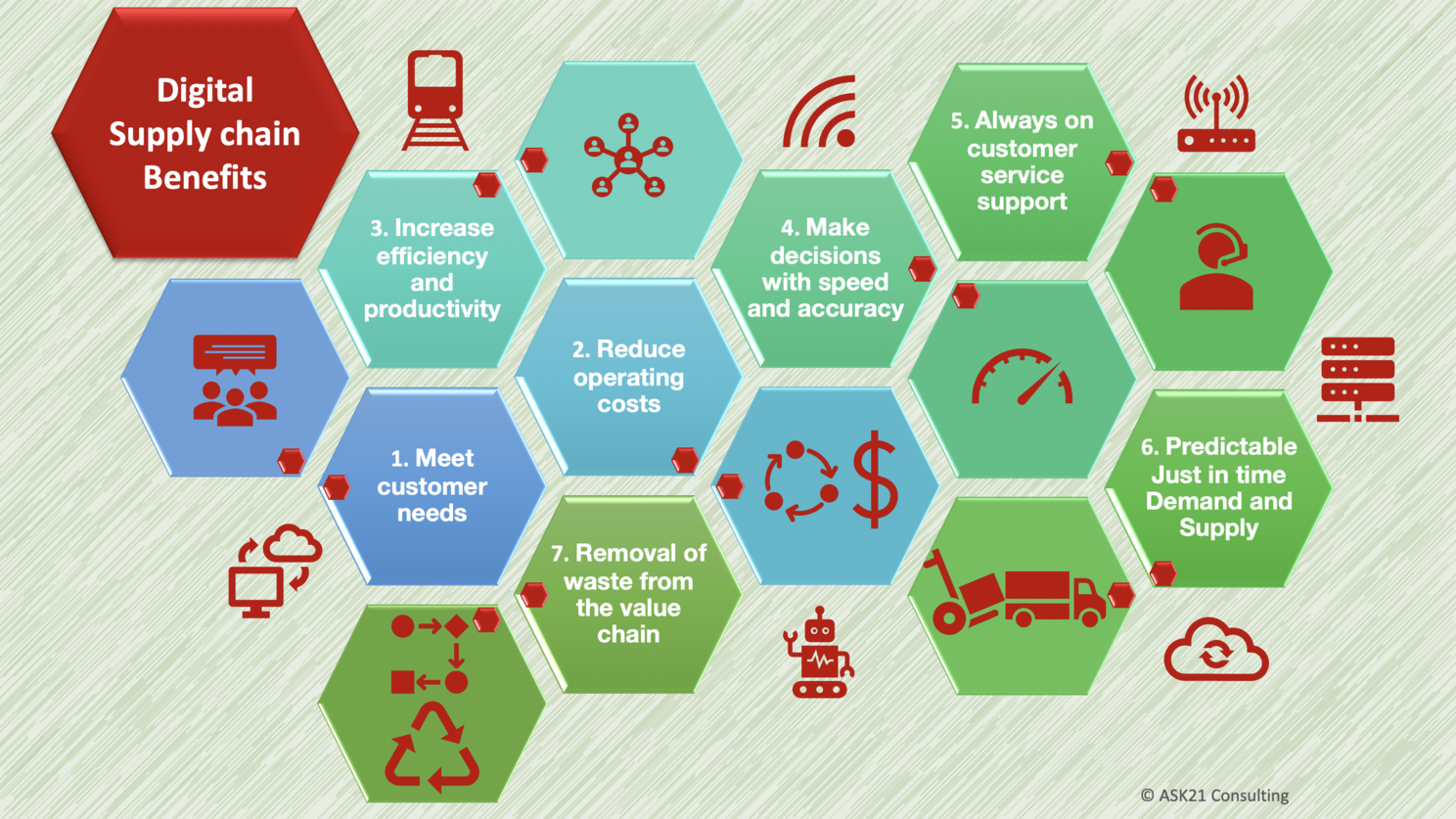
Why must organizations embark on Digital Supply Chain initiatives? Here are the key benefits that drive the organizations towards digital supply chain,
1. Meet customer needs – Digital supply chain helps organizations meet their customers’ needs as most customers prefer purchasing online and delivery done at their door steps with speed and quality. This is possible only if the entire value chain is connected and digitalized with solutions, systems, interfaces, sensors, scanners and devices.
2. Reduce operating costs – Digital supply chain ensures reduction in costs as a lot of costs of handling deliveries back and forth, carrying stocks for longer than needed, customer satisfaction and support issues etc. are reduced with structurally planned and connected value streams that are always on and working round the clock.
3. Increase efficiency and productivity – Digital supply chain help ensure the efficiency and productivity of entire supply value chain goes up including partners. This happens because repetitive tasks and non-value-added tasks are removed or automated with robotics process automation. In the warehouse it becomes easier to store and locate products using online systems and robotics that can track and bring the products to ease up picking, packing and shipping.
4. Make decisions with speed and accuracy – Digital supply chain gives an edge to the organization by bringing the insights and visualizations from the data at their fingertips. This allows them to make accurate decisions with speed to ensure they can cut down costs, improve sales and deliveries which in turn results in positive customer experience.
5. Always on customer service support – Digital supply chain enables the organization with an always on customer service that can be designed to handle queries and support customers on its own using chatbots and voice enabled call flows. It can collect all the information and route it to customer service team to step in and support. As the general and standard enquiry gets automated the customer service agents can give quality time in delivering great experience and support for the customers and consumer alike.
6. Predictable Just in time Demand and Supply – Digital supply chain enables the organization to adapt to predictable just in time demand and supply plans ensuring customer demands are met on time while the stocks don’t need to remain in the warehouse for too long incurring storage costs
7. Removal of waste from the value chain – Digital supply chain transformation means the organization will have to undergo full value stream mapping and restructuring or engineering of the value chain to identify and eliminate waste across all processes. This gives a competitive edge to the organization to have faster turnaround at lighting speed to meet the customer needs with speed. The elimination of waste doesn’t just happen in the organization but also all of its partners and suppliers as they will need to adapt to similar standards to keep the entire process seamless.
Digital supply chain 4.0 in conjunction with industry 4.0 is still in process of being deployed and improved by many organizations while top organizations might have already achieved the needful digital transformations and are now continuing improvements.
Digital supply chain 5.0 is on the horizon as we move towards Web 3.0 and 5G lightning internet speeds making everything connected, always on and seamlessly reachable across the globe. Digital supply chain 5.0 will bring hyper automation and autonomous warehouse management and even autonomous deliveries. Robotics, Robots, Artificial Intelligence and Autonomous vehicles will change the way supply chain is managed and customers are served.
Supply chain management is key for all organizations to ensure its idea to market (I2M) and order to cash (O2C) operations are efficiently managed. Any gaps in I2M or O2C process groups creates a gap that could lead to significant customer service, delivery and value creation issues in the value chain.
In the second half of past decade industry 4.0 transformation started and alongside supply chain 4.0 transformation also got initiated. Industry 4.0 largely focused on I2M (idea to market) process automations and automations of manufacturing plants. Supply chain 4.0 focused on idea to market as well as order to cash process automations including parts of market to order (customer service) process automations. Supply chain 4.0 also focused on enhancing the warehouse automations to be able to handle various types of orders, shipments, deliveries and regulatory compliance needs.
In the past two years with the Covid outbreak, a lot has changed in terms of how we work and live. Consumer behaviors changed to purchasing online instead of visiting the retail stores. User Ecommerce stores and hubs have gone up significantly covering as much as 70% to 80% of sales done using online stores (Digital).
While all the Ecommerce boom and online shopping trend increased so does the challenge and complexity for supply chain management (SCM) team increased. SCM team has to ensure deliveries are made appropriately in time and trends shift from large orders to distributors and retailers to small orders direct to consumers (D2C).
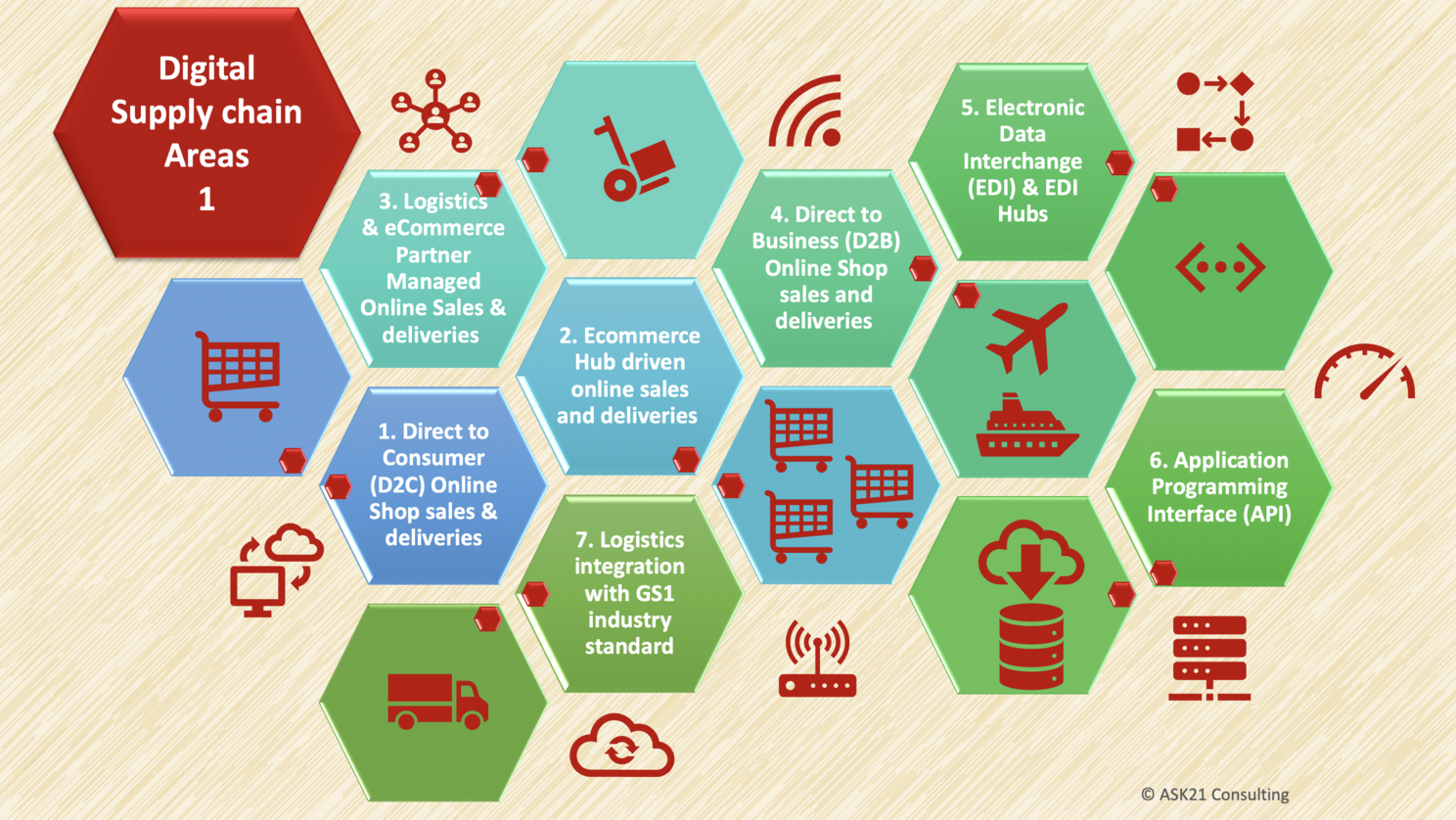
The Ecommerce boom also created new avenues for organizations to build more Direct to Consumer orders handling and delivery mechanisms. There were 7 different avenues opened up for managing and operating online sales seamlessly across the value chain. Let’s go through the part 1 of seven digital supply chain transformation areas for organizations,
1. Direct to Consumer (D2C) Online Shop sales and deliveries – This included organizations deploying more D2C (direct to consumers) shops across all countries even where there was low value creation business case to do so, as they envisioned the need would increase in the coming years and it’s better to prepare upfront.
2. Ecommerce Hub driven online sales and deliveries – Outsourcing and managing the Market to order and Order to cash operations through eCommerce hubs (E.g., Shoppe, Lazada, JD and many more) in various countries. This ensured reduced load on SCM and logistics partner as they didn’t have to cope with up and down streams of online orders and deliveries on day-to-day basis. It also gave them an advantage to use respective partner eCommerce platforms for orders as well as returns, cancellations, refunds (customer service) to some extent.
3. Logistics and eCommerce Partner Managed Online Sales and deliveries – The 3rd avenue was to tie up with logistics & eComm partners (E.g., Urban Fox, YCH, Lotte etc.) that can manage both the organization owned D2C shops as well as multiple eCommerce hubs (E.g., Shoppe, Lazada, JD and many more). This further ensured that SCM teams burden reduced in terms everyday monitoring and tracking of so many online platforms and all the complexities attached.
4. Direct to Business (D2B) Online Shop sales and deliveries – On one end the need for online sales direct to consumers increased but it also triggered a need for online sales to distributors, retailers and in some cases even online partners. The need arises from online customers (distributors, retailers, shop owners etc.) needing a flexible platform to order on demand as and when they needed the stocks to fulfill the end consumer’s needs.
5. Electronic Data Interchange (EDI) and EDI Hubs – For making the order to cash process seamless, most customers (especially large distributors and frequent ordering customers) asked to connect their ordering systems (mostly ERP systems like SAP, Oracle etc.) to organizations ordering systems (mostly ERP systems like SAP, Oracle etc.) using Electronic Data Interchange (EDI) and in many cases through the EDI Hubs. EDI Hubs are EDI service providers that connect customer systems with the sellers organization’s systems. This ensured orders, acknowledgement and invoices seamlessly flow between systems without any need for reentering the order in any online platform.
The customers that didn’t have EDIs possible or have not so frequent ordering pattern, chose to go with D2B shops option as the D2B shops also allowed order upload, order copy, reorder options.
6. Application Programming Interface (API) – The need for Application Programming Interface (API) came up as going online means dealing with too many distributed and segregated systems. For eCommerce and SCM order to cash processes to work seamlessly in real time or even near real time, there has to be integration between multiple systems.
The internal organization managed systems (ERP, eCommerce shop, CRM etc.) can be tightly integrated to ensure updates from one system to other systems happens seamlessly.
The integration with the partner systems (logistics and ecommerce partners) can be made tight or loosely coupled based on the type of system and need. If loosely coupled would mean there will be a time lag between online order/activity and when it gets synchronized to organization’s systems.
7. Logistics integration with GS1 industry standard – For supply chain management to work efficiently, it is important that the organization’s logistics systems and logistics providers warehouse management and transportation systems are integrated with GS1 industry standard interfaces. The GS1 organization has created a worldwide standard for logistics organizations to function efficiently. These standards ensure timely messaging between systems to keep the inbound (from factory to shipping to warehouse) and outbound (from warehouse to delivery partner to customer) processes fully automated and synchronized.
Each of the above seven areas can be detailed out in separate articles as each area is very wide with its own approach, platforms and benefits. For keeping the article limited in length, let’s keep the explanations high level only.
Digital supply chain 4.0 in conjunction with industry 4.0 is still in process of being deployed and improved by many organizations while top organizations might have already achieved the needful digital transformations and are now continuing improvements.
Digital supply chain 5.0 is on the horizon as we move towards Web 3.0 and 5G lightning internet speeds making everything connected, always on and seamlessly reachable across the globe. Digital supply chain 5.0 will bring hyper automation and autonomous warehouse management and even autonomous deliveries. Robotics, Robots, Artificial Intelligence and Autonomous vehicles will change the way supply chain is managed and customers are served.
In the previous article you have seen why use lean problem solving, what are the types of problem solving and some examples. In this article let’s understand the process of Lean Problem Solving.
Once you have identified the type of problem faced in the value stream or value chain, they next step is to understand how to structurally work on detailing, analyzing, find the root cause, implementing resolution and monitoring it to ensure the value stream or value chain works as per expected.
By removing the obstacles the organization continues it trajectory of becoming better at delivering customer value and eliminating waste across the entire value chain.
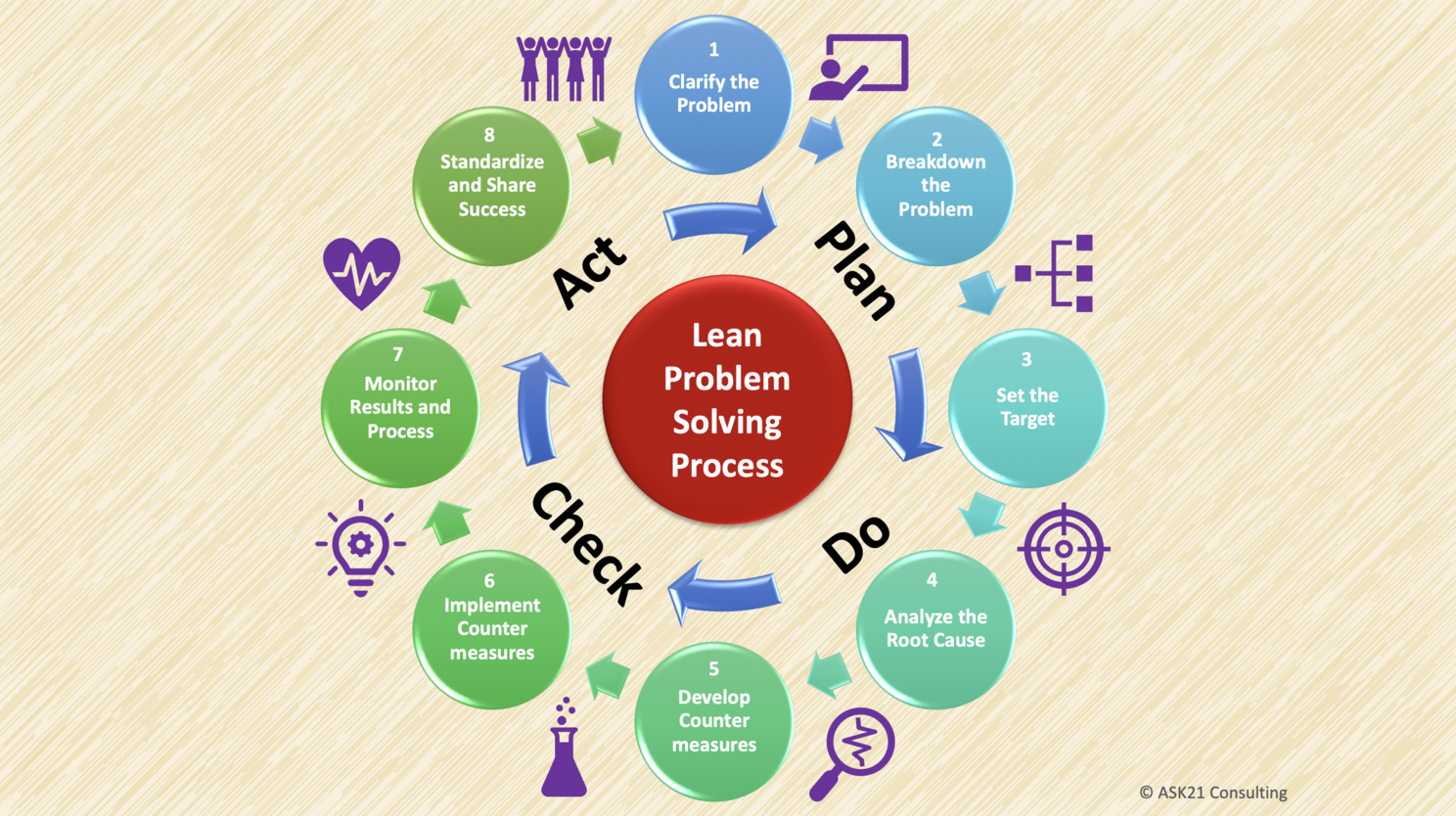
For effectively solving the problem, lean management prescribes an eight step structured process to be followed. The steps can be , there are The steps in the Lean problem-solving process are as follows:
1. Clarify the Problem – In this step the team needs to go to gemba and identify the type of problem as well as do necessary clarifications to ensure the problem is clearly articulated and understood by all in the same way. Always keep in mind that different people will see the same problem differently and this is why this step is critical in ensuring everyone see the problem correctly.
2. Breakdown the Problem – The easiest way to solve the problem is to break it down in smaller pieces and then analyze each piece with respective team members to understand the cause and effects clearly. During the earlier step different set of areas might have been reported related to same problem. Breaking down the problem in to smaller areas or smaller pieces makes it easier to go through each with the right focus and tools.
3. Set the Target – Based on the type problem, it is important to set a realistic target to get it resolved with speed and accuracy. The target must be established keeping in mind the impact of the problem on the entire value chain and how fast it needs to be addressed to remove the blockage. It is also equally important to understand capacity and capability of the team in resolving the problem. People with right expertise and experience must be involved to set the target and resolve the problem.
4. Analyze the Root Cause – This is an important step in problem solving where the root cause analyses needs to be performed. The root cause analyses can be performed using fishbone diagram and 5 Whys method. There can be other tools and techniques also applied like the Problem Tree method to clearly articulate the core problem, it’s possible root causes and impact or effect of those. This needs to be done with the team to ensure all inputs are correctly captured and documented.
5. Develop Countermeasures – After the root cause analysis is completed, the team can focus on identifying and developing counter measure to remove the obstacles and resolve the problem. The focus should be on having counter measures for each root cause or even better one countermeasure that can address and resolve multiple root causes. It is important that the effect of counter measure must be thought through as well to ensure they do not create more impacts and/or gaps in the value chain outputs.
6. Implement Countermeasures – One of the important steps in the problem solving process is to test and implement the counter measures. Before implementing it, the counter measures must be tested and validated with a possible dry run to ensure they will work as per planned and not create any new impact to the value chain. Upon successfully testing and validation the counter measures can be implemented as per planned schedule.
7. Monitor Results and Process – Post implementation close monitoring and reporting must be enabled for capturing the results from the value chain and especially the impacted area. The entire value chain process must be kept under monitoring to confirm that the before and after implementation of countermeasures have standardized the output results.
8. Standardizeand Share Success – After a pre-defined period of monitoring and reporting, the problem can be marked as fully resolved and completed. At this stage the standardised process can be replicated across in case there are more similar instances of the process running (E.g., an application with multiple instances). The success can be also shared widely in the organization to ensure everyone is kept informed about the problem and how it was resolved.
Along the entire problem solving process there is an underlying Deming’s Cycle (PDCA) in work. Deming’s cycle (Plan-Do-Check-Act) helps in ensuring continuous improvement is on everyone’s mind. Here’s a quick overview of Deming Cycle stages,
1. Plan: Plan focuses on identifying, articulating and planning improvement. If we look at it from the problem solving process steps, Clarify the Problem, Breakdown the problem and Set the Target are part of Plan stage.
2. Do: Do is also about executing the change or improvement. We can also relate it to Design, Build and Test and Implement parts. If we look at it from the problem solving process steps, Analyze the root cause, Develop Countermeasures and Implement Countermeasure are part of Do Stage.
3. Check: Check comes after implementing the improvement to monitor and report results. Check is all about monitoring and reporting to confirm that the improvement, change or problem solving is working fine across the value chain. If we look at it from the problem solving process steps, Monitor results and Process step is part of Check stage.
4. Act: Act is focused on making the change or improvement stick and making it a best practice by adhering it across the organization. If we look at it from the problem solving process steps, Standardize and Share Success step is part of Act stage.
The PDCA cycle continues as the improvements are never over. For the problem solving part also the problem is resolved but further improvements and standardization as well as raising the standard to the next level continues.
Lean Problem Solving is important for all organizations. It helps to remove the obstacles in the value chain / value stream and brings the organization to the new standard, reducing costs, improving efficiency, effectiveness, and value for the customer.
Lean management focuses on eliminating waste, improving efficiency and effectiveness. It helps raise the standard for the organization year on year. There are four important areas for effective Lean management, these are kaizen, daily management, value stream mapping and problem solving.
Lean Problem solving focuses on removing obstacles faced in the value chain to deliver superior value to the customer. Problems in Lean are referred as obstacles that impact the process by brining stop to it or slowing it down significantly.
Lean Problem solving is a not stop journey across the organization’s value chain to identify facts based obstacles and team up to identify root causes and resolve it. Problem solving can be also related to going to raising the level of standard at which the organization operates. Going to next level of standards would also need removal of obstacles in the value chain to make the shift.
Problem solving in general must be handled structurally with facts and prioritization to ensure priority obstacles are addressed first and addressed first time right. Jumping to gun and rushing to resolve problems could create several other problems that the team might not have thought as they would have not studied all possible root causes and effects of change.
Types of Lean Problems
To ensure right approach is applied to problems, the problem must be first identified and categorized correctly. The problem categorization will help select the correct approach for analyzing and identifying the root causes, impacts and solution for the problem. The categorization also helps identify the correct tools and processes to be used for effective and efficient problem solving.
There are generally four types of Lean prescribed problem categories. The first two categories (Troubleshooting and Gap from standard) are related to obstacles that happened in the value chain and identified as a problem to be solved. The other two (New Target condition and Innovation / Open Ended) are obstacles foreseen or happened while raising the standard or level of the value chain. Let’s understand these four types in little more details,
1. Troubleshooting Problems –Troubleshooting problems are common types of problems that every organization has. This type of problem solving is generally called reactive problem-solving as the problem is solved only after it has happened and created an impact for the value chain. In this type of problem solving the fix is quickly identified and fixed. But it might be that the problem will repeat again unless root causes are fully identified and process changes made to ensure it doesn’t repeat.
Here is an example to understand this type of problems,
The organization has a manufacturing line for Electronic Water Heating Kettles. The manufacturing line produces 100 Kettles per hour by putting together several parts of the Kettle and assembling 10 Kettles every 6 minutes. During the morning shift an Andon alarm sounds off and the production line has to be stopped. Everyone gathers around to review what happened. The team founds that the Kettles plastic base is not being placed properly by the machine as the pressure pad seems to have spoiled. The team quickly replaces the pressure pad and the production line is restarted with a downtime of 1 to 2 hours. The team has replaced the pressure pad but didn’t fix it from reoccurring as they did not check the frequency when the pressure pad must be replaced to avoid any significant downtimes again. In such cases a proper root cause analyses and long term monitoring can help to understand when the pressure pads should worn out and replaced. The threshold can be set to replace the pressure pads at the appropriate interval and the problem will be stopped from reoccurring.
2. Gap from Standard Problems –The second type of problems are called Gap from Standard problems. These problems are Gaps found in the standards procedure and outputs / performance of the process. These problems have to be solved structurally to ensure the value chain outputs and outcome match then stipulated standards. These problems have huge impact to the overall value chain and value creation so they need to be resolved in such a way that they do not repeat. A quick fix won’t work for these problems.
Here is an example to understand this type of problems,
The organization has a manufacturing line for Electric Irons. The manufacturing line produces 100 electric irons per hour by putting together several parts and assembling 10 irons every 6 minutes. The production line has been operational but the throughput of the production line has dropped from 100 per hour to only 50 per hour over past 3 days. In this case the production can continue still but the team must sit together and look at the cause and effects of what could be causing the problem. Tools like 5 Why’s and Fishbone analysis etc, should be used to identify root causes. The Gap in the standard output is clear, the root cause could be many areas and each must be checked and analysed to come to conclusion on root cause. The fixes can be applied accordingly and a cadence on reporting and monitoring must be placed to check if the fix has worked. The entire problem solving approach and process must be structurally done to ensure first time right resolution of the problem without any room for reoccurrence. In this case the root cause was assembly output where out of 100 irons produced only 50 were passing the quality checks. The reason identified was the soldering gun on the assembly line was missing the soldering point resulting in irons not working post assembly. The further analysis reflected the soldering wire used was of poor quality making the solders non effective and loose ended. The real root case was to change the soldering wire vendor and choose better quality soldering material.
3. New Target Condition:The third type of problem is caused due to New Target Condition in the value chain. The new target condition can arise due to kaizen improvements or events. It can also arise if the standard output and outcome of the value chain is already above its stipulated target mark, so the organization can decide to raise the standard to next level target. But raising the output levels also means understanding the gaps in detail on what obstacles could be faced if not handled well while raising the standard target output. This also requires structured approach to understand current capacity and capability of the resources and what needs to change to meet the new standard accurately. Kaizen tools as well as A3 problem solving tools should be used in full to ensure each area is well studied for cause and effect.
Here is an example of new target condition,
The organization has a manufacturing line for Electric Irons. The manufacturing line produces 100 electric irons per hour by putting together several parts and assembling 10 irons every 6 minutes. The production line has been operational but the throughput of the production line has been consistently up from 100 per hour to only 150 per hour over past 1 week. In this case the organization is thinking about raising the standard to 150 irons per hours looking at past 1 week performance. Before the step is taken the team will need to formally run through Kaizen event including value stream mapping and use of other cause and effect tools to understand full overview and impact of the change in the long run.
4. Innovation / Open ended: The fourth type of problem is innovation related and can be also called open ended problem solving. These type of problem solving emerge from the organization bringing in new innovation in the value chain. The innovation will impact and change the entire value chain. In such situations it’s not easy to realize what problems could arise and how to resolve them. The team will need to work through the process to identify areas in the value chain that could lead to obstacles if the new innovation value chain is introduced. In such cases a risk log with mitigation actions and ownerships must be workout and put in place.
Here is an example of new target condition,
The organization has a manufacturing line for mobile phones. The current manufacturing value chain is a mix of people and machines working together to get the outputs. The current output is 50 mobile phones per hour. The organization has decided to bring an innovation to double the production of mobile phones. For achieving this the value chain has been planned to be made full automated with robotics. A trial run has proven that it should work out. This is an innovation problem which will require the team to work together to identify how this will need to be orchestrated to avoid any problems. The team can structurally work out the plan to step by step ramp up and introduce the new innovation as well as plan for required capacity and capability plans.
In this article only this much. In the next article we will discuss the process of problem solving and how it helps the organizations to raise the standards.
Lean Problem Solving is important for all organizations. It helps to remove the obstacles in the value chain / value stream and brings the organization to the new standard, reducing costs, improving efficiency, effectiveness, and value for the customer.
One of the important tools in Lean Management is Daily Management. Daily management is achieved using a visual dashboard. The dashboard can be manually prepared, printed and presented or even electronically published each day to share progress with all involved stakeholders and participants.
Daily Management visual dashboard is used to track and monitor progress of key performance indicators, targets and goals that are important for the organization. It is used on especially those areas where impact is high and the team needs to ensure that they do not slip agreed targets. It is also used to quickly identify and visualize areas of attention and issues that must be resolved to achieve the targets.
Daily Management helps in comparing performance improvements on daily basis at a glance look. It shows the areas with colors to bring attention (E.g., red could mean target is not achieved, green means target achieved and on track, orange or yellow means target will be achieved with in agreed threshold of some %).
Daily management needs standardized processes, templates and possibly automated systems to generate and share daily progress at a specific time each day. It requires efforts and commitment from the organization stakeholders and key team players, to ensure they stick to the cadence and review progress each day.
Over a period of time, it becomes a habit and when it’s done well, it helps in ensuring key targets are achieved and exceeded across the organization. Lean prescribes some standards on how daily management should be done to achieve efficient results.
Daily Management (DM) Process
Daily management consists of four areas that must be done. These four areas help to check and understand how the organization is progressing and which areas need attention to keep on track. Here are the four areas,
1. Daily Accountability Process Meeting – The daily accountability process meeting is arranged to visualize progress and identify areas of concerns as well as run through the issues and actions.
In the meeting a check is done to ensure everyone on the team has everything they need to perform and achieve that day’s targets. It also allows people to speak up and ask for help wherever they need attention and help from the team and senior stakeholders.
The DM (Daily Management) visual dashboard used is to track the overall targets and attention areas. The DM board also captures key issues and actions on a daily basis. The DM boards can be automated to save repetitive efforts and a big TV screen can be used to visualize tracking of KPIs and review of issues and actions.
Daily Accountability Process (DAP) meeting helps the participants visualize the entire progress transparently, collaborate and brainstorm together.
The meeting is a stand-up meeting as it is supposed to be a quick review of 15 to 30 minutes followed by next steps of actions.
2. Leader Standard Work – Leader standard work is set of work culture and behaviors that the lean leaders must adhere. Lean leaders are tasked to ensure every member of the team contributes to best of their abilities in achieving the results.
Part of the work is also to ensure Lean standards and ways of working are followed by all team members. Leaders check the progress on daily basis to ensure ways of working are modelled and used by all.
In case of gaps or issues found in ways of working, Lean leaders coach and train the members to lift them up and bring them back on track.
3. Gemba Walks – Gemba walks are attached to going to place where the work is done and action is ongoing. Gemba walks are done to places where its important to check and seek opportunities for improvements to become more efficient and effective in delivering superior value to the customer.
Lean leaders and drivers take the gemba walk to observe how the processes are functioning in real life on the ground Vs how they are being presented. The insights help them think about better ways to do things as well as identify best practices that can be applied to other parts of the organization.
4. Process Confirmation – Best on the observations from the Gemba walk, the team can confirm if the process is working as defined or they see variations of it and need for improvements.
The process confirmation can be also be done as period internal or external audits without notice to check and confirm that standard operating procedures (SOPs) are fully adhered to as well as Segregation of duties are well maintained as per defined roles not allowing conflicting roles managing tasks or stages that they are not supposed to manage.
This results in ensuring the entire organization functions as per defined as well as fully adheres to process changes and standards.
Daily Management (DM) Board
The DM Board can be designed to have KPIs that matter most for the organization as well as department or division (level) at which the DM board is prepared. There is no point having top level or even region level KPIs on the department’s DM board if those are not actioned and in control of the team members. The KPIs used for tracking must be meaningful and in control of all the team members.
The DM board can have or look for KPIs from SQDCP areas(Safety, Quality, Delivery, Cost, and People). The DM board must be placed near to the work area where all team members and stakeholders can easily look at it. This will ensure the board is kept latest and remains on everybody’s mind for regular review and actions. It will improve collaboration and discussions amongst team members to help each other with new ideas on making things easier and efficient for all.
Let’s understand how the DM board can be arranged for effectiveness and efficiency.
1. In the DM board SQDCP areas always have 31 short cells representing 31 days of the month.
2. In case of weekly DM board, each cell can be representing the weeks and in such case 52 cells will be required to track weekly hit or miss of respective targets.
3. The cells can be filled with Red, Green, Orange/Yellow and Grey colors.
a. Red means the target is missed for that day and generally there will be an issue reflected in the board under issues section.
b. Green means the target is achieved and everything is on track.
c. Orange/Yellow can be used to show is target is missed but still within defined threshold and controllable to get it back on track.
d. Grey can be used for non-working days or for days that are extra in the month (e.g. if Sep is 30 days, 31st cell will be in grey color).
4. The issues occurred for red cells are discussed in the Daily Stand up meeting and action(s) are assigned to ensure those issues are resolved and does not repeat.
5. It is not mandatory to place all the SQDCP areas on the board. The team can select only those they need to track depending on mutual agreement and alignment with stakeholders.
6. The SQDCP areas can be also arranged flexibly (e.g., PCDQS or SQCDP etc.) based on the organization, department or division’s priority focus areas.
7. There are other areas that can added as well for tracking, E.g., Inventory (I), Productivity (P), Bugs (B), Environment (E), Tickets (T) etc. This means the letters can KPIs to track for hit or miss are flexible as per team needs.
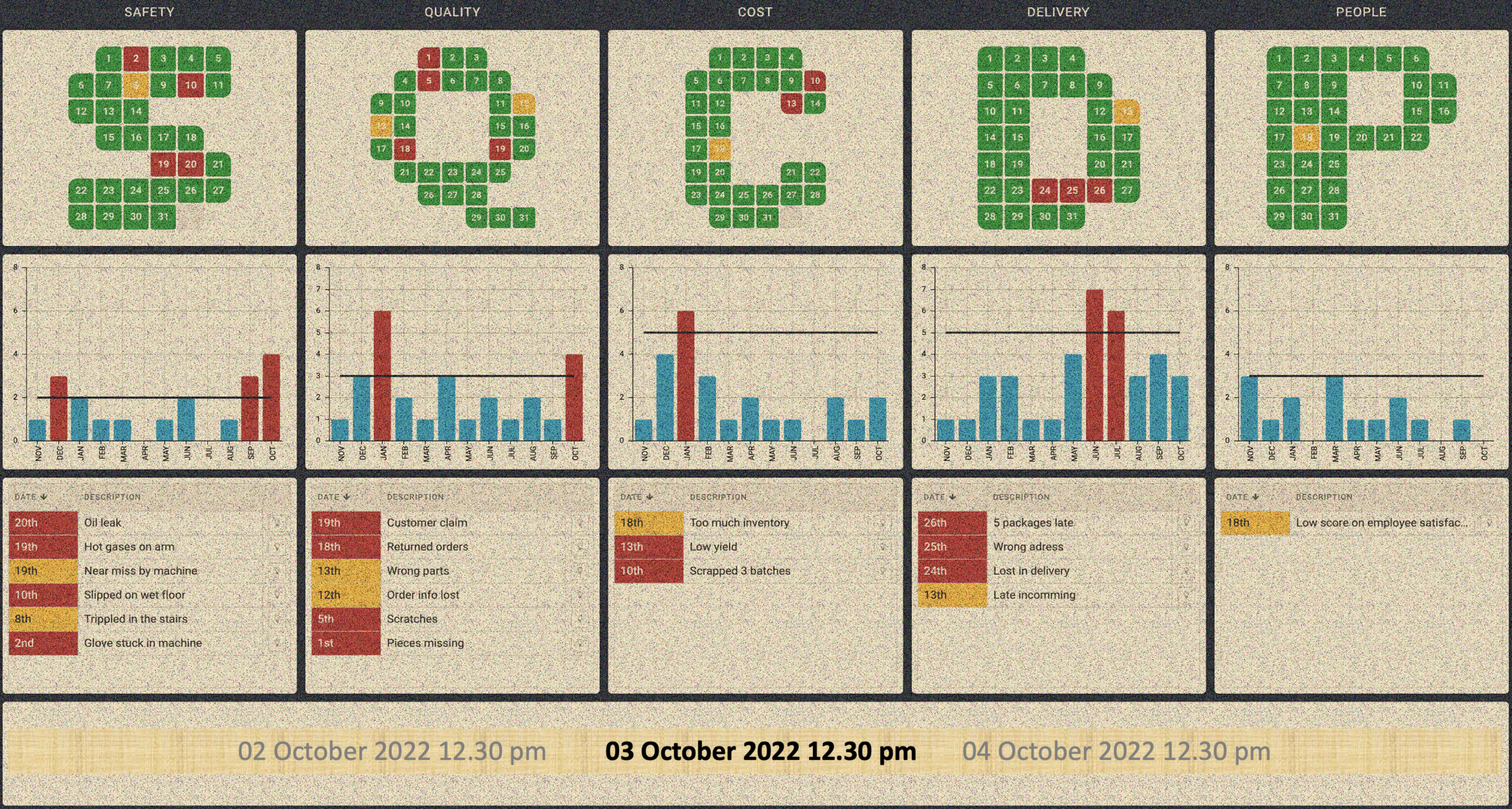
8. Here are two examples of the SQDCP DM board. One example is using simple excel or white board based template while the other is a fully automated online dashboard.
a. Excel or white board Based Tracking Dashboardb.
b. Fully Automated Tracking Dashboard
Benefits of Daily Management
Let’s understand the benefits of using Lean, Daily Management and Visual Dashboards,
1. Visualize the progress of important targets and KPIs on daily or weekly basis, at glance with in few minutes.
2. Visualize the issues faced by the team in respective key performance areas within few minutes.
3. Understand actions taken by the team, action owners and by when the issue will be resolved to bring the team back on track.
4. Improved transparency and empowerment as the DM boards are maintained by the team members and bring full transparency to the team on progress made as well as issues faced.
5. Team collaboration improves as team members discuss, brainstorm and come up with new ideas to get things done and achieve targets.
6. Lean and Daily management culture gets embedded in every one’s way of working leading to significant improvements and
7. Full compliance on regulatory audits as entire team follows and complies with the standardized operating procedures.
8. Customer experience and value increases as the team continuously improves.
Lean Daily Management and Visual Dashboard helps organizations achieve and exceed their targets swiftly as everyone in the team thrives to do the best by adhering to Lean ways of working.








 Learn-Share-Change-Grow