
Scrum is an agile project management framework that was developed for speedy software development in 90s. The Agile Scrum framework started being used from 2001. It became largely famous and almost every organization’s IT teams have started using it from 2011.
The framework is not just used for IT projects but it’s also used by business projects due to its ease of use, empowering methods, flexibility and speedy progress and delivery. There are many Agile Frameworks but the one largely used by all is Scrum. Here is the list of current famous five Agile frameworks used for project management, program management, Portfolio management and software development worldwide.
1. Scrum and Scrum @ Scale – Used for Projects, Program and Product Management.
2. Scaled Agile Framework (SAFe) – Used for Projects, Program, Product and Portfolio Management at Enterprise level.
3. Large Scale Scrum (LeSS) – Used for Large Scale Program Management at Enterprise level
4. Disciplined Agile (DA) – Used at Enterprise Level
5. Enterprise / Portfolio Kanban – Used for Projects, Program, Product and Portfolio Management at Enterprise level.
Let’s get back to Scrum. The Scrum term was introduced by Hirotaka Takeuchi and Ikujiro Nonaka for product development. In the millennium decade the Scrum Alliance was formed by Schwaber and team. This is when Scrum came to the corporate world for adoption and use for project management. As the years passed we moved in the information economy.
In the last decade adoption of Agile Scrum went up across the world but along the line also the need for how to scale it for the entire enterprise increased. This is when in last 7 years several agile frameworks emerged for adoption at enterprise level. Scrum remained in use for projects and programs while new agile frameworks like Scaled Agile Framework (SAFe) became more famous and adopted by many enterprises across the world.
Now let’s focus on understanding Scrum Framework and how it works,

The Scrum Framework is relatively easily formed and consists of roles (team), product features, meetings and deliverables. The entire project is done using small sprints to ensure focus, timeboxing and speedy delivery of features in every sprint. Let’s understand the scrum roles first then we can move into product features, meetings and deliverables.
Scrum Roles – Scrum consists of 3 roles. The product owner, scrum master and the team.
1. Product Owner – Product owner is the most important role of scrum team. The product owner as the name suggests owns the product, project or program. The product owner has the product, project or program vision. The product owner is also the sponsor. The product owner defines what is important and must be delivered first and what should be delivered in what order. The product owner supports the entire team in ensure they understand what deliverables and features are required. The product owner is generally the business owner or sponsor and sometimes the business owner’s delegate who understands the business needs clearly and able to decide and drive them.
2. Scrum Master – The scrum master is second most important role of the scrum team. The scrum master is normally one of the team members who is well respected and who can work well with all the team members. The primary job of the scrum master is to remove obstacles and impediments from team members work. The scrum master is also responsible to discuss daily progress and issues resolution.
3. Scrum Team – The scrum team consists of all the members of the team. This includes every role needed for the project and the respective sprint. The scrum team members are empowered to choose the features and stories they want to work on in the project. The scrum team updates their daily progress and issues and impediments in the scrum meeting.
Agile Product Artefacts – The scrum framework doesn’t work with any large documentation and knowing every detail of the product upfront. This is what makes it easier and flexible to start and change as the team progresses. Here is a quick overview of the Product Artefacts Model,

Product Vision – The product artefacts start with the product, project or program vision. The vision is what the product, project or program will achieve in 1 or two simple sentences.
Themes –The vision leads to Themes, the themes are major modules of the product, program or project. The themes are broken down to Epics.
Epics – The epics are sub modules of the product, program or the project. The Epics are then broken down to product features.
Features / User Stories – The product features are then either broken down or converted to one or more user stories. User stories clearly articulate what input, action and result is expected from each user story and how it will help the user.
Tasks – The user stories are broken down to tasks. The scrum team members generally work on the user story level and they execute the tasks to deliver the working user story. Here is a brief model overview and its illustration.
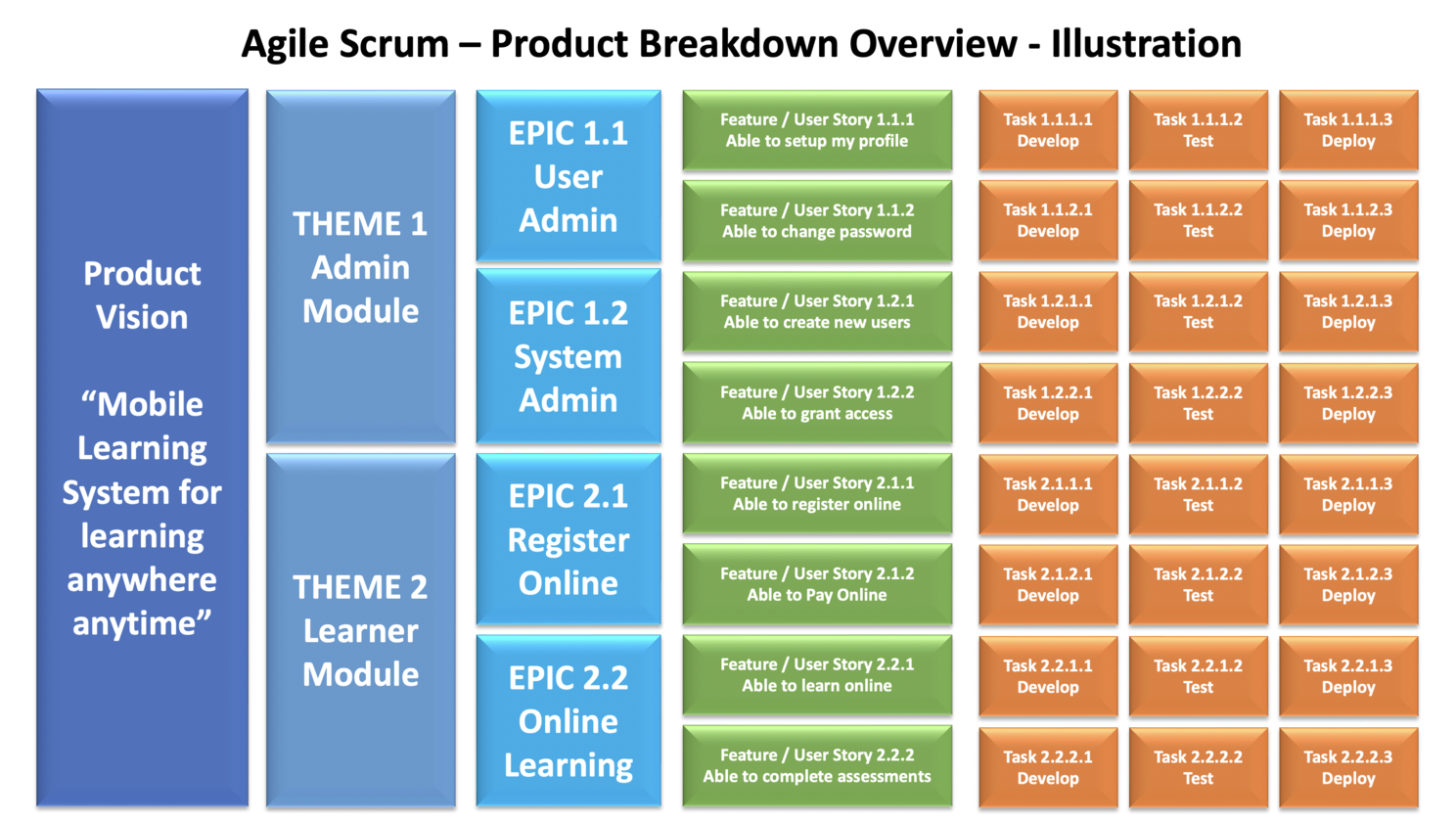
Due to space limitations you will only short text is used in the illustration. In general all user stories have to be written in the format of “As a user [persona], I [want to], [so that]”. E.g. The User Registration feature can be written as “A an online user I want to be able to register online so that I can login and register for online learning courses”.
Similarly the tasks can be detailed out to specific actions needed to achieve the user story readiness. They might not be specified just as Develop, Test and Deploy.
The user stories are prepared by the product owner. Once the product features and user stories are ready, the team ready to the estimation for them.
Agile Scrum Process – Let’s understand the way of working and how the project management is done using scrum,
Product Backlog – All the user stories along with Themes, Epics and Features are put up in a product backlog by the product owner. The Product Backlog is list of all the features that must be made ready for achieving the product vision.
User Story Estimation – User stories are reviewed and estimated by the entire team. The Scrum Master arranges the estimation meeting along with the product owner and all the scrum team members. The estimation is done using a point system (1, 3, 5, 7 etc.) or size system (small, medium, large and extra large etc.).
The scrum master and the team first decides how much weightage each point of size has in terms of number of hours of work. This is done using teams past experience and improved as the team moves forward with sprint executions. The weightage helps the team decide how much time each user story will take to get it ready. Based on the combined size of all stories under one epic, the epic’s size is determined and same applies to themes.
The estimation is done using consensus model where for each user story the scrum master asks each member to score the points the scoring is then discussed and a consensus is reached to finalize and assign the points or size to the story. The cycle continues until all stories are assigned with points and size.
Sprint and Sprint Planning – As the user stories are ready and prioritized product backlog is fully in place, the team can begin with sprint planning. A sprint is cycle of 2 to 4 weeks in which the team picks up the stories from the product backlog in the order of priority and puts them in the sprint specifying in which sprint what stories will be made ready.
Each sprint then gets its own sprint backlog consisting of user stories to be delivered. Each sprint must ensure that a fully working user story is delivered at the end of the sprint. The sprint deliverable must be fully working and demo able to the product owner. The product owner must signoff and accept the features delivered to mark that user story complete.
The team works out the entire sprint planning to ensure they know how to execute, how many sprints (equals to how many weeks and months) and how much resources will be required to get there.
The deliverable from each sprint is referred as increment and at the end of all sprints, all the must have user stories should have been delivered for the product vision to be marked as achieved.
The Agile approach is a timebox approach to ensure the team reaches its product vision with speed and agility. The emphasis is on delivering results and not so much on detailed documentation, long workshops and long meetings. The focus is on working in small size teams in each sprint to deliver results.
During the sprint 1 to 6 team members can work together to pick up their respective stories. The scrum team members working on the user story, define and execute tasks for the readiness of respective stories.
Daily Scrum Meeting – On a daily basis at a fix time the entire scrum team meets up to share progress made, progress planned, issues and impediments. The scrum master arranges the meeting and ensures all scrum team members join in including product owner. The product owner might not join every day but based on the needs can be pulled in for discussion and guidance.
The meeting is called “Daily Scrum” and its only 15 to 30 minutes max. It is also called as a stand-up meeting, means the team only focuses on sharing what’s important and where they need help. Based on the updates shared, the scrum master reaches out to respective team members separately to understand their issues / impediments and help them resolve it with priority.
The Daily scrum meeting ensures that the scrum team doesn’t lose motivation and they are able to time box and move with speed to deliver.
Increment – At the end of each sprint a working set of user stories are demoed to the product owner to seek the acceptance for completion. The combine set of users stories in the sprint are referred as “Increment” as they make only part of the product vision. Eventually when all sprints are completed, all increments combined make the product vision come through.
Sprint Review – At the end of each sprint, the scrum team come together to review how the sprint execution and deliverables faired against the plan. It is possible that some user stories took longer impacting some other stories that couldn’t be completed. It is also possible that some user stories couldn’t be done due to dependency and / or impediments from other user stories. The incomplete users stories are then prioritised and moved back to the product backlog to be taken up in the next sprints.
Burn-down Charts – The burn-down charts acts as a daily weather forecast report for the team to see how they are progressing jointly against the plan they have agreed.
The scrum master and the scrum team also maintain a burn-down chart that shows them their planned progress and how they are actually progressing for each day. In the burn-down chart it is possible that there are some peaks and valleys seen as the execution of sprint and efforts spent might not be exactly same all across.
The scrum master and the team together strives to make sure they keep their commitments, help each other and achieve the needed results.
Sprint Retrospective – The scrum retrospective meeting is also held at the end of each sprint after the sprint review meeting. The purpose of the scrum retrospective is to focus on individuals, collaboration process, tools and definitions of done (deliverable as per acceptance criteria). The team discusses how things went, what worked well, what needs to improve. The improvements are then taken up by the scrum master and team members to improve and feed in for the next sprints to improve collaborations process, tools and deliverables.
The team then moves on with next sprint and any incomplete sprint backlog from previous sprint is also taken up in the next sprint or sprint after next depending on team’s decision. The execution cycle continues in the same manner for each sprint.
Agile Scrum Framework works very well because of its focus on results, empowerment for team members, no detailed documentation cycles, flexibility to adapt and change as we move sprint by sprint and most importantly, breaking down the product into smaller increments that work and allow the product owner to see results in short cycles (sprints) of 2-3 weeks, without waiting for months.
Agile Scrum Framework is used across the world by thousands for organizations to team up and deliver great results. Many Organizations have even moved further with scaling up the agile way of working by using the enterprise agile models of scrum and other frameworks. Some organizations have also gone ahead with a hybrid model mixing Agile, Waterfall and Lean, Kanban frameworks to fit their needs.
 Learn-Share-Change-Grow